
Institute of Environmental Sciences
Research
CML contributes to sustainable societies by generating and analysing solutions for complex environmental challenges that arise from the ways societies live, produce, and consume. Through our research, we advance scientific knowledge in the fields of industrial ecology and environmental biology.
Research programmes
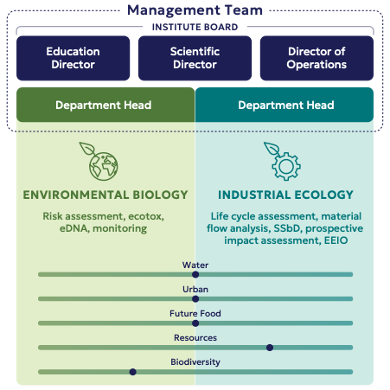
CML research is organised around two departments: Industrial Ecology and Environmental Biology. These are complemented by five cross-cutting research programmes, each contributing to multiple Sustainable Development Goals (SDGs) including, but not limited to, those on sustainable water and land use, resilient urban planning, ecosystem resilience, and renewable energy transitions.
Read more about our research programmes:
Our research approach
CML addresses environmental challenges by linking disciplines, scales, and forms of knowledge. Rather than limiting our work to problem description, we develop quantitative concepts, models, and analytical frameworks to support informed decision making and help shape pathways towards a sustainable future, from the local to the global scale.
Across the institute’s research programmes, our scientists apply a coherent set of research strategies. These strategies aim to position CML as a leading institute in the development of quantative tools and conceptual innovations in environmental science:
- System-based research. Our research is grounded in systems thinking, approaching environmental challenges as interconnected systems rather than isolated components.
- Interdisciplinary integration. We connect disciplinary perspectives to address environmental change in its ecological, economic, and societal dimensions.
- Development of quantative tools. A core strategic focus lies in the development and application of quantative tools, complemented by analytical frameworks from governance and social sciences.
- Scaling. We bridge local, case-based knowledge all the way to global modelling approaches.
- Connecting fundamental and applied research. Our fundamental research underpins applied work addressing concrete societal challenges.
- Bridging science and policy. We engage with policymakers, public authorities, and societal stakeholders to ensure that scientific insights inform decision-making.
Impact-driven research
Through our comprehensive approach to research and education, CML aims to drive innovation in environmental science and contribute significantly to global sustainability efforts. We strive to create tangible impacts, for example through translating scientific results into actionable policy recommendations, collaborating with policy makers, industry, and civil society, communicating research outcomes to promote environmental awareness, and collaborating across scientific disciplines and sectors.