

Australia
These are two separate Erasmus+ International Credit Mobility projects with Monash University in Australia, one of Leiden University’s Faculty of Law (LLS), the other of the Leiden Academic Centre for Drug Research (LACDR).

Types of mobility:
|
Project duration:
|
Project 1: Connecting research, teaching and innovation
The Erasmus+ ICM collaboration between Leiden Law School and Monash University is coordinated by Anette van Sandwijk. The project concentrates on law, digital technologies, and legal education.
Down Under: Staff mobility to Australia
In August 2026, Dr Rogier Kegge visited Monash University with an ICM grant for staff mobility. He tells about his initial expectations and the actual experience of travelling to the other side of the globe.
"When I was asked whether I would be interested in an exchange visit to Monash University in Melbourne, I had to think about it for a moment. When I thought of Australia, I mainly associated it with Kylie Minogue, the Eurovision Song Contest, kangaroos, koalas, and Sydney, rather than administrative and environmental law. But that was, of course, my own misconception. I soon discovered that Australia has a great deal in common with the Netherlands and the European Union in the field of environmental law, while also displaying some striking differences.
As part of the master's course International Environmental Law, I taught classes on nature conservation law and biodiversity and the precautionary principle. Unlike in the Netherlands, the precautionary principle is codified in Australian national legislation. However, this does not necessarily result in better protection for endangered plant and animal species. This led to fascinating discussions with colleagues and students about the reasons behind this apparent paradox. Another topic that generated valuable insights and lively debate was the relatively new concept of rewilding in both international and domestic nature conservation law."
-
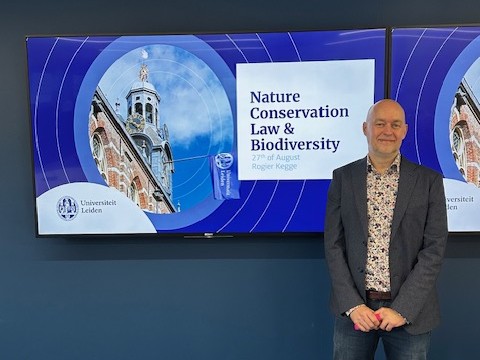
Rogier Kegge during his visit in Australia, August 2026. -
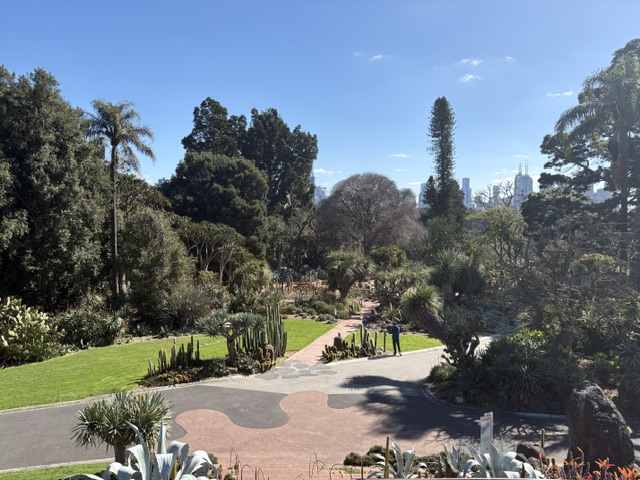
"I also delivered a staff seminar on adaptive environmental law in the EU and Australia. As in the Netherlands, Australia is grappling with questions about how environmental law can be made more flexible without lowering environmental protection standards, and at what level of government environmental protection should be regulated.
From an educational perspective, I was struck by how interactive Australian teaching is. Even during large lectures, there is considerable room for discussion. Students know this in advance, are generally well prepared, and actively participate in class debates. The lecture halls themselves are often designed to facilitate interaction. This emphasis on engagement is something I intend to incorporate into my own teaching.
In short, my exchange at Monash University in Melbourne provided me with many new insights and ideas. It was also an immensely enjoyable experience. Afterwards, I spent some time travelling around Australia, giving me the opportunity to see the country's extraordinary biodiversity with my own eyes. I thoroughly enjoyed it.
An exchange experience Down Under is something I can wholeheartedly recommend!"
Dr Paul Burgess visits the eLaw Centre
From 30 May to 6 June 2026, senior lecturer Paul Burgess from the Faculty of Law at Monash University visited the eLaw Centre for Law and Digital Technologies at Leiden Law School. His research mobility was funded through Erasmus+ ICM. The visit strengthened academic ties between both partners and created new opportunities for collaboration in the fields of law, technology, and legal education.
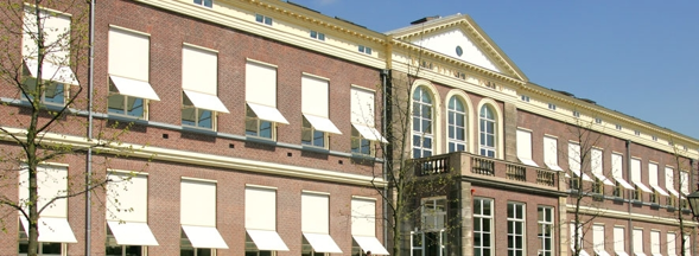
Exploring Leiden Law School
Upon his arrival, Dr Burgess was welcomed to Leiden Law School and given a Faculty tour, including the historic Lorentz Room (in Dutch: Lorentzzaal). The visit offered an introduction to one of Europe's oldest and most respected law faculties and provided an inspiring setting for a week of academic exchange.

Research presentation at the eLaw Centre
On 1 June, Dr Burgess presented a work-in-progress paper to members of the eLaw Centre. His research explores the impact of generative AI on legal practice and education, arguing that AI has introduced a new form of delegation within the legal profession. While junior lawyers are increasingly able to delegate substantive tasks to AI systems, they have received little training in how to do so responsibly and effectively, and legal education has yet to fully address this emerging challenge.
The presentation sparked a lively discussion among participants, including comparative perspectives on the implications of AI use in both common law and civil law jurisdictions.
Academic exchange and collaboration
Throughout the week, Dr Burgess met with numerous colleagues from Leiden University, including Gianclaudio Malgieri, Anne Meuwese, Francien Dechesne, Alan Sears, Bart Custers, Carlotta Rigotti, Marije Schneider, Tycho Degraaf, Simone van der Hof, and Rogier Kegge, who is scheduled to undertake a reciprocal visit to Monash University.
The conversations covered a wide range of topics, including:
- AI regulation and governance
- Responsible AI in legal education
- Digital platform governance
- Comparative approaches to curriculum design
- Future research collaboration opportunities
In addition to formal meetings, Dr Burgess participated in several informal gatherings and the Centre's Hora Est Lunch, providing further opportunities for knowledge exchange and community building.
The visit also provided an opportunity to meet with Anette van Sandwijk, ICM project coordinator and Head of International Education at Leiden Law School, to discuss how collaborations between Monash University and Leiden University can be further expanded through future staff and research exchanges.
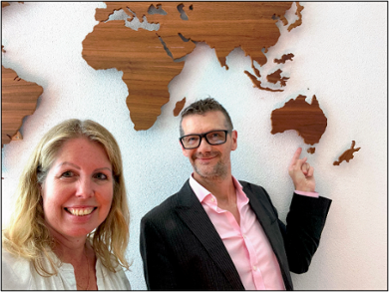
New research initiatives
One of the key outcomes of the visit was the development of a prospective research collaboration with Professor Gianclaudio Malgieri examining the concept of productive friction in digital engagement and legal education. Building on the TAILER Lab's Friction Project, winner of a stream of the 2026 EduX Oceania Hackathon, the proposed project aims to explore friction from regulatory, educational, and rights-based perspectives.
The visit also laid the foundation for a potential collaboration with Professor Francien Dechesne and Alan Sears focusing on comparative educational policies and approaches at Leiden University and Monash University.
In addition, plans were established for a joint Monash-eLaw virtual workshop to be held in the second half of 2026, further strengthening the partnership between the two institutions.
Strengthening international partnerships
Dr Burgess's visit highlights the value of international academic mobility in fostering meaningful research partnerships, sharing expertise, and advancing innovative approaches to legal education and digital technologies. The mobility has already generated several promising initiatives and further reinforces the growing relationship between Leiden Law School and Monash University.
Project 2: Computational drug discovery
Through this Erasmus+ ICM project, Leiden University/LACDR and Monash University strengthened their collaboration in the field of computational drug discovery. The project supported two staff mobilities. Project coordinator Willem Jespers visited Monash University in February 2025, where he gave an invited lecture and seminar and met with the local research team. Viktor Prypoten visited Leiden University in September and October 2025. He gave two seminars, and was embedded in the research group.
Although the project was implemented on a smaller scale than originally planned, the staff exchanges had concrete and lasting outcomes. They contributed to an ongoing long-distance collaboration, the preparation of a joint scientific paper, and the submission of a joint grant application. The collaboration is expected to continue, including through a future visit of David Chalmers from Monash University to the Netherlands.

More about the project strategy and impact
Strategy on internationalisation
The project contributed to the internationalisation strategy of the participating research groups by strengthening academic cooperation and enabling knowledge exchange between Leiden University and Monash University. In addition, the scientific focus of the collaboration is closely connected to the digital transition, as the groups work on computer models and computational approaches for drug discovery. The staff mobilities supported the exchange of expertise in these digital and computational methods, and the collaboration has continued partly through long-distance and digital communication.
Impact
There is a clear positive impact on the participating staff members and research groups. For the participants, the mobilities created opportunities to present research, exchange expertise, discuss future collaboration, and become embedded in each other's academic environments. For both partners, the project strengthened an existing international collaboration in the field of computational approaches to drug discovery. The impact is visible in concrete follow-up activities, including an ongoing long-distance collaboration, the preparation of a joint paper, the submission of a joint grant application, and the expected visit of David Chalmers from Monash University to the Netherlands.
Overall, the project contributed to the internationalisation of education and research, the development of durable international partnerships, and the exchange of knowledge and expertise between European and non-European higher education institutions.
"The concrete follow-up activities indicate that the project had a positive and sustainable academic impact."
The project functioned as a bridge between higher education, research, and innovation by supporting staff mobility in an active research field: computational approaches to drug discovery. The exchanges facilitated the sharing of scientific expertise, the development of new research ideas, and the continuation of collaboration beyond the mobility period. This is reflected in the preparation of a joint paper and the submission of a joint grant application. The collaboration has created a basis for future joint funding opportunities.