
Proefschrift
Extracellular Matrix Mechanics in the Regulation of the early steps of the Metastatic Cascade
Metastasis is responsible for over 90% of cancer-related deaths and arises from the ability of a small subset of tumor cells to detach from the primary tumor, overcome multiple biochemical and mechanical barriers, disseminate through the body, and colonize distant organs.
- Auteur
- K. Beslmüller
- Datum
- 23 januari 2026
- Links
- Thesis in Leiden Repository
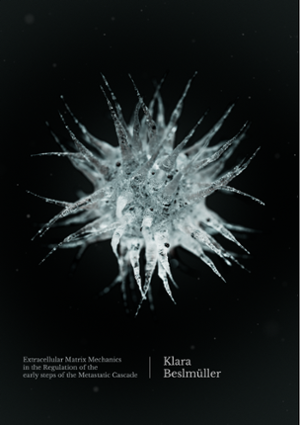
These metastatic cells often exhibit increased resistance to therapy, making metastasis a major challenge in clinical oncology. Tumor cell dissemination is driven by interconnected biological and biophysical processes, including epithelial–mesenchymal transition (EMT), solid–fluid-like transitions, and dynamic interactions with the tumor microenvironment (TME). The TME, composed of stromal cells and extracellular matrix (ECM) components such as collagens, laminins, and proteoglycans, plays a decisive role in regulating tumor invasion. Alterations in ECM stiffness, composition, and organization—especially collagen remodeling and basement membrane breakdown—modulate cell migration, influence signaling pathways, and support metastatic niche formation. Both insufficient and excessive cell–ECM adhesion or stiffness exhibit biphasic effects on migration, underscoring the complexity of mechanical regulation. Additionally, changes in cell–cell adhesion, particularly involving cadherins, determine whether tumor cells migrate individually or collectively. As tumors grow, increasing solid stress further shapes invasive behavior through mechanotransduction. Understanding how these physical parameters cooperate to facilitate escape from the primary tumor is critical for identifying new therapeutic vulnerabilities. This thesis investigates individual ECM-related mechanical factors—including ECM stiffness, collagen remodeling, cell stiffness, and laminin-mediated regulation—to elucidate their contributions to metastatic progression. Through computational and experimental approaches, we reveal how specific mechanical cues modulate invasion, highlight the tumor-suppressive potential of laminin-111, and identify signatures of early collagen remodeling associated with metastatic potential. Collectively, these findings advance the mechanistic understanding of metastasis and may inform the development of future therapies aimed at restricting cancer spread.