
Week 4b: 29-31 January 2026
For the second half of our first week in the Luxor area, we received a barrage of some of the most notable sites in Egypt. On Thursday, after being told that we would have to wake up before 6:00am, we thankfully succeeded at this task, and it was well worth the discomfort. Our first stop was Deir el-Ballas where we met Dr. Nicholas Brown, a research fellow at Yale. This Second Intermediate Period settlement was impressive to see given its placement on a series of hills, providing an impressive view of the nearby modern town of Deir el-Gharbi. Here Dr. Brown told us about the current efforts to conserve the site for future generations and heavily emphasized the importance of community outreach with the modern population to ensure the archaeological work is not merely extractive but cooperative, ethical, and edifying to those who call this place home. Given the early hour of this visit, we were unable to pack our own food in time. Thankfully Karin, the manager of our hotel, was kind enough to arrange lunches for us. A thousand thanks to her!

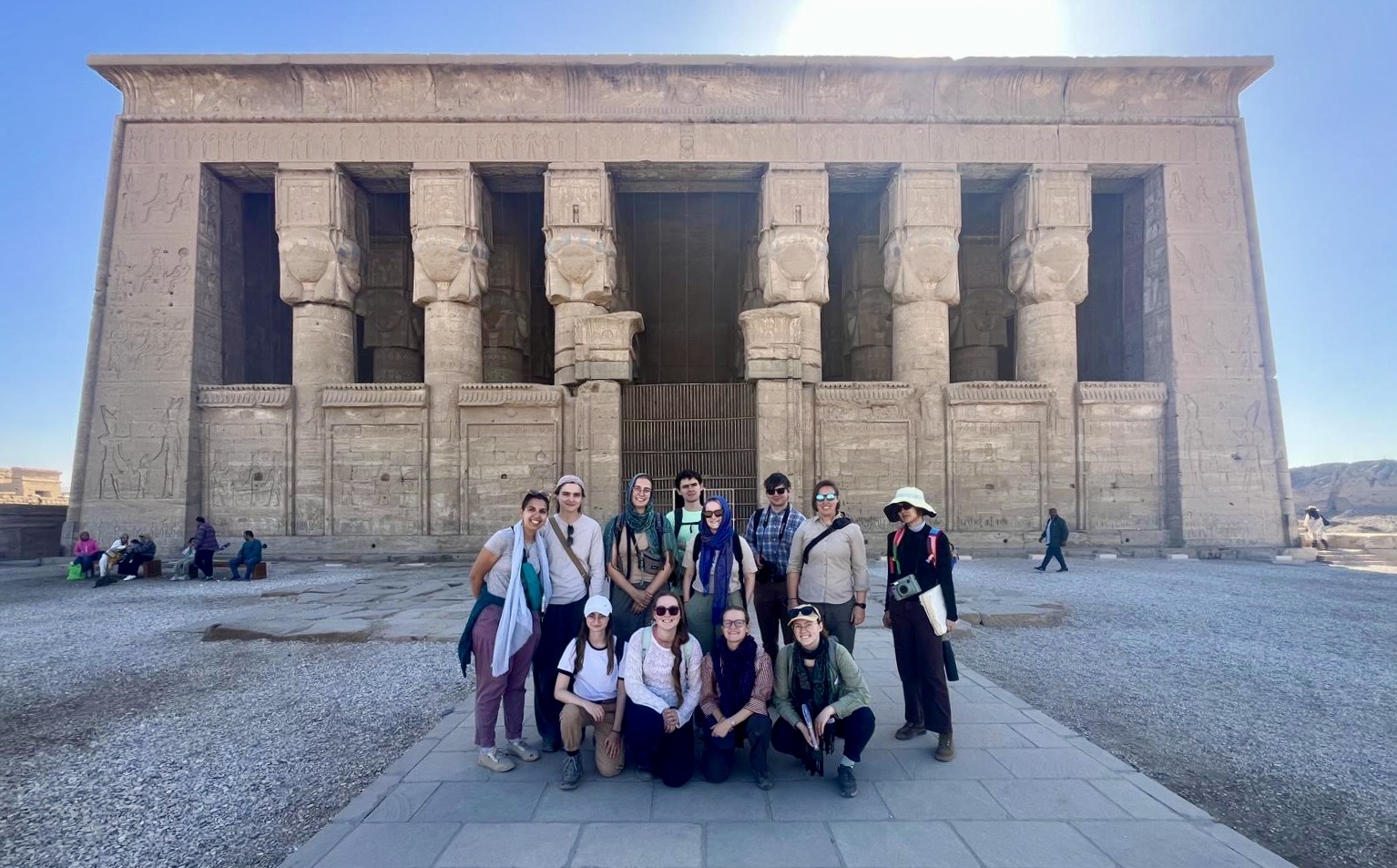
Next was the famous temple of Dendera, dedicated to the goddess Hathor. This surely is a highlight of the trip since it is one of the most exquisitely preserved temples, with distinctive (and painted!) Hathor-headed columns. This was further enhanced by the tour given by Prof. René Preys, a Belgian Egyptologist who has worked on the temple for many years. His explanations were crucial in understanding some of the details of the site, such as the phases of construction, ritual community, and the different artisanal hands involved in producing the wall inscriptions.

The next day thankfully allowed us to recuperate, and we were allowed to explore the Luxor area on our own. We decided to visit the nearby Ramesseum, the mortuary temple of Ramses II. This temple, like Dendera, has some of its color preserved for some of its inscriptions and columns. Since this was self-directed, we were able to wander more at our own pace, but it also demonstrated the value of talking with specialists on site since additional context would have been much appreciated.

The visits on Saturday were incredibly impressive: Deir el-Bahari and the Valley of the Kings. Deir el-Bahari, famous for being the site of the mortuary temple of Queen Hatshepsut, was also the site for several other constructions including the temples of Mentuhotep II (Middle Kingdom), Thutmose III (New Kingdom), and the Bab el-Gasus cache (Third Intermediate Period). Like our earlier visit to Deir el-Ballas, it shows that these spaces held cultural significance across centuries, even in antiquity.

The Valley of the Kings also was a fascinating site to visit; with perhaps the best decorated tomb we got to see being that of Seti I. Unfortunately, not all the tombs are open simultaneously, but it does give incentive to consistently revisit the site as one never knows what one might see!

Our last visit for the week was a brief stop at Howard Carter’s excavation house, allowing us to see where he lived, worked, ate, and slept. Perhaps it is ironic to view it now as we have been housed in Egypt for the past month, but it does make us wonder about what our future place in the Egyptological field will be.
Diego Córdova Rosado