Week 2: 11-17 January 2026
Although this is only our second week here in Cairo, the city already feels quite familiar. Step by step, we adapt to the fascinating life in Egypt. Yet one thing was still missing. People were speaking, but we couldn’t understand anything! Luckily, we started this week with our first class in Egyptian Arabic. Khawla taught us, at a running pace, some of our first words and phrases. Although it was quite hard at the beginning, after some time we were able to introduce ourselves.
On Sunday afternoon, we visited two distinct, yet historically connected institutes: the Swiss and German institute. The directors, Cornelius von Pilgrim and Dietrich Raue, respectively, shared their institute’s history and gave us a tour of the buildings and gardens. We ended this day by drinking a coffee with a view of the Nile.

On Monday, we visited the Egyptian Museum in Tahrir Square. Our hearts filled with excitement as we approached the red building. However, before we could marvel at false doors and faience shabtis, Ariel took us to the staff entrance. We followed closely through small staircases and equally low archways. There, we met Dr. Marwa Abdel Razek, who explained to us how the Egyptian Museum's database works. Afterwards, we had the honour to meet the director of the museum, Dr. Ali Abdelhalim Ali. At last, we entered the museum through the staff entrance. I tried to take notes during the tour by Ariel, but it was hard to focus. Everywhere, my attention was taken by a different fascinating object. I can only say this: ršwy ib=i m s.t tn ‘my heart is double happy in this place’. In the afternoon, Marleen told us about the history of NVIC and Egyptology.

The next day, Tuesday, we had our second class of Egyptian Arabic. In the afternoon, Ariel gave us an overview of the upcoming excursions and what we should certainly not forget! After this lecture, some of us went back to the Egyptian Museum.
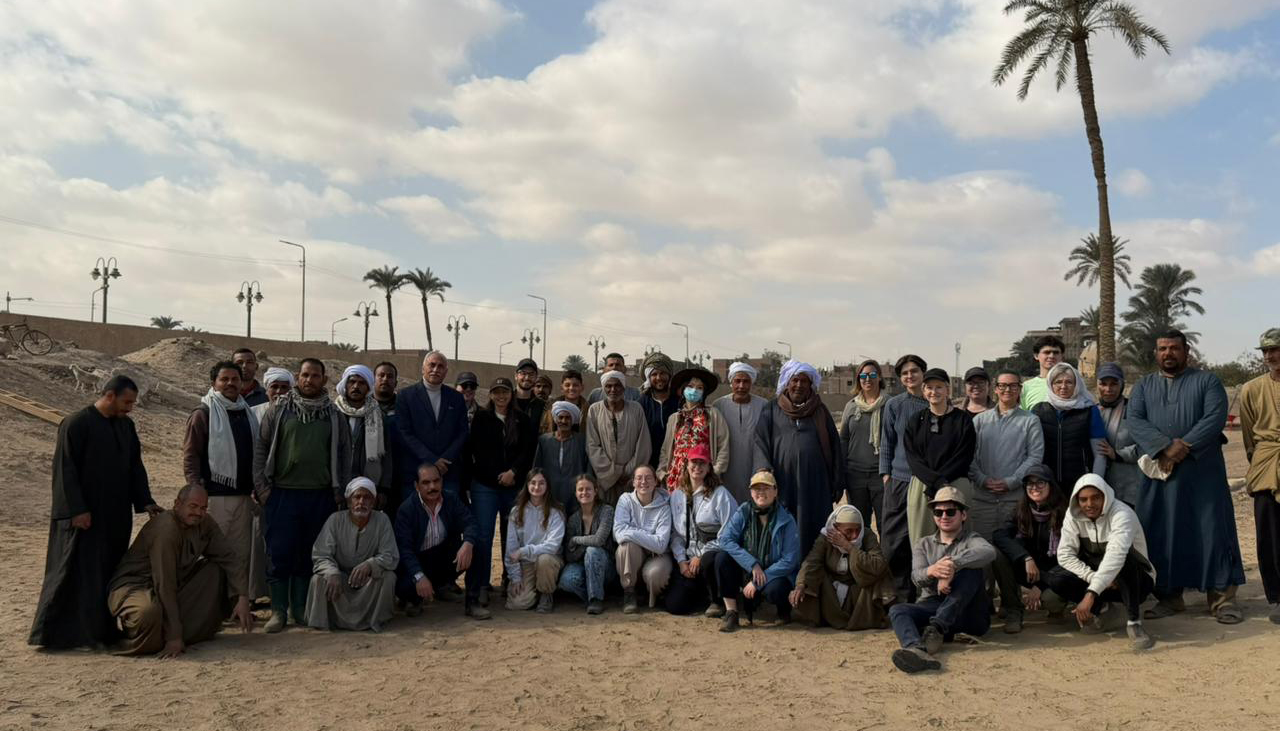
Wednesday was the most exhausting day of the week. We gathered early in the morning at NVIC to travel by bus to the archaeological site of Mit Rahina. The team of archaeologists guided us through the excavation. It was so interesting to experience ongoing fieldwork. Around 11 am, we enjoyed second breakfast with the team.
Our bus drove by the Nile through the countryside. It was our first time seeing this part of Egypt. Everything was so full of life. Eventually, we reached Dahshur. Like true adventurers, we first climbed down the Bent Pyramid. Ariel did not lie when she had warned us about the difficult climb. We followed stairs, crawled through small openings, and finally reached the inner tomb. Our legs hurt a lot, but who could say no to such an experience? In comparison, climbing down the Red Pyramid was a piece of cake. We only had to follow a long and narrow staircase. Inside, it was quite hot; I sincerely hope for every ancient Egyptian true of voice that the Duat has better air circulation.


The evening brought us no rest yet. On the 14th of January, the Day of the Archaeologists is celebrated in Egypt, a special event organised by the Ministry of Tourism and Antiquities to honour Egyptians working in Egyptology. This celebration took place in the national opera house on Zamalek. After many awards were handed out, the evening ended with classical Egyptian music.

The following day, Thursday, we finally had time to let our legs rest as our Arabic class was moved to the afternoon. It is already getting so advanced that we could now ask for directions. In the evening, we attended a lecture by Carina van den Hoven at NVIC about her excavation at TT 45. On Friday, we went back to the Egyptian Museum, this time to look for interesting artefacts to write our paper about. In the afternoon, the students of Leuven, including myself, visited the palace of Prince Mohammed Ali. We were very impressed by the palace itself, but the throne hall and adjoining building were not really to our taste. In addition, we wandered through Cairo and saw how it differs from Zamalek. The rest of the evening we used to pack for Alexandria.

The last day of the week began quite early in the morning. We gathered at NVIC and travelled by bus to Alexandria. The trip went smoothly until we were halted by a roadblock. Apparently, the fog on the Alexandrian highway was too dense. Luckily for us, it cleared quite quickly. In Alexandria, we visited the Roman catacombs of Kom el-Shuqafa and the theatre at Kom el-Dikka. As the modern city of Alexandria is built on top of its ancient predecessor, it is rare to see glimpses of its past. Finally, we visited the Graeco-Roman Museum and its wonderful collection. A place, worth its visit; to say it with a sš iqr ḏbꜣ.w=f formula. The day ended at the Mediterranean coast, where we enjoyed the last meal of the week. The waves were lapping gently against the shore as we slept.
Jelle Schelfthout