

Do children really do so poorly in maths? ‘Not at all'
Research image: Pexels - Nationaal Kennisinstituut Onderwijs
The maths level of Dutch primary school children? Nothing to write home about. At least, that’s the common perception. But according to researchers Marian Hickendorff and Emilie Prast from the Institute of Education and Child Studies, that idea is simply not correct.
Negative news about education
You can almost set your watch by it. Every year, when the Inspectorate of Education publishes its annual State of Education report, media outlets report that Dutch children are not performing well enough in maths. The same happened again in 2026.
'Education is stagnating, concludes inspectorate: basic skills are not improving, gaps are widening,' headlined Dutch newspaper de Volkskrant on April 15. Yet the inspection report itself paints a different picture: 'In primary education, the results of pupils in grades 3 to 7 for language and mathematics have remained relatively stable between the school years 2018–2019 and 2024–2025. They are back to pre-pandemic levels.'
Reference levels shape the perception
Based on media headlines, one might think that primary school children are collectively poor at maths. But that is far from the truth, says associate professor Marian Hickendorff, who studies mathematics education.
'This negative image is partly due to how the Inspectorate evaluates how many students achieve the national reference levels for language and maths', she explains. 'The government has set a target that 65 percent of students should reach the advanced level (1S) in maths. The assumption was that students need this level to progress to higher secondary education tracks, but this has never actually been tested', she continues. 'At the time of its introduction, about 50 percent of students reached this level, and the target was simply raised to 65 percent, without a plan on how to achieve it.'
A different picture from research
Hickendorff is keen to challenge the idea that children are 'bad' at maths. Studies that specifically focus on mathematics paint a very different picture.
'If you look at the results of the national Peil.Onderwijs study, you see that children’s maths performance has remained largely stable for about 20 years.' Results from the international Trends in International Mathematics and Science Study (TIMSS) show a similar pattern since the mid-1990s.
In fact, TIMSS shows that almost all Dutch children (98 percent) reach the most basic level. 'Very few countries achieve such a high percentage.'
Room for improvement
So Dutch children are not performing badly at maths, although there is always room for improvement.
'More children could reach the advanced level', says Emilie Prast, assistant professor specialising in differentiation in mathematics education. Differentiation means that teaching is adapted to the different needs of students in the classroom. Some students need additional step-by-step instruction and practice, while others need more challenging material than the standard curriculum provides.
Prast completed her PhD on this topic in 2018. During her research, she analysed many classroom videos of mathematics lessons. There, she noticed something striking.
'The lessons were divided into five-minute segments. For each segment, we recorded what both students and teachers were doing. In 21 percent of the segments, teachers provided extra instruction to students who struggled with maths. In only 2 percent of the segments did students who needed more challenge receive instruction or guidance for more advanced tasks.'
'Other studies show a similar pattern', she adds. 'Teachers themselves report that they spend relatively little instructional time on students with high potential in mathematics.'
Recommendations for strong maths education
The fact that high-performing students receive less attention is not due to unwillingness. Teachers face high workloads, classes are large, and not every school has enrichment materials available.
'Sometimes such materials do exist, but students receive little guidance', says Prast. 'And sometimes children are given secondary school-level material, which is not ideal either. When they reach secondary school, they encounter the same problem again.'
So how can schools improve maths education for all students? A recently developed guideline on mathematics education by Hickendorff and colleagues offers support, along with a thematic page on high-potential maths learners by Prast. These resources were developed for the National Education Knowledge Institute.
'The guideline includes six recommendations that provide teachers and maths coordinators with inspiration and practical tools to improve maths education', Hickendorff explains.
For example: 'It’s important not to focus only on isolated calculations. Show students that multiplication, such as 3 × 4, is repeated addition: 4 + 4 + 4. Measuring in metres and centimetres is also a great application of decimal numbers. This approach gives maths more meaning and helps students remember it better.'
No plain addition or subtraction sums
This way of teaching also prepares students better for everyday situations. 'In real life, you don’t face simple textbook problems', Prast explains. 'Instead, you need maths to figure out, for example, how many boxes of flooring you need to buy.'
It is also important that students work on problems for which there is no ready-made method, but where they have to develop a solution themselves. Prast gives an example:
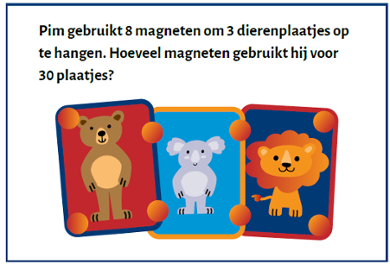
'Pim uses 8 magnets to hang up 3 picture cards. How many magnets does he need for 30 cards? To solve this, you first have to think about your own approach.'
Early grouping doesn’t help
The guideline also covers differentiation and refers to the previously mentioned thematic page written by Prast about promising mathematics learners.
Both Hickendorff and Prast observe that some mathematics methods track children at an early stage based on their level at that time. Once placed on such a track, it can be difficult to move away from it. As a result, a student who may have a lot of potential might never fully develop. 'We really need to move away from this rigid way of grouping', Hickendorff emphasizes.
The examples from Prast and Hickendorff show that there is still room for improvement in mathematics education. At the same time, the state of mathematics education and children’s performance are certainly not as poor as media headlines suggest.