
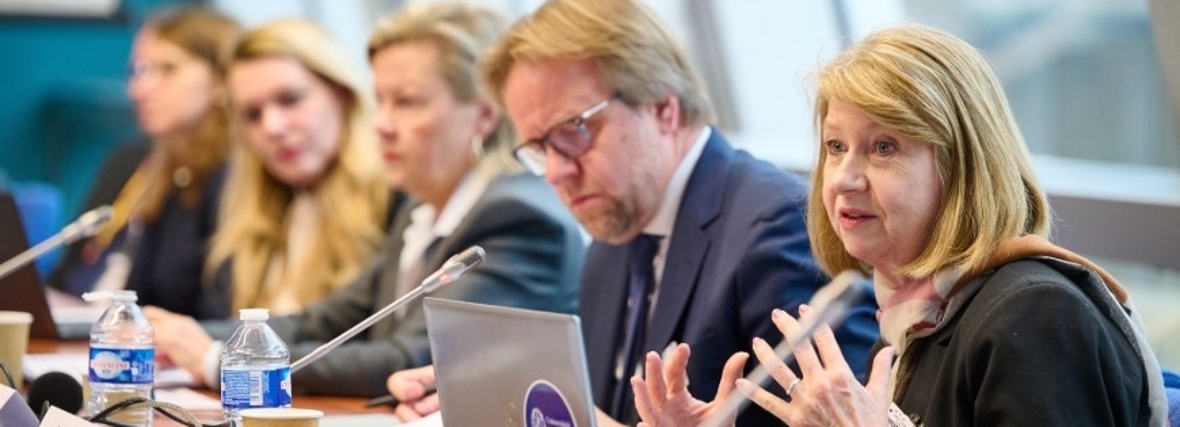
Leiden University co-hosts Council of Europe expert exchange on accountability for crimes against children in Ukraine
Bringing together practitioners, policy-makers, academics and children’s rights experts, the event explored how accountability for atrocity crimes committed against children during Russia’s war of aggression against Ukraine can be strengthened.
The Council of Europe’s Consultation Group on the Children of Ukraine (CGU) held its eighth plenary meeting from 1 to 3 December 2025. As part of the programme, a thematic expert exchange was organised on 3 December, co-hosted with Leiden University, and dedicated to the theme: 'Accountability for Crimes Committed against Children during Russia’s War of Aggression against Ukraine: Child-Friendly Justice and Access to Remedies'.
Ms. Marja Ruotanen, Director General of Democracy and Human Dignity at the Council of Europe, opened the exchange together with Professor Ton Liefaard, Head of the Department of Child Law and Health Law at Leiden Law School. In her opening remarks, Ms. Marja Ruotanen stressed that supporting children to seek justice for atrocities is a legal obligation, a moral imperative, and a precondition for building a just and sustainable future for generations to come, in Ukraine and across all liberal democracies.
In his opening remarks, Professor Liefaard highlighted the crucial role of academic institutions in generating evidence, fostering critical reflection and supporting practitioners and policymakers in shaping child-centred justice systems. In this context, he underlined that the Department of Child Law and Health Law has, for many years, been at the forefront of children’s rights research, education, training and network building. Bringing together legal expertise, empirical research and interdisciplinary perspectives, the department examines how justice systems respond to children, educates future practitioners and policymakers, and collaborates closely with international bodies including the UN Committee on the Rights of the Child, the Council of Europe, UNICEF and a wide range of partners worldwide. Central to the department’s work is strengthening accountability for children’s rights violations and ensuring that legal and related systems are equipped to protect, listen to, and provide just and timely remedies for children.
The discussions, which included contributions from Leiden University’s Professor Ann Skelton, further underscored that accountability must be anchored in a Children’s Rights-Based Approach, which recognises children as independent rights-holders and requires responses that go beyond criminal prosecutions. The exchange also highlighted that international and regional frameworks already offer a robust normative foundation, including the International Criminal Court’s policy on children, the jurisprudence of the European Court of Human Rights and the Council of Europe child-friendly justice standards. Together, these frameworks provide detailed guidance on how to document, investigate and adjudicate atrocity crimes against children in ways that are child-sensitive and trauma-informed.
The exchange reaffirmed that child-friendly, rights-based and trauma-informed practice is indispensable to both justice and protection. Research-based investigative interviewing, open-ended and non-suggestive questioning, adapted environments and multidisciplinary teams are critical to safeguarding children and securing reliable evidence. Child-friendly rights-based justice also requires clear information, support persons, privacy protections and prioritisation of cases involving children, drawing on lessons from international mechanisms, universal jurisdiction cases and integrated models such as Barnahus.
By co-hosting this expert exchange, Leiden University reaffirmed its long-standing commitment to advancing the protection of children’s rights in situations of armed conflict, strengthening accountability mechanisms and working closely with international and regional actors to secure justice for child victims of grave violations. The insights generated during the expert exchange will inform ongoing efforts to strengthen legal and policy frameworks aimed at ensuring that crimes committed against children do not go unpunished and that child victims receive appropriate recognition, protection and remedies. It also forms part of the CGU’s work under the Council of Europe’s broader commitment to securing accountability for Russia’s war of aggression, including through the Register of Damage for Ukraine, which documents losses to enable future claims for reparation, and ongoing efforts towards establishing a Special Tribunal for the Crime of Aggression against Ukraine.
With the exception of the opening, as per usual practice, the expert exchange was held under the Chatham House Rule.
Photo Credits: Council of Europe 2025