
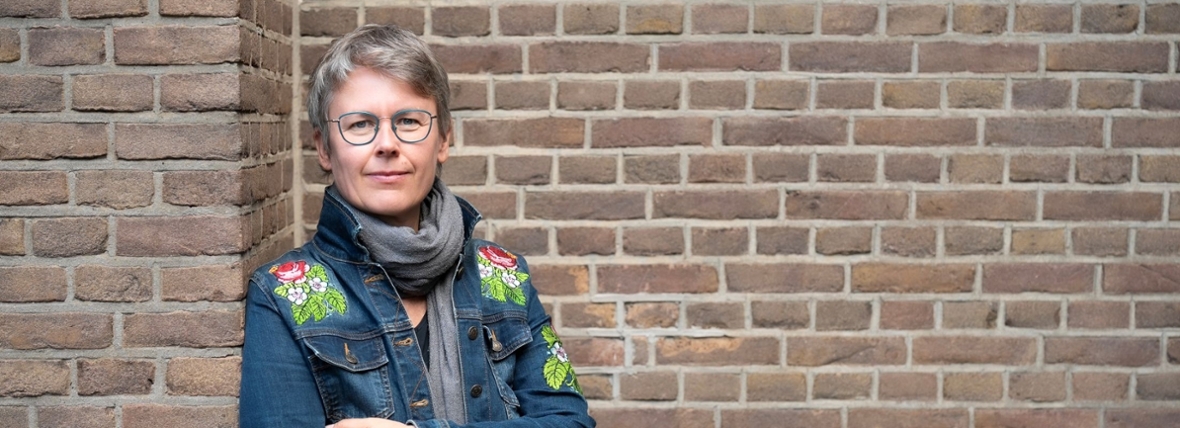
Jenny Audring is mapping the network of words in the brain
NWO L grant image: Nehir Aksel
Anyone who speaks a language unconsciously draws on a vast network of words and grammar. Associate Professor Jenny Audring has been awarded an NWO L grant to reconstruct such a mental network.
‘We do not know how linguistic knowledge is stored in the brain,’ Audring begins. ‘Neuroscientists may be able to look inside the brain, but we still cannot observe what the brain knows. That is why, as linguists, we approach this from a theoretical perspective.’
According to Audring, in order to speak a language, our brain uses two ‘books’: one filled with words and one with grammar, which explains how we connect those words to one another. ‘The question is: what does that look like in your brain?’ says Audring. ‘Of course, you don’t have alphabetical lists of words or grammar rules with explanations in your head. It is probably a network in which words with the same meanings — but also, for example, with the same form — are linked together. Grammar is also part of the same network.’
Modelling the network
In her new project, Audring aims to digitally model such a network. ‘I am focusing on the grammar within words,’ she explains. Although grammar is often associated with sentences, words also have a grammatical structure. ‘Koffiekopje, for example, consists of three parts: koffie, kop and -je,’ she explains. ‘As a speaker, you know that Dutch has this kind of compounds and diminutive forms. I want to replicate knowledge of these patterns in a network.’
Such ‘constructicons’ already exist for other languages; for Dutch, this is a new development. ‘Moreover, this will be the world’s first constructicon that is focused on word grammar,’ adds Audring. ‘The Dutch Language Institute manages all sorts of databases, including word lists in which the structure of the words is already partially incorporated. I can also draw on solid previous research: it is a Leiden tradition to focus on morphology, the grammar of words.’
Prefixes and suffixes
In doing so, Audring focuses more on the -je than on the koffiekop. ‘The relationships between parts of a compound can become so complex that this is a job for another project,’ she explains. ‘Otherwise, it becomes too much.’ Instead, she looks at prefixes and suffixes, such as be-, ver-, -baar and -je. Dutch has hundreds of them, and there is a great deal of complexity involved. ‘In Dutch, you have verbs that begin with op-, such as ophangen. When it comes to hanging a coat on a coat rack, you can see very clearly that op adds an upward movement to the verb hangen. That makes sense, but when ophangen involves a phone (hanging up), there is no upward movement in replacing the receiver. With ophangen in the context of a story (verhaal ophangen), the link is even more tenuous. As a result, form and content do not align as well. The same applies to opslaan (saving files) on the computer. There you have the same construction, but without that upward movement implied by op. All these subtleties must be reflected in the network.’