
Grotius Centre brings academic expertise to Rome Statute Assembly
At the 24th session of the Assembly of States Parties to the Rome Statute, held in The Hague from 1 to 6 December, the Grotius Centre for International Legal Studies played a prominent role, contributing cutting-edge research and expert insights to key debates on international law.
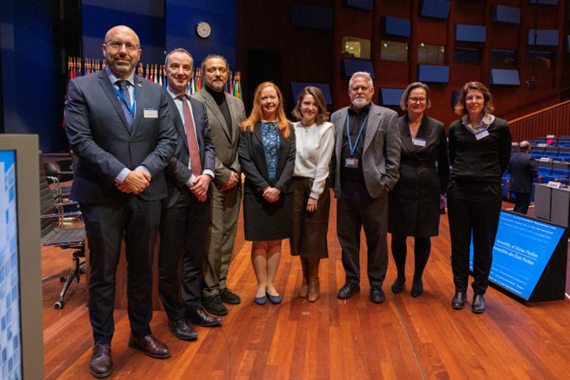
The Assembly of States Parties is the management oversight and legislative body of the International Criminal Court (ICC). It meets annually to take decisions regarding the functioning of the Court, including its budget and the appointment of officials. The Assembly also adopts the Court’s Rules of Procedure and Evidence and the Elements of Crime. The annual meetings provide opportunities for interactions between state representatives, civil society and international criminal law experts.
Environmental crimes
Daniëlla Dam-de Jong, Professor of International Sustainable Development Law and Director of the Grotius Centre, participated in a panel on the occasion of the launch of the new policy of the ICC’s Office of the Prosecutor on Addressing Environmental Damage Through the Rome Statute. The policy sets out how the Office of the Prosecutor will ensure that the Rome Statute is applied to crimes that involve environmental damage. It is an important recognition of the urgent need to ensure accountability for harm to the environment. Daniëlla represented the International Union for the Conservation of Nature’s World Commission on Environmental Law (IUCN-WCEL). The event featured keynote speeches by ICC Deputy Prosecutor Nazhat Shameem Khan and several other distinguished speakers.
Non-cooperation and sanctions against the ICC
Emre Acar, Contract PhD Candidate at the Grotius Centre, participated as a delegate of Liechtenstein at the ASP plenary sessions, and supported the delegation’s preparations for the ASP, particularly on the issue of non-cooperation and sanctions against the Court, considering his PhD research on the role of the ASP in responding to state resistance. On behalf of Liechtenstein, he contributed to the drafting process of the joint declaration in support of the ICC at The Hague Working Group. During the ASP meetings and events, he had opportunities to observe and collect data for his research.
International criminal justice
Larissa van den Herik, Professor of Public International Law, played a leading role in several high-level side events on international justice. She moderated a panel on restorative justice and the International Criminal Court, drawing lessons from Colombia and discussing the first two judgments of Colombia’s Special Jurisdiction for Peace in Cases 01 (hostage-taking by former FARC-EP) and 03 (extrajudicial executions by armed forces), delivered in September 2025. The event was organised by the Embassies of Norway and Colombia and featured senior Colombian officials and judges from the SJP and the ICC. Larissa also served as a discussant at an AFLA-organised side event on reforming the crime of aggression regime, using the Democratic Republic of Congo as a test case, with participation from ministers and senior legal officials from the DRC, Ghana, Sierra Leone, and the Central African Republic.
In addition, she chaired a session organised by the Swiss Federal Department of Foreign Affairs and partner embassies on advancing a Crimes against Humanity Convention, leading discussions with international judges and leading scholars on the prospects for successful treaty negotiations and the way forward.
Quality control in fraud and corruption investigations
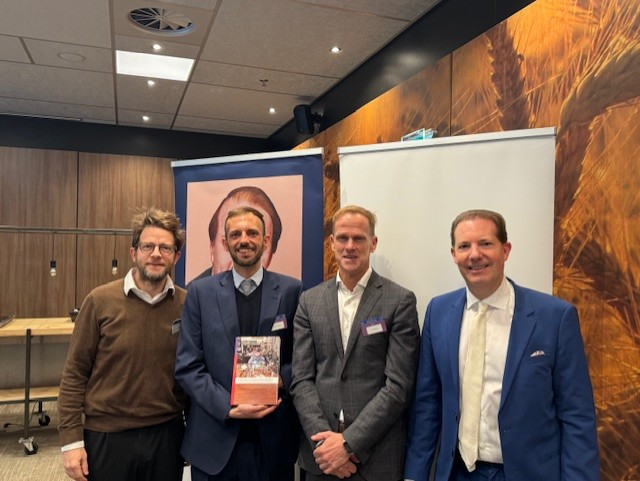
Carsten Stahn, Professor of International Criminal Law and Global Justice, launched a new open access volume on Quality Control in Fraud and Corruption Investigations (Torkel Opsahl Academic EPublisher, Brussels, 2025), co-edited with Tom Willems, Darren Frey and Antonio Angotti, as part of a CILRAP Panel on Frontiers of International Criminal Law and Justice, co-sponsored by Korea, Norway, Sweden, the European Anti-Fraud Office and others. The book is the fourth volume of the Quality Control Project and feeds into ongoing discussions on the interplay between atrocity crime and financial crime and initiatives towards an international anti-corruption court.
NGOs in courts and tribunals
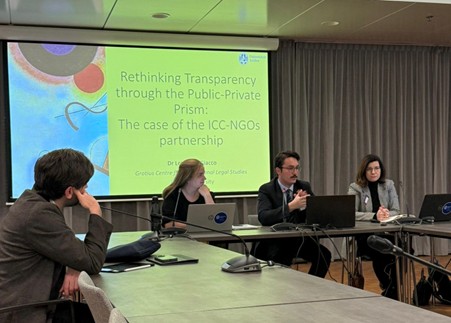
Letizia Lo Giacco, Assistant Professor of Public International Law, was an invited speaker to the event hosted by OSINT for Ukraine on the theme ‘The Evolving Role of NGOs in international courts and tribunals: Limits and opportunities’. She presented her study on the consolidating institutionalisation of NGOs at the ICC, which recently appeared on the Journal of International Dispute Settlement with the title ‘Rethinking transparency through the public–private prism: the case of the ICC–NGOs partnership’. Alongside Letizia’s intervention, Ukrainian lawyer and former Leiden Advanced LLM PIL alumni Deniz Derisu – the founder of OSINT for Ukraine – and Joni Van Laeken, Meijers PhD Candidate at the Grotius Centre, spoke at the event. Joni reflected on the central role of NGOs as implementing partners in the Trust Fund for Victims’ reparations and assistance mandates.