
Science for Sustainable Societies (BSc)
Programme structure
In the Science for Sustainable Societies programme, you will develop the expertise with which you can contribute to a more sustainable world. You will develop a sound knowledge base in the relevant disciplines of natural and social sciences and gain an innovative perspective on environmental and sustainability issues. At the same time, you will acquire the practical and professional skills that will assist you in your further career path, whether this is at a university, in business, or in the public sector.
First year
In order to contribute to a sustainable world, you need to understand this planet, how it works, and how the actions of humans influence flora, fauna, sea life, climate, and many other aspects. During the first year, we will make sure that you gain a sound foundation in the natural and social sciences, including disciplines such as ecology, earth system sciences, anthropology, psychology, and governance.
Introduction to Science for Sustainable Societies
In this course you will discover the benefits of our broad approach towards complex sustainability issues, combining a wide range of disciplines. The course highlights some of today’s most critical challenges and their root causes, drawing on both local and global examples. Questions that you will examine in this course include:
- How do human activities— including deforestation, agriculture, pollution, resource exploitation, and urbanisation—reshape Earth’s environmental systems?
- Why do these swift environmental changes pose threats to the overall well-being of the planet, impacting not only the environment but also our health and long-term survival as a species?
- In what ways is climate change influencing intertwined environmental and human systems, and what predictions can we make about the (near) future?
- How does environmental change affect human well-being, and how does this differ across the globe?
- When it comes to addressing environmental change, what decisions must be made, and how will they shape our lives and the future of our planet?
- Do we, as individuals, bear responsibility for the health of our planet?
Anthropology of Sustainability
This course will introduce you to anthropological perspectives on relationships between economies, societies, and the environment. You will also learn how anthropological research can shed new light on a diversity of possible sustainable societies. Our topics include the uneven distribution of environmental benefits and burdens along lines of gender, race, and class; how political economies shape our relations with more-than-human life; and anthropological ways of understanding climate disasters.
Earth System Science in the Anthropocene
How does human behaviour affect the Earth System? This course will explore planet Earth and its finite resources. These resources are governed by interacting processes that are increasingly affected by human activities. You will learn how and why the Earth is a dynamic system and explore these dynamics in terms of sustainability. In the course you will also examine human impacts such as climate change, environmental degradation, overexploitation, and overall pollution.
Socio-Economic Policy Evaluation
Who bears the costs of environmental action and inaction? This is a central question in this course. You will explore the perspective of different stakeholders, from multinational companies to local people living in regions that are under threat of climate change. Some of the questions you will study are:
- What is socio-economic policy evaluation and how does it influence the stakeholders and issues which are given priority in decision-making for sustainability?
- How are different societal groups, (from local to global) impacted by policies and practices of resource extraction, management and conservation?
- What are the possibilities and limitations of policy and market-based mechanisms (i.e. certification) to make these impacts more equitable?
- Does putting a value on nature serve to protect or further exploit it?
Methods that you will learn to use include environmental footprinting and evaluating the economic values of nature, interviewing and analysing stakeholders.
Second year
In the second year, you will build on the knowledge and skills you acquired in the first year, which will enable you to see how strongly the various disciplines in the natural and social sciences are interconnected. There will be 10 ECTS courses that are co-taught, meaning that in this course you will have lecturers from the natural sciences and the social sciences teaching together. This educational set-up is intended to inspire our students to develop out-of-the-box insights and to teach them how different perspectives can complement and stimulate each other. The knowledge and skills you will develop in this year will enable you to analyse complex sustainability problems and their possible solutions.
Third year
In the third year of the programme, you will have the chance to explore. During first semester you can do a minor, take courses on a new subject, or study at a university abroad. You can choose to specialise in a specific topic or discipline or to broaden your knowledge by following courses on new topics. It is not possible to do an internship within the framework of the programme. There are, however, options to work as an intern outside of the programme. If you consider this, please check with our study advisors.
In the second semester of your third year, you will form a consultancy team with a group of fellow students. Together you will be working on a sustainability issue put forward by a company, organisation, or governing body. In your team, everyone will have their own responsibility, such as researching a certain topic, coordinating the team work, overseeing the input for the project plan, etc. And as a team, you will have the joint responsibility to produce a viable and valuable project plan for the commissioning party. The team will analyse the problem, develop a path towards a feasible solution, and present their project plan to the commissioning organisation or company. This unique consultancy course will give you the chance to test and apply the expertise you gained during Science for Sustainable Societies.
Of course, during this year you will also write your final thesis, based on your own research project.
Field work
During all three years of the programme, you will have the chance to do a fair amount of field work. This means you will have to go outside, no matter the weather, and often walk through dunes, forests, or urban areas. The fieldwork will give you the chance to put your theoretical insights into practice and to develop various practical skills. The field work that you will be engaged in is diverse, and includes biodiversity assessments, measuring of nutrients, interviewing stakeholders and conducting surveys.
During the second year, you will go on a field trip to the Dutch Wadden Islands. Part of the third year is devoted to an eight-week team assignment, the Sustainable Science Project where you will be working on real-life sustainability problems put forward by organisations and companies.
Detailed programme
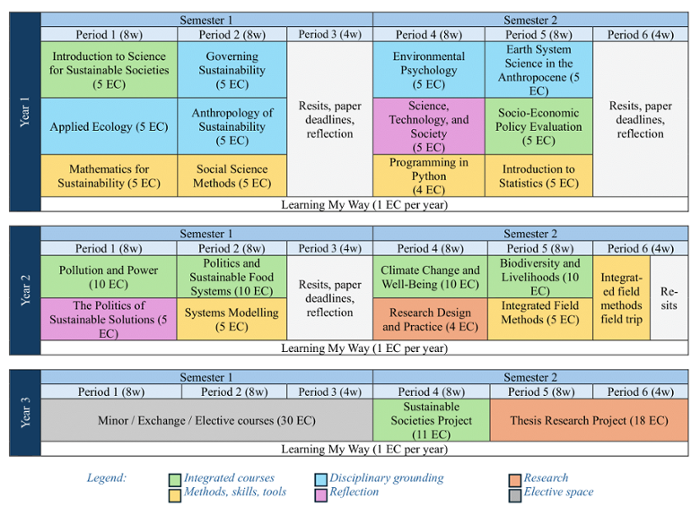
Below you find an overview of the curriculum. For a detailed description of the courses, check the study guide. Please note that this guide applies to the current academic year, the curriculum for next year may differ slightly.