
Research project
Images on the Move. Friendship Albums as Pictorial Networks in Early Modern Europe, 1550-1700
In early modern Europe images of all sorts circulated widely due to innovative print technologies and social media—but how did the public engage with these pictures? This project offers a qualitative analysis of album images and their early modern users.
- Duration
- 2025 - 2029
- Contact
- Marika Keblusek
- Funding
-
 NWO Open Competitie SSH-L
- Partners
Leiden Centre for Digital Humanities
Universiteitsbibliotheek, Leiden
Digital Heritage Design, Faculty Industrian Design Engineering, Delft
ICONCLASS
KB-Nationale Bibliotheek, Den Haag
Herzogin Anna Amalia Bibliothek, Klassik-Stiftung, Weimar
Herzog August Bibliothek, Wolfenbüttel
Niedersächsisches Landesarchiv, Wolfenbüttel
Bibliothek Germanisches Museum, Nuremberg
Stadtbibliothek, Nuremberg
Forschungsbibliothek Gotha, Universität Erfurt
Württembergische Landesbibliothek, Stuttgart
Kungliga Biblioteket (National Library), Stockholm
University Library, Uppsala
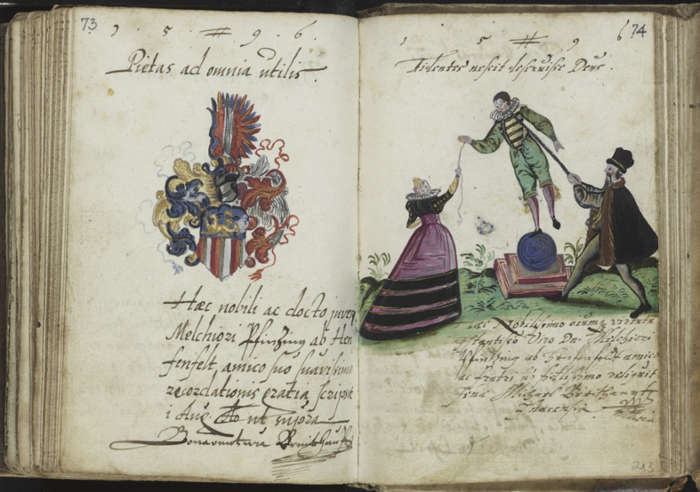
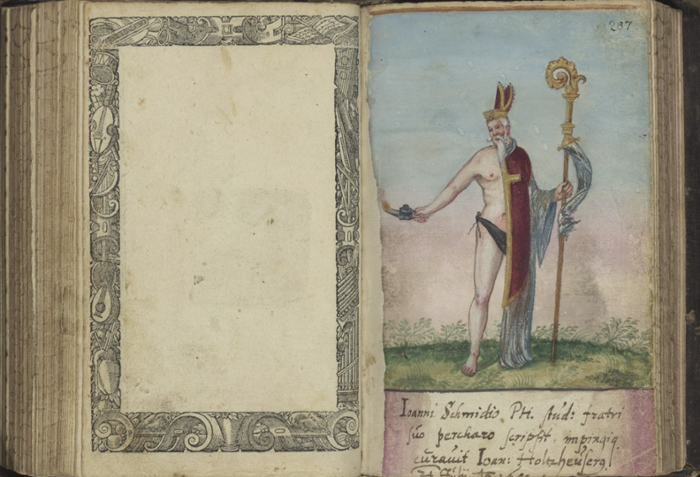
In early modern Europe, students, humanists, collectors, naturalists, soldiers, merchants, civil servants, and women compiled friendship albums—alba amicorum, in Latin—containing paper traces of social networks, friendships, travel, and professional contacts. The pages of these personal volumes contain text—in the form of signatures, dedications, and mottoes—and an abundance of vivid images. Iconographically dense painted pictures, costume studies and emblems in watercolour, and artists’ “signature” drawings figure alongside numerous printed images. Images on the Move, the first scholarly and digital research project to investigate the rich pictorial culture of alba amicorum, will situate these pictorial microcosms within early modern visual culture in the era of print.
Especially in printed form, images traveled: they were disseminated in published form and could also be transferred from one medium to another, resurfacing in new contexts and forms. The circulation of images in the everyday lives of a literate but not exclusively aristocratic or elite public entailed new forms of production and reception, especially of secular and vernacular images—pictures that were widely distributed, that were made by craftsmen rather than artists, and that reached broad sectors of society. But how did early modern European viewers organize their experience of the many images available to them? In what ways did diverse social and professional audiences actively engage with the abundance of images afforded by print technology through a collective pictorial vocabulary? How did involvement with images lead to further adoption, adaptation, modification, and even manipulation of iconographical motifs?
The central aim of this project is to reconstruct through (art) historical analysis key components of a shared early modern European visual language, and to do so in a way that affords new insights into the use, reuse, adaptation, and interpretation of images across time and space. Images on the Move proposes to analyze the ways in which readers and viewers of pictorial books and printed images came to terms with this visual language, by studying how diverse groups of users engaged and adapted it in their personal albums.
Subprojects
PhD-project 1
PhD-project 2
Database AlbumPics