
Dissertation
Protein Engineering of Keto Acid Decarboxylase for 3- Hydroxypropionic Acid Biosynthesis via Oxaloacetate
3-Hydroxypropionic acid (3-HP) is an important platform chemical with diverse industrial applications, particularly as a precursor for the production of value-added compounds and biodegradable polymers.
- Author
- C. Wang
- Date
- 09 June 2026
- Links
- Thesis in Leiden Repository
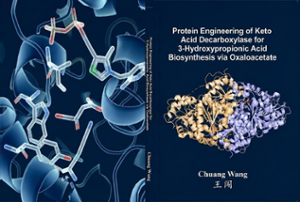
In contrast to conventional chemical synthesis, which relies on toxic feedstocks and harsh reaction conditions, microbial production of 3-HP attracts increasing interest as a more sustainable alternative. This dissertation focuses on the protein engineering of branched-chain α-keto acid decarboxylase (KdcA) from Lactococcus lactis to expand its substrate specificity toward the non-native substrate oxaloacetate and to apply the engineered enzyme in the biosynthetic production of 3-HP via the oxaloacetate pathway in Escherichia coli. Through site-saturation mutagenesis of KdcA, the mutant KdcA (S286T) shows greatly improved activity compared with wild-type KdcA, and a 3-HP-responsive transcription factor from Pseudomonas putida NBRC 14164 is reprogrammed into a biosensor for 3-HP detection and applied in evolutionary screening. Directed evolution of KdcA, combined with a growth-coupled selection system, yields the mutant KdcA (S286R/S287T/F381H/F382P/L534S/L535F/M538T/G539F), which displays significantly improved binding affinity compared with wild-type KdcA (Km = 1.15 mM vs. Km > 25 mM). In addition, optimization of protein expression, screening of suitable upstream and downstream pathway enzymes in the oxaloacetate pathway, and optimization of growth conditions achieve a 3-HP titer of approximately 0.71 mM from glucose. Rational engineering of KdcA further generates multiple promising mutants with enhanced activity and binding affinity, notably KdcA (S286K/V461I/M538Y) and KdcA (S286K/F381W/V461I/M538Y), which display significantly lower Km values (6.55 and 6.01 mM, respectively) relative to wild-type KdcA, along with up to approximately 120-fold increases in catalytic efficiency (kcat/Km). Integration of KdcA (S286K/V461I/M538Y) into E. coli, 3-HP production reaches 1.6 mM in shake-flask cultures. Overall, this dissertation demonstrates the effectiveness of protein engineering in overcoming enzymatic bottlenecks for enhanced 3-HP biosynthesis. The findings regarding substrate recognition and protein structure provide valuable insights and strategies for the rational design of KdcA and other ThDP-dependent decarboxylases toward other 2-keto acids for the biosynthesis of higher alcohols and related bioproducts.