
Huizinga Lecture: The Right to Wonder
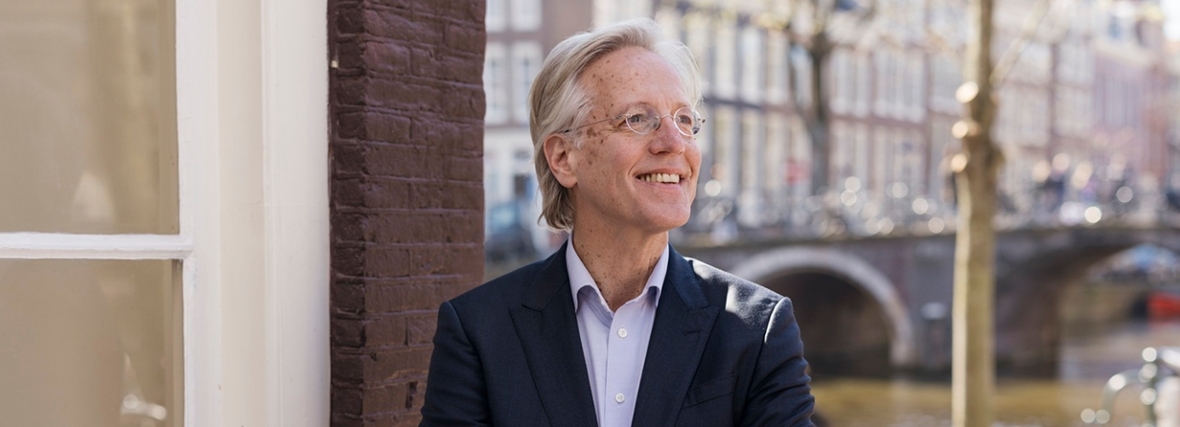
image: Kirsten van Santen
Prof.Dr. Robbert Dijkgraaf, mathematical physicist and University Professor at the University of Amsterdam (UvA), will deliver the 55th Huizinga Lecture at the Stadsgehoorzaal in Leiden on Thursday 3 December. Under the title ‘The Right to Wonder’, Dijkgraaf will reflect on what this right to wonder demands of the way we organise our education, our science and our society.
The Right to Wonder
Science and technology are our most reliable source of optimism. Yet while our knowledge is expanding, our world of experience is shrinking. Algorithms already know what we want to see, and models answer questions before we have even asked them. We are outsourcing not only calculations, but increasingly our thinking itself. This forces us to confront an uncomfortable question: what comes before the prompt?
Wonder
One answer lies in what precedes all knowledge: wonder. The realisation, both uplifting and unsettling, that the world is infinitely larger than we can comprehend, let alone understand. It is the allure of the blank spaces on the map. Wonder is the spark that ignites the powers of imagination and curiosity. It cannot be outsourced to any machine. And everyone has the right to be inspired by it.
It is precisely this spark that is under pressure, and not only because of technology. Science is increasingly suffering under the curse of its application and is expected to justify itself in terms of the benefits it promises. Just as Huizinga argued in Homo Ludens that culture arises through play without practical purpose, the same is true of science. Its driving force and greatest strength lie in something that does not need to justify itself: the pleasure of understanding the world.
A winding path
This is also where the way forward lies: liberation from utility, a restoration of play to its rightful place, and the right not to know where you are going. In retrospect, every discovery is presented as a straight, logical line, but in reality every path twists and turns. And only a winding path takes us to places that appear on no map.
What does this right to wonder demand of the way we organise our education, our science and our society? And what is the role of human beings in an age so firmly in the grip of technology, where wonder is quite literally being screened off? After all, this is also about how knowledge helps us understand our place in the world. Perhaps the arts can show us the way. The painter facing the blank canvas, the writer facing the empty page: time and again, they venture where no one has gone before.

About the speaker
Robbert Dijkgraaf (1960) is a mathematical physicist and academic administrator. He is University Professor at the University of Amsterdam and President of the International Science Council, the oldest and broadest organisation representing science worldwide. He previously served as Minister of Education, Culture and Science and spent ten years as Director of the Institute for Advanced Study in Princeton.
Dijkgraaf’s research lies at the intersection of theoretical physics and mathematics, where he has contributed to our understanding of string theory, black holes and topological field theories. In recognition of his scientific achievements, he was awarded the Spinoza Prize, the highest scientific distinction in the Netherlands. He has received honorary doctorates from Leiden University, Vrije Universiteit Brussel and Radboud University.
Dijkgraaf has always been committed to engaging a broad audience with science, including through his columns in NRC Handelsblad, his numerous media appearances and his popular science books. He studied mathematics and physics at Utrecht University, where he worked under Nobel laureate Gerard ’t Hooft.
Practical information
The lecture will take place on Thursday, December 3, 2026, at the Stadsgehoorzaal in Leiden. Please note that the lecture is in Dutch.
The doors will open at 7:00 PM, and the lecture will begin at 8:00 PM. Attendees will receive a book with the lecture text and a drink afterward.
More information
For questions about the lecture, contact Mrs. Sanderien de Jong, secretary of the Huizinga Committee.
A full overview of all Huizinga Lectures from the past 54 years can be found here.
Please note: tickets are sold out