

Turning scientific insights into impact: the winners of the Krijn Rietveld Awards 2026
Impact image: Monique Shaw
New clues to heart disease, more sustainable ways to protect crops, and a new technology for analysing tiny samples: the winners of the Krijn Rietveld Memorial Innovation Awards 2026 work on very different challenges, but share one ambition: turning scientific discoveries into impact.
Jill de Mol, Marijan Višić and Leiden Analytics received their awards on 1 September during the faculty’s opening of the academic year. Supported by dsm-firmenich and the Leiden University Fund, the Krijn Rietveld Awards recognise scientific achievements with the potential to contribute to society. This year, the jury selected winners in three categories: the Graduate Award, Doctoral Award and, for the first time, the Business Development Grant.
From laboratory prototype to future spin-off
Tiny samples often contain too little material to analyse properly. Spin-off company Leiden Analytics, winner of the first Krijn Rietveld Business Development Grant, developed a solution: the Hanging Droplet Evaporator (HDE). This device concentrates tiny samples by ten to hundred times before analysis. This allows researchers to detect much more of what they contain.
‘Today, researchers often have to combine millions of cells just to have enough material to measure’, says developer Alex Joesaar. ‘That means we lose the differences between individual cells. Our technology could reveal more from smaller samples; ultimately even single cells.’
Developed in Professor Thomas Hankemeier’s research group, the technology could make more detailed cancer research possible, enable analyses from a fingerprick rather than a full blood draw, and detect trace pollutants such as PFAS in ever smaller environmental samples.

The jury highlighted the combination of scientific innovation and commercial potential. A particular strength of the HDE is that it can be added to existing laboratory instruments, removing the need to replace current equipment. The grant will help the team prepare the technology for testing outside their own lab, while building Leiden Analytics as a spin-off company with support from the PLNT incubator. The goal: to bring the technology into everyday use in the first research labs.
Joesaar: ‘The leap from academic research to a product is one of the biggest challenges. As a researcher, you suddenly have to become an entrepreneur. Winning this grant is a real vote of confidence as we take that step.’
New insights into the ageing immune system
A previously overlooked group of immune cells may hold important clues about cardiovascular disease. Jill de Mol, winner of the Krijn Rietveld Doctoral Award, studied these so-called age-associated B cells (ABCs). She discovered that people with higher numbers of these cells in their blood had a greater risk of experiencing a first heart attack, independent of notorious risks factors such as high blood pressure or cholesterol. She also showed that ABCs could contribute to more severe atherosclerosis.
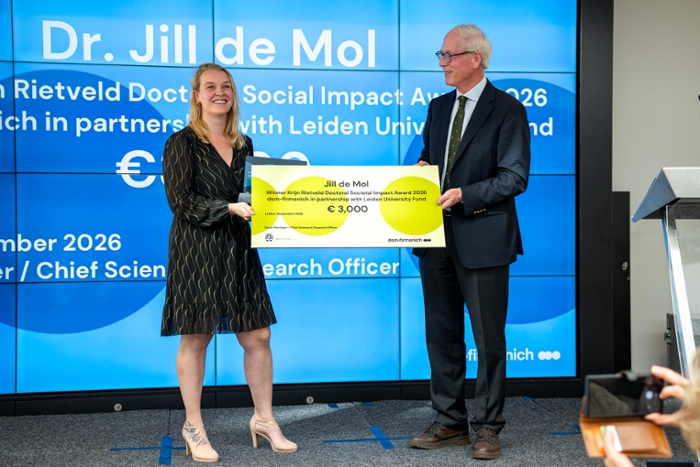
The research provides new insights into how immune ageing influences cardiovascular disease and could eventually improve risk prevention and inform new prevention strategies. The jury particularly praised De Mol’s scientific independence and creativity, and highlighted the scientific impact and societal relevance of her work.
‘We realised that these cells could be much more important than previously thought.’
De Mol is now investigating how we can selectively eliminate these cells without affecting healthy immune cells. The most surprising part was how strong the link turned out to be: ‘You always hope to find a meaningful link, but it is never guaranteed. Seeing such a clear association made us realise that these cells could be much more important than previously thought.’
Evolving bacteria to fight crop diseases
‘Experimental evolution is a blind approach: you never know what and if anything will happen.’ For Graduate Award winner Marijan Višić, that uncertainty was exactly what made his discovery so exciting. In his master’s research, he used evolution as a tool to improve a soil bacterium that naturally produces compounds capable of suppressing fungi and similar crop pathogens.
‘The societal importance of evolutionary biology is not often directly recognised, so receiving this award means a great deal to me.’
Višić repeatedly exposed the bacterium to competition and selected a bacterial variant that was better at suppressing fungal competitors. This way, he discovered that these evolved bacteria produced much higher amounts of two compounds responsible for this effect and identified the genetic change behind it.

The findings could contribute to more sustainable agriculture by helping develop biological alternatives to chemical fungicides.
The jury praised Višić’s combination of experimental evolution, microbiology and advanced data analysis. By integrating different approaches, Višić moved beyond observing the change and explained the biological mechanism behind it.
LURIS also selected two runners-up for this year’s Graduate Award: Rianne Weber and Filipe Cruz (see banner picture)
About the Krijn Rietveld Memorial Innovation Awards
The Krijn Rietveld Memorial Innovation Awards were established in 2020 in memory of Krijn Rietveld (1956–2018). The awards recognise innovative research with the potential to create real-world impact. Supported by dsm-firmenich and Leiden University Fund, the awards celebrate outstanding researchers and innovators connected to Leiden University — from master’s students and PhD candidates to postdoctoral researchers and start-ups — across life sciences, (environmental) health sciences and biotechnology, with data science at the core.
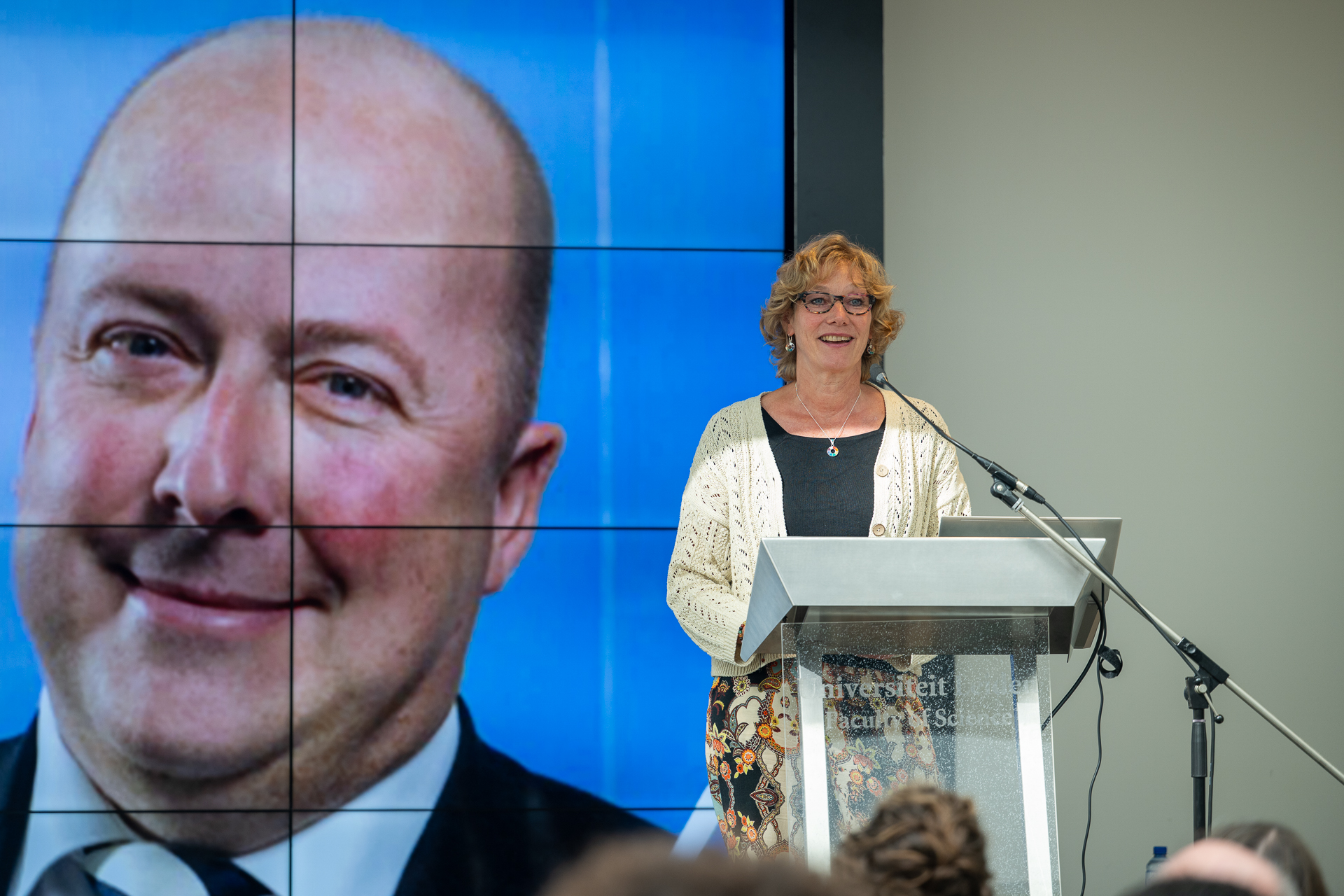
Image: Jury chair Cindy Gerhardt, Managing Director of Planet B.io, talks about her time working with Krijn Rietveld at dsm-firmenich.