
In a maze of posters, Psychology students find their way to new insights
Psychology image: Hannah Jacobs
Why does EMDR therapy actually work? And how do people experience a small dose of psychedelics? Curious Psychology bachelor's and master's students investigated these and other questions through their research projects. They presented their findings during Science Day.
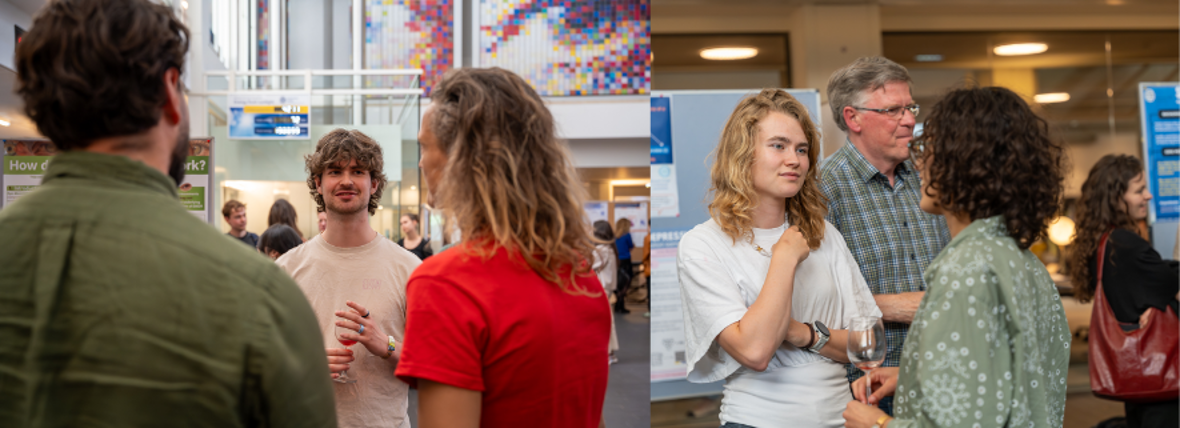
Students from the Bachelor Honours Project and the Research Master's programme presented the fruits of their intensive research efforts on Thursday, 4 June 2026. First on stage for lecturers, friends and family, and afterwards in a square of posters in the central hall. Would they like to tell us about their projects? Of course.
Do anxious people look more quickly at negative stimuli?
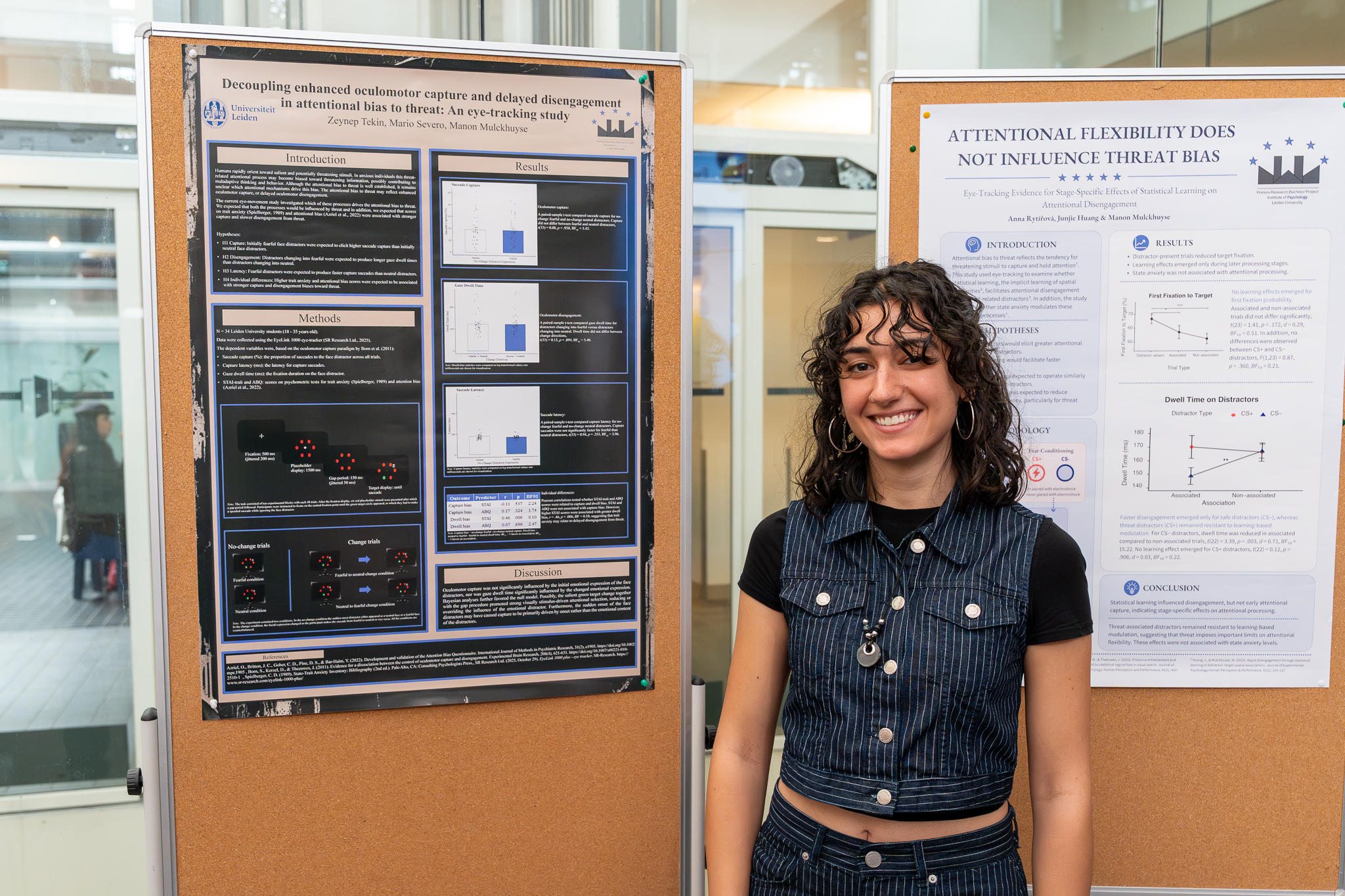
As humans, we have a keen eye for danger. You may be fully focused on your work and suddenly jump out of your skin when a spider appears in the corner of your eye. 'From an evolutionary perspective, it is adaptive to focus on that,' explains Zeynep Tekin. 'But it can also become excessive; then you continue to focus too much on negative things, even when that is no longer necessary.' In anxious people, this negative attentional bias, as it is known in psychology, is greater. 'But how that bias works is still unknown. Are anxious people more actively drawn towards stimuli? Or do they have difficulty looking away?'
To find out, Zeynep set up an eye-tracking study for her Honours Bachelor Project. She managed to recruit 56 people for her experiment, in which participants were asked to look from a row of red dots towards a green dot and ignore the rest of the screen. Then, suddenly, a neutral or anxious face appeared among the dots. 'We looked at whether people looked at the face, how quickly they did so, and whether they looked more at the neutral or anxious face. We also examined whether anxious people looked more quickly.'
In the end, none of the results were significant, which in itself was rather striking. Because, says Zeynep, in similar studies the results were significant. So the question is: how can that be? 'It may be due to the study design,' says Zeynep. Or perhaps because scientific journals tend to publish positive findings, while less exciting results receive less attention. Another bias altogether: publication bias.
Either way, Zeynep is certain that she enjoys doing research. She already suspected as much, but now she knows for sure. 'When I found out that the honours project allowed you to spend a year on your dissertation instead of just two months, I knew: this is the perfect test to see whether I enjoy research as much as I think I do. Now I've really been able to experience what research is like.' And she wants more. 'For my master's, I want to follow the Cognitive Neuro track; I'll hear soon whether I've been accepted.'
EMDR works, but why?
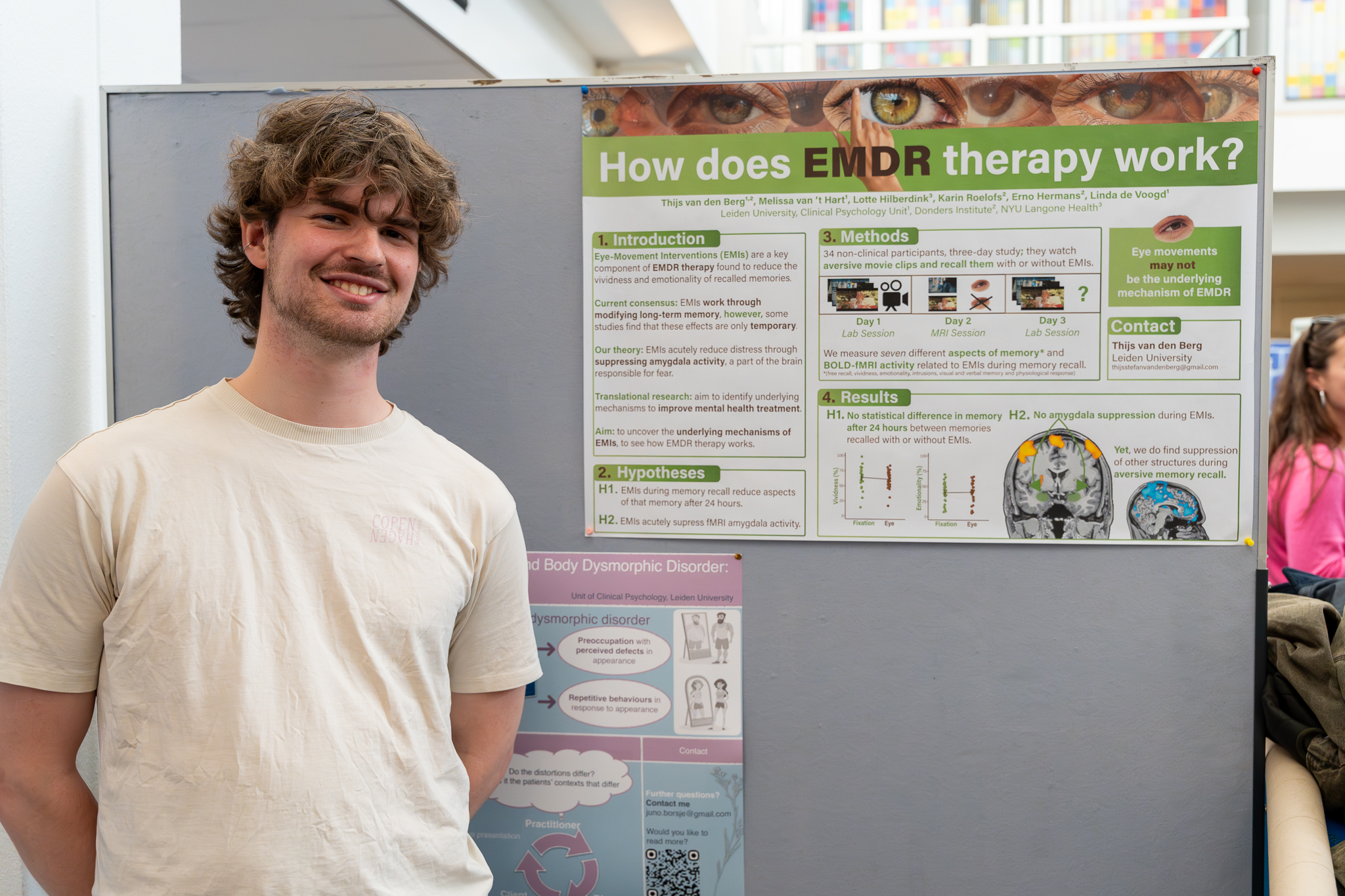
That certainly catches your attention. Or, as Thijs van den Berg himself says about his poster: 'Lots of eyes'. Thijs investigated the role of eye movements in EMDR therapy. He wanted to know: are those eye movements the factor that makes EMDR therapy effective?
To be clear: 'We know that EMDR therapy works. Just like other trauma therapies; they are approximately equally effective,' explains Thijs. 'All forms of trauma therapy share the same characteristics. You have to recall your traumatic memory, and there is a therapist present. Perhaps these shared factors explain better why trauma therapy works than specific mechanisms, such as eye movements in EMDR.'
Researchers still do not know exactly how EMDR works. A widely shared idea, including in the media, is that eye movements overload the brain's working memory, causing memories to be retrieved less effectively and thereby altered. 'The idea is therefore that eye movements make memories less emotional and vivid,' says Thijs. 'But we see in many studies that this effect has already disappeared after a day. So is it really a memory effect? Has something happened to the memory, or has something else happened?'
The study design spanned three days. On the first day, participants watched thirty clips from horror films, featuring scenes of murder and drowning ('that was required by the ethics committee'). The following day, participants were asked to recall the images they had seen the day before. For half of the videos, all participants had to make eye movements; for the other half, they did nothing. On the third day, they were questioned about various aspects of the memories, including emotion and vividness. Thijs: 'Our results showed no effect on memory between the two conditions. This is at odds with what people believe about EMDR.'
So eye movements do not seem to do very much to memory, according to Thijs's research. That is why he would like to continue investigating what actually makes trauma therapies effective. 'Have you seen that Zembla episode about Yes We Can Clinics? In it, people receive highly intensive trauma therapy, in which they are completely immersed in their trauma. This turns out not to be any more effective than EMDR. So it causes unnecessary suffering. If we understand why a therapy works, we only need to do that part.'
How do people experience small amounts of psychedelics?
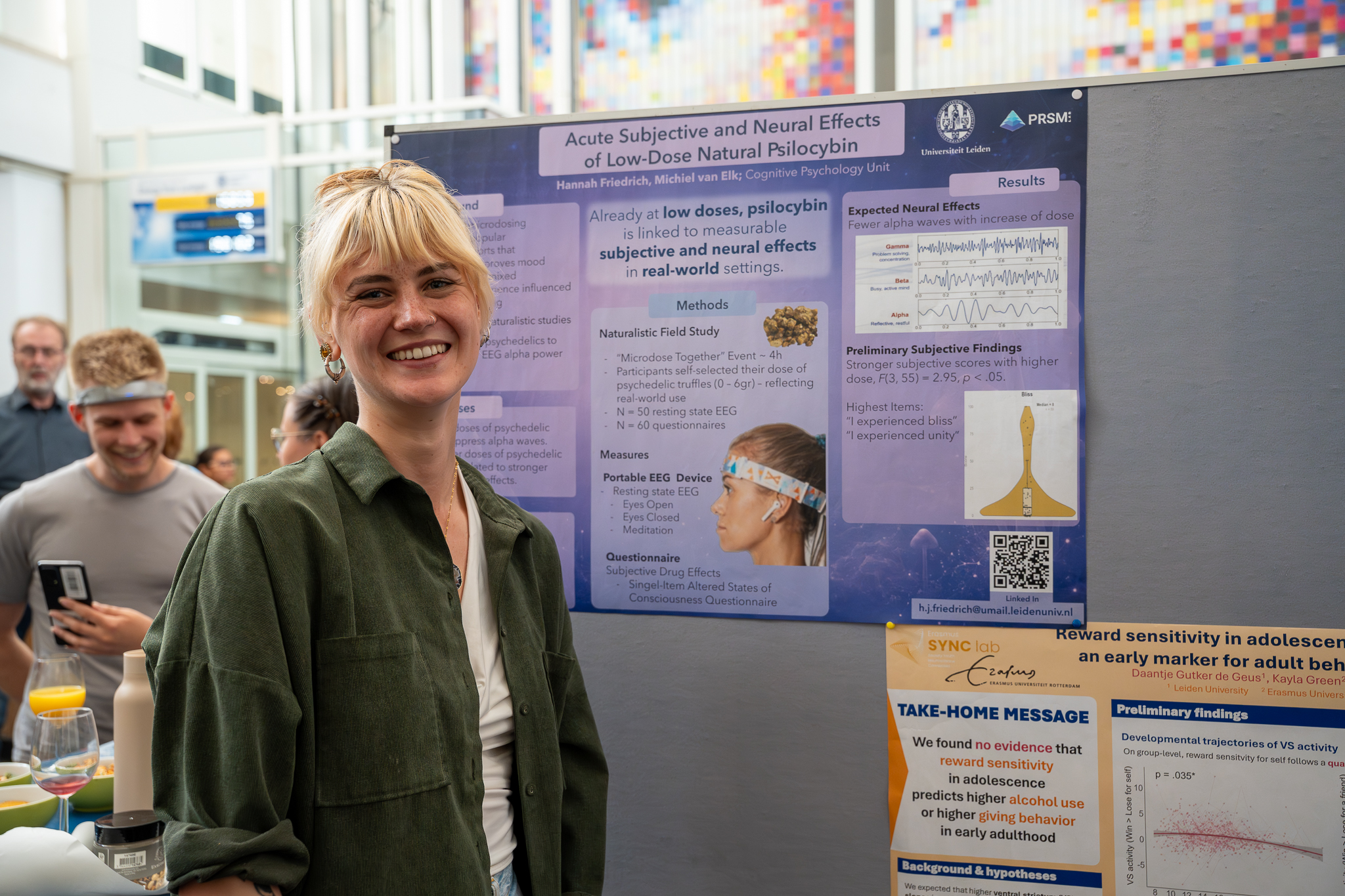
Researching the experience of psychedelics is not that straightforward, because how do you ensure that participants do not feel in any way pressured to take drugs? Well, for example by conducting your study in a place where people were already planning to use psychedelic substances. That is why Hannah Friedrich went to a 'Microdosing Together' event, carrying a portable EEG headband and a stack of questionnaires in her bag. Her goal: to investigate the psychological effects of psilocybin, the active substance in magic truffles, as well as its effects on the brain.
'The effects of psilocybin are often tested in a laboratory in a synthesized form; in this study, people took it in its natural form, by drinking the truffles steeped in tea, and in a more natural setting.' Using the portable EEG headband, a relatively new devcice in research, Hannah was able to measure participants' brain activity, while the questionnaires asked about their subjective experiences. 'I'm still analysing the EEG data because it's a new device for which the code still needs to be written. I'm learning by doing,' says Hannah. 'The questionnaires mainly indicate positive experiences; people felt good or experienced a sense of bliss. Although we also noticed some adverse effects, such as anxiety.'
According to Hannah, it was striking that the amount of truffles people consumed did not seem to make much difference to the effects they experienced. Whether it was one gram or six grams did not greatly affect how 'high' they felt. 'Timing was a more important factor in how people felt. Participants could choose whether to come to us for a measurement fifteen minutes, half an hour or an hour after taking the truffles.'
Timing therefore appears to have more impact than quantity, and in general people at this event had a positive experience. With her research, Hannah contributes to a substantial body of research into psychedelic substances, the results of which have been equally mixed. 'That is because there is no fixed protocol for this type of research,' she explains. 'For example, what exactly constitutes a microdose has not been established. That makes this type of research difficult to compare.'
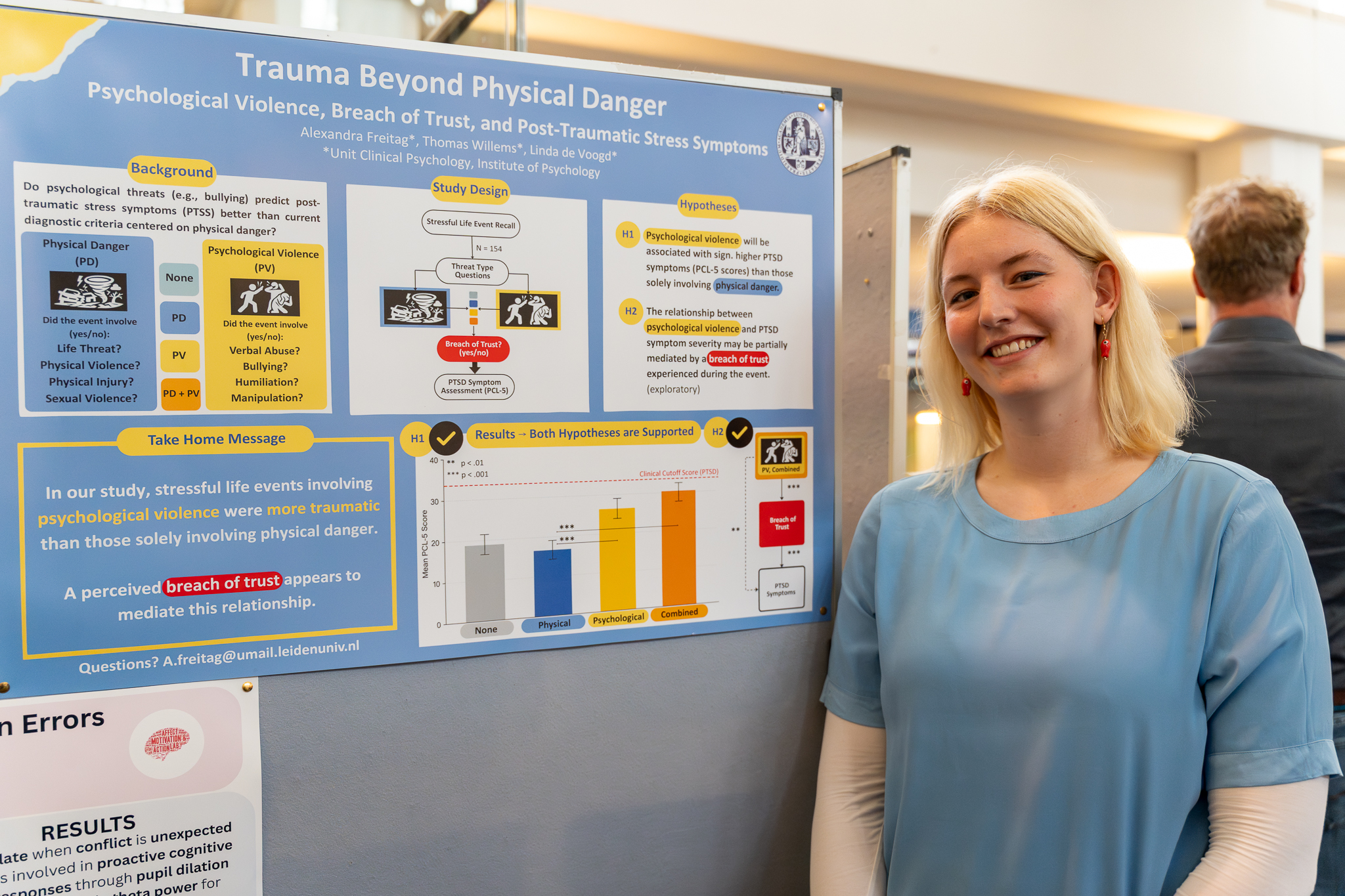
Why can psychological violence be so traumatic?
When people hear the word 'trauma', they often think of violent crimes, road traffic accidents or sexual violence, but, says Alexandra Freitag: 'Trauma goes far beyond physical danger alone.' In her dissertation project, she discovered that impactful life events involving psychological violence, such as bullying or humiliation, were experienced as more traumatic than events involving only physical suffering. 'We see that the reason for this is that psychological violence causes a rupture in trust in other people, which contributes to the development of PTSD.'
It was quite difficult to find participants for her study; not everyone feels comfortable revisiting traumatic events. 'We wanted a general sample; we were not specifically looking for people who already identified themselves as having experienced trauma. The study was conducted online, and people completed the questionnaires in their own time.'
What surprised Alexandra was the great variety of events that participants described as traumatic. 'People reported all sorts of experiences: from severe verbal aggression and humiliation to road traffic accidents, incidents during pregnancy and experiences of sexual violence. I was also struck by the severity of the symptoms that some participants reported afterwards, because we had not specifically recruited people with PTSD.'
Psychological violence can therefore be experienced as more traumatic than physical trauma alone because it damages trust in other people. But how exactly does that work? What do we define as a breach of trust, and how exactly does such a breach contribute to PTSD symptoms? That will be the subject of Alexandra's follow-up research. In any case, she would very much like to remain in research, although it is difficult because she also wants to pursue the clinical route. 'Ideally, I would combine the two.'