
Professor Sofia Ranchordás examines citizenship and datafication in AI governance
The lecture series 'Humanity in the Automated State' continued on 29 January 2026, at Leiden Law School with Professor Sofia Ranchordás from Tilburg University and Luiss Guido Carli. Professor Ranchordás holds the chair in administrative law at Tilburg Law School and is a part-time professor of public law, innovation, and sustainability at Luiss Guido Carli.
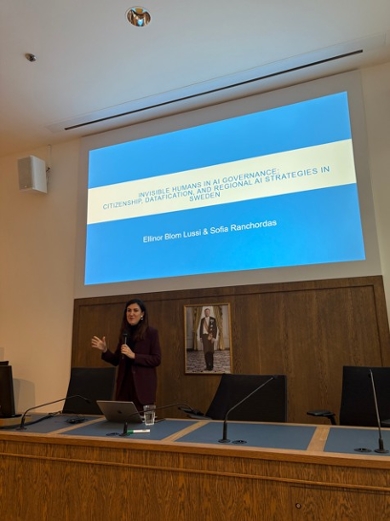
In her lecture, 'Invisible Humans in AI Governance: Citizenship, Datafication, and Regional AI Strategies in Sweden', Professor Ranchordás examined how citizens are conceptualised within AI regulatory frameworks and whether they are meaningfully integrated or treated primarily as variables within efficiency-driven logics. Drawing on research conducted with Ellinor Blom Lussi from Lund University, the lecture analysed the datafication of the Swedish social welfare system – often regarded as a paradigmatic model of solidarity and citizen-centric social security.
Professor Ranchordás revealed a striking mismatch between the marginal presence of citizens in AI policy frameworks and the foundational pillars of the Scandinavian welfare model. This mismatch, she argued, is rooted in longer historical processes including neoliberal governance, New Public Management reforms, politicised narratives of social welfare fraud, and the expansion of datafication policies. The lecture demonstrated how AI and datafication have consolidated a novel approach to social rights in which solidarity, diversity, and empathy toward citizens have become secondary, while efficiency, rationality, and individual self-responsibility have become central.
Empirical analysis
Through empirical analysis of regional public sector AI strategies in Sweden, Professor Ranchordás examined how citizens are represented and how their needs, vulnerabilities, and rights are translated into data-driven governance logics. The regional level provides a critical site of inquiry, given the central role Swedish regions play in delivering welfare services and their proximity to citizens in everyday administrative interactions. Her work raises urgent questions about whether datafication adequately reflects the distinctive features and normative commitments of welfare states or marks a new phase in their ongoing transformation.
The lecture is particularly relevant to Professor Ranchordás's ongoing NWO-Vidi project (2023-2028) on vulnerability in the automated state, which addresses the unequal relationship between citizens and administrative bodies and how technology reinforces existing inequalities.
Organisers
The lecture series, organised by Dr Melanie Fink (Europa Institute) and Dr Daria Morozova (Department of Business Studies), is funded by the Dutch Research Council (NWO) under the VENI grant 'Gateways for Humanity: The Duty to Reason in the Automated State' and supported by Leiden Law School's research focus area 'Technology, law, and justice'. The series brings together scholars from law, management, public administration, and computer science throughout the 2025/2026 academic year to examine how algorithmic governance reshapes human relationships with public authority.
Upcoming sessions feature:
- Madalina Busuioc (VU Amsterdam, 12 February)
- Mengchen Dong (Max Planck Institute for Human Development, 19 March)
- Ida Koivisto (University of Helsinki, 9 April)
- Natali Helberger (University of Amsterdam, 26 May)
Past lecture and more information
Aya Rizk (Linköping University, 12 January 2026)
More information on the lecture series and registration for upcoming lectures