
Aya Rizk examines automation’s impact on public administration decision-making
The lecture series 'Humanity in the Automated State' held its second session on 12 January 2026, at Leiden Law School. Dr Aya Rizk, Linköping University, brought her expertise on information systems with a focus on how digital technologies and data drive organisational change, particularly in decision-making and innovation.
In her lecture, 'Algorithms at the Frontline: Making Sense of Automated Decision-Making in Public Administrations', Rizk explored how automation is transforming the fundamental relationship between public officials and citizens. Drawing on research from public administration, information systems, and AI literature, alongside practical examples from several countries, she examined how algorithmic tools are reshaping discretion in welfare allocation, policing, and immigration screening.
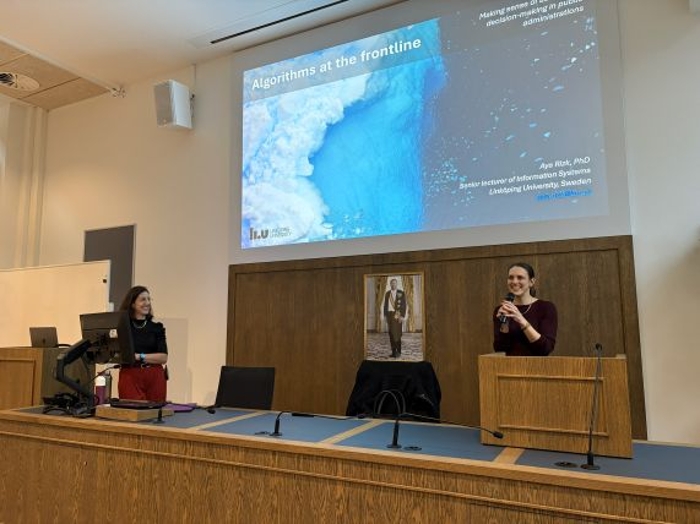
Rizk presented research clarifying pathways through which automated decision-making influences what she terms the 'decision space'– the dynamic interaction between officials and citizens where discretion, transparency, and participation operate. Her work demonstrates that societal and organisational structures shape individual attitudes toward automation, which in turn affect actions that collectively reshape existing structures. This cyclical relationship highlights significant knowledge gaps in understanding how automation affects core public administration values.
A central argument of the lecture was the need for carefully examined hybrid human-AI approaches that maintain meaningful human involvement. Rizk emphasised that automation implementation demands attention not merely to technological performance, but to the decisions, social processes, and institutional conditions within which those decisions are embedded. Drawing on historical perspectives of technological progress, she noted that previous waves of major technological change triggered and necessitated corresponding shifts in organisational and societal structures – a pattern repeating with contemporary automation.
Recommendations
The lecture concluded with recommendations for developing more citizen-centred decision-making practices that acknowledge both the opportunities automation provides for efficiency and the risks it poses to existing values and structures.
Organisers
The lecture series, organised by Dr Melanie Fink (Europa Institute) and Dr Daria Morozova (Department of Business Studies), is funded by the Dutch Research Council (NWO) under the VENI grant 'Gateways for Humanity: The Duty to Reason in the Automated State' and supported by Leiden Law School’s research focus area 'Technology, law, and justice'. The series brings together scholars from law, management, public administration, and computer science throughout the 2025/2026 academic year to examine how algorithmic governance reshapes human relationships with public authority.
Upcoming sessions feature:
- Sofia Ranchordás (Tilburg University/Luiss Guido Carli, 29 January)
- Madalina Busuioc (VU Amsterdam, 12 February)
- Mengchen Dong (Max Planck Institute for Human Development, 19 March)
- Ida Koivisto (University of Helsinki, 9 April)
- Natali Helberger (University of Amsterdam, 26 May)
Past lecture and more information
Professor Christine Moser (VU Amsterdam, 20 November 2025)
More information on the lecture series and registration for upcoming lectures