
Professor Madalina Busuioc on AI as a ‘go-to’ solution: The institutional costs of uncritical adoption
The lecture series 'Humanity in the Automated State' continued on 12 February 2026 at Leiden Law School with Professor Madalina Busuioc of VU Amsterdam, a public governance scholar, AI-DG Lab co-director, MSc programme founder, and recipient of a European Research Council grant.
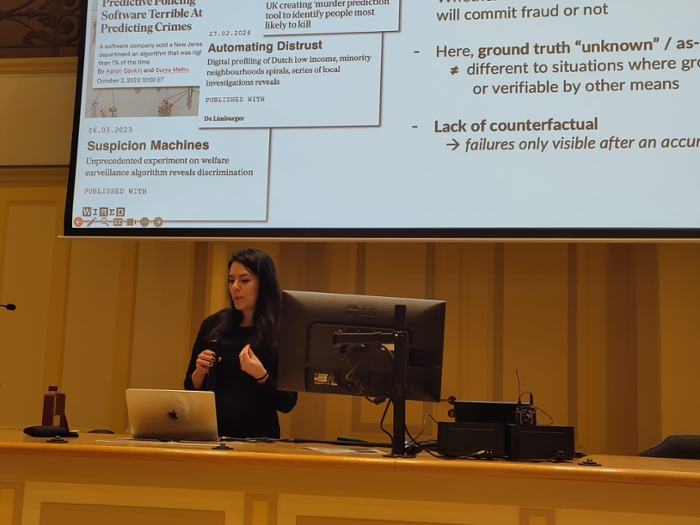
In her lecture, 'AI in the Public Sector: Not Just Plug and Play', Professor Busuioc identified a troubling pattern in how governments are adopting AI: driven by efficiency promises and sustained hype, AI is increasingly becoming a ‘go-to’ solution for public organisations – deployed irrespective of task and institutional fit, including in high-stakes domains that directly and consequentially shape citizens’ lives. Drawing on examples from across government, she examined what this uncritical embrace of AI means for the values and safeguards that public institutions are meant to uphold.
The central argument of the lecture was that AI adoption in the public sector is not simply a technical upgrade but a governance challenge with significant institutional costs. While efficiency gains are real, they tend to crowd out careful attention to whether AI is actually the right tool for a given task, and whether existing institutional structures are equipped to manage its consequences. Professor Busuioc showed how this ‘plug and play’ mindset creates risks that are often poorly understood until they materialise: the exacerbation of existing inequities and discrimination, and the erosion of core public values that the state is meant to embody.
Professor Busuioc also raised urgent questions about whether established accountability safeguards remain fit-for-purpose as algorithmic logics increasingly encroach upon administrative domains that were once the exclusive purview of civil servants and domain experts. Rather than treating accountability as a problem to be solved after deployment, she argued that responsible engagement with AI in government requires attending upfront to institutional fit, social processes, and the conditions under which algorithmic tools are embedded – making the case for a more demanding, institutionally aware approach to public sector AI.
Organisers
The lecture series, organised by Dr Melanie Fink (Europa Institute) and Dr Daria Morozova (Department of Business Studies), is funded by the Dutch Research Council (NWO) under the VENI grant 'Gateways for Humanity: The Duty to Reason in the Automated State' and supported by Leiden Law School’s research focus area 'Technology, law, and justice'. The series brings together scholars from law, management, public administration, and computer science throughout the 2025/2026 academic year to examine how algorithmic governance reshapes human relationships with public authority.
Upcoming sessions feature
- Mengchen Dong (Max Planck Institute for Human Development, 19 March)
- Ida Koivisto (University of Helsinki, 9 April)
- Natali Helberger (University of Amsterdam, 26 May)