
Book Manuscript Conference welcomes eight international scholars to the Netherlands
On Wednesday, September 17, 2025, Prof.dr. Sarah Cramsey convened a book manuscript event at the beach of Wassenaar near Leiden to discuss her new book 'Caring through Catastrophe: Jewish Children and their Caretakers during the Holocaust' which is under contract with Indiana University Press.
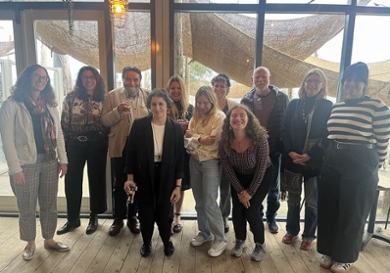
A unique assemblage gathered to discuss Cramsey’s new research: Prof. Elisheva Baumgarten and Dr. Eyal Lewinson (The Hebrew University in Jerusalem), Dr. Katarzyna Person (Director of the Warsaw Ghetto Museum), Prof. Robin Judd (The Ohio State University), Dr. Maggie Kirsh (The College of William & Mary), Prof. Sarah Ifft-Decker (Rhodes College), Prof. Anna Cichopek-Gajraj (Arizona State University, Mr. Konstaty Gebert (Independent Journalist and Public Intellectual based in Warsaw) and Leiden colleagues Dr. Lital Abazon and Dr. Kate Brackney read and responded to Cramsey’s work. Ms. Sophia Pekowsky and Ms. Borka Balogh, doctoral researchers under Cramsey’s supervision at LIAS, helped plan and coordinate the day-long event. Cramsey’s European Research Council Starting Grant, the Leiden Jewish Studies Network and the Austria Centre Leiden generously sponsored the event.
Cramsey’s new book interrogates the Shoah from the standpoint of its youngest victims and the caretakers who sustained them until they could not. Inspired by recent works that have focused on the Polish Jewish population which survived the the 1940s in the Soviet Union and what Natalia Aleksiun has termed a “familial turn” in Holocaust Studies, this book uses the socio-economic concept of “invisible work” to make earlychild care matter as a historical concept that can illuminate any era or event, even an event as complex as the Shoah. Caring through Catastrophe transports its readers to place like the Lenger Ugol settlement in Kazakhstan where Polish Jewish families expanded during their displacement in the wartime Soviet Union, the Warsaw Ghetto where caregivers, especially non-biological caregivers, knitted webs of care in extreme conditions and the hellish, off-loading ramps at Auschwitz Birkenau where mothers and other obligated women went in large numbers to their deaths with the youngest in their arms and tugging at their hips. Caring through Catastrophe identifies new documents for historical analysis and reads existing documents like those from the Oyneg Shabbes Archive in novel ways to make visible a crucial heretofore invisible history that is central to the lived experience of the Holocaust. Already this research has spawned two publications, an article in Polin: Studies in Polish Jewry and the introduction to a Special Issue in the International Migration Review which Cramsey convened, curated and co-edited. In sum, by imbricating the perspective of the unborn and recently born child as well as the (often) invisible caretakers who loved them into the canon of Holocaust studies, she hopes to make an important statement about Nazi ideology, how the Holocaust happened and the invisible work “care” as a usable and replicable historical concept.