
Lecture
IPH Prof. Catherine Malabou “On the Plasticity of the Unconditional”
- Date
- Tuesday 10 February 2026
- Time
- Location
-
P.J. Veth
Nonnensteeg 1-3
2311 VJ Leiden - Room
- 1.01
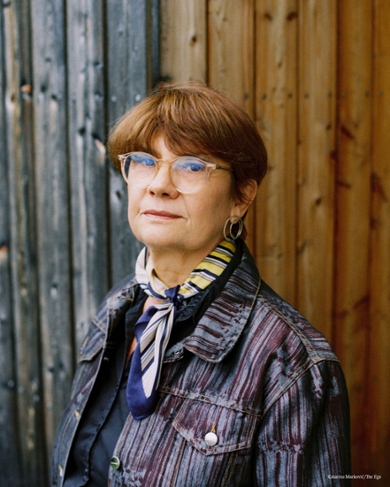
On 9 February 2026, the dies natalis of Leiden University, Professor Catherine Malabou will be awarded the degree of doctor honoris causa of our university.
You are warmly welcomed to two events following this ceremony:
On 10 February, Professor Malabou will give a public lecture at the Institute for Philosophy of Leiden University. Titled “On the Plasticity of the Unconditional”, the lecture will take its departure from and against Jacques Derrida’s ‘University Without Condition’ and discuss the situation of the university today. All philosophers and other interested people are welcome. The talk will take place at 14:15 – 16:00 at P J Veth building 1.01, and it will be followed by a reception at the brasserie of the Faculty Club.
Registration: c.w.sombroek@hum.leidenuniv.nl
On 11 February Professor Malabou will engage in an open discussion with students in an event organised with the philosophy student organisation Symposion This talk will take place at 15:00-17:00 in Lipsius 1.30. This event is also open to all those who are interested in discussing prof. Malabou’s work and the role of philosophers in the contemporary world.
About
Professor Catherine Malabou was born in Algeria, studied in Paris, and has worked as professor of philosophy at the Centre for Research in Modern European Philosophy (CRMEP) at Kingston University, as well as at the European Graduate School and the Department of Comparative Literature at the University of California, Irvine. She previously held the Spinoza Chair in Philosophy in Amsterdam.
Professor Malabou is a well-chosen honorary doctor because she has been a continuous defender of the relevance of the humanities – and the university – within a globalised world. Her approach has always been to champion openness toward the natural sciences and social sciences, be that to reckon with the consequences of new information technologies, neuroscientific discoveries, or climate science. In this way, she has exemplified an admirable approach to both research and education, one that shows us exactly why we need to protect universities today: because it forms one of the few sites where the endeavour to orient ourselves in a rapidly changing world has a privileged placed. For Malabou, philosophy is first and foremost the art of distinguishing and the work of critique as a constant engagement with other disciplines.
Professor Malabou’s vast bibliography testifies to her multifaceted interests. Her first works draw from the history of philosophy, especially Kant, Hegel, Freud, Heidegger, and Derrida, whom she reads in the light of contemporary challenges. Against this tradition she has formulated an original theory of plasticity, understood as capacity of taking form, giving form and even of destroying form. Originally a student of Derrida, her manner of working is nourished by deconstruction, but she is also critical of its abstraction. Instead, she advocates an overcoming of the continental-analytic divide, and proposes her theory of plasticity as a form of new materialism.
Professor Malabou has essentially posed the question of materialism as the question of the materiality of the thing traditionally called “mind”, in the brain as well as in computers. She has engaged with sciences of mind, such as neurology and psychanalysis, and with computer science and AI and shown how these new discoveries also oblige to reform inherited philosophical conceptions of thinking.
Professor Malabou has a great interest in contemporary society and its political challenges. In her first works, this interest translated into the question of the social context of mental trauma and illnesses. She also worked on feminism, where she has co-authored a book with Judith Butler and written recently a joyous little book on the clitoris. In recent years, her interest has focused on anarchism as a generative problematic for philosophy and politics alike. Evident in all these interventions is Professor Malabou’s rigorous passion for philosophical thinking. It is with good reason that they have established her reputation as a preeminent thinker of the 21st century, not only among Continental philosophers, but also among the many scholars in other disciplines who today draw on and engage with her work.
Suggested readings
Readings in history of philosophy
- L'Avenir de Hegel. Plasticité, temporalité, dialectique, Paris, J. Vrin, 1994. English translation by Lisabeth During: The Future of Hegel: Plasticity, Temporality, and Dialectic. New York: Routledge, 2004.
- Le Change Heidegger : Du fantastique en philosophie. Paris, Léo Scheer, 2004. The Heidegger Change: On the Fantastic in Philosophy (New York: SUNY Press, 2012).
- La plasticité au soir de l’écriture. Dialectique, destruction, déconstruction . Paris, Léo Scheer, 2004. English translation by Carolyn Shread: Plasticity at the Dusk of Writing: Dialectic, Destruction, Deconstruction. New York: Columbia University Press, 2009.
- Avant demain. Épigenèse et rationalité, Paris, PUF, 2014. English translation by Carolyn Shread. Before Tomorrow. Epigenesis and Rationality. Cambridge: Polity, 2016.
Works on psychanalysis, neurosciences and artificial thinking
- Que Faire de notre cerveau ? Paris, Bayard, coll. « Le temps d'une question », 2004. English translation by Sebastian Rand: What Should We Do With Our Brain? (New York: Fordham University Press, 2009, trans.)
- Les Nouveaux Blessés. De Freud à la neurologie, penser les traumatismes contemporains, Paris, Bayard, 2007. English translationThe New Wounded: From Neurosis to Brain Damage. New York: Fordham University Press, 2012.
- Métamorphoses de l'intelligence: Que faire de leur cerveau bleu ? Paris, PUF, 2018.
- With Adrian Johnston Self And Emotional Life, Philosophy, Psychoanalysis, And Neuroscience. New York, Columbia University Press, 2013.
Feminism
- Changer de difference. Paris, Galilée, 2009. English translation by Carolyn Shread: Changing Difference. Cambridge: Polity Press, 2011.
- With Judith Butler: Sois mon corps. Paris, Bayard, 2010. ou Be My Body For Me, For, Corporeity, Plasticity in Hegel's Phenomenology of Spirit. London: Blackwell.
- Le Plaisir effacé. Clitoris et Pensée, Paris, Payot & Rivages, 2020. English translation by Carolyn Shread. Pleasure Erased: The Clitoris Unthought. Cambridge: Polity, 2022.
Politics
- Au voleur ! Anarchisme et philosophie. Paris, PUF, 2022. English translation by Carolyn Shread. Stop Thief!: Anarchism and Philosophy. Cambridge: Polity, 2024.
All are welcome!