
Research project
Law and Entanglement: Quantum technology and consumer law
How can the law provide legal safeguards for the save introduction of quantum technology for consumers, and how can these safeguards be examined and interpreted through interdisciplinary collaboration?
- Duration
- 2025 - 2026
- Contact
- Julia Cramer
- Funding
- KIEM grant (Leiden University)
Introduction
Quantum technology opens up new possibilities for information technology, including computing systems, networks, and data processing, and therefore has the potential to bring about profound societal change. Fields such as healthcare, defense, and financial services are likely to be strongly affected. At the same time, the emergence of quantum technology raises important questions about safety, ethics, and the law. How can existing legal frameworks and societal norms protect users when quantum applications become publicly accessible through cloud-based services such as IBM Quantum Experience or Quantum Inspire? What happens if the use of such technology causes damage to software or hardware, and who can be held liable?
The project adopts an interdisciplinary approach, including literature research, the involvement of student assistants from both faculties, a creative hackathon with interdisciplinary student teams, and a concluding symposium. The results will contribute to both academic publications and education at both faculties.
Research Objective
The aim of this project is to examine the legal challenges and safeguards for consumers arising from the introduction of quantum technology. In addition, the project seeks to understand how existing consumer law frameworks and societal norms can contribute to the safe and responsible use of this emerging technology. By combining perspectives from law and the natural sciences, the project generates interdisciplinary insights that clarify both legal and technological aspects and support future policy development and educational initiatives.
Interdisciplinary Approach
The project brings together expertise from:
- Julia Cramer (FWN): quantum research, quantum algorithms, science communication, and the societal impact of technology.
- Vanessa Mak (LAW): consumer law, contract law, and liability.
By bringing together students, junior researchers, and senior experts from both faculties, the project fosters new interfaculty collaborations and opportunities for knowledge exchange and educational innovation. Through workshops, hackathons, and joint publications, we strengthen the interaction between technology and law.
Project Description – Lawful Entanglement: Exploring the Legal Implications of Quantum Applications for the Consumer Market
This project explores the legal challenges and safeguards associated with the introduction of quantum applications into the consumer market. Quantum technology, once primarily an academic research field, is now on the verge of becoming accessible to companies and consumers, for example through cloud-based services such as IBM Quantum Experience, Quantum Inspire, or the future EuroHPC quantum computer hosted by SURF in the Netherlands. This transition from laboratory to market raises questions about liability, contractual relationships, and consumer protection. What happens, for instance, if the use of quantum software causes damage to existing hardware or other software? Who bears responsibility, and what legal safeguards are available to consumers?
We combine expertise from law and the natural sciences to understand how legal frameworks can contribute to the safe and responsible use of quantum technology. The researchers conduct legal analyses, map existing legislation and regulation, and explore how societal norms can help guide responsible use of quantum applications. In doing so, the project also draws lessons from earlier emerging technologies, such as generative AI (for example ChatGPT), where questions concerning ethics, copyright, and sustainability were often addressed only at a later stage.
The KIEM project focuses on the following activities:
- A literature review of existing (grey) literature on quantum technology and consumer law, supplemented by research on other technologies and consumer law, carried out by student assistants from both faculties.
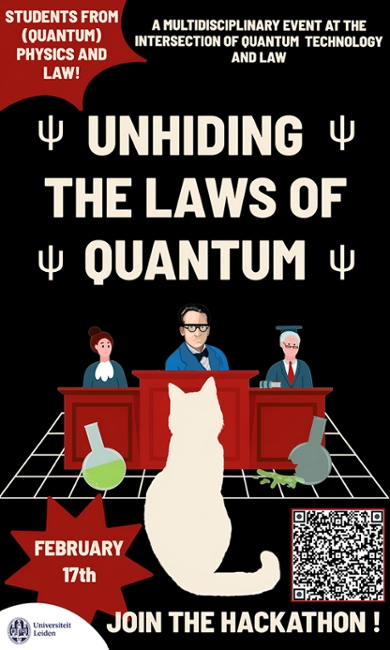
- A hackathon (on 17 February 2026) in which interdisciplinary student teams develop creative solutions to legal case studies emerging from the literature review.
- A concluding symposium (on 23 April 2026) in which the findings are presented and discussed.
- Guest lectures based on the insights gained, aimed at promoting knowledge exchange.
- The publication of a vision paper on the safeguards that the law can provide in the introduction of quantum technology for consumers.
Through this interdisciplinary collaboration, Prof. Vanessa Mak (LAW) and Dr. Julia Cramer (FWN) strengthen the connection between their fields and increase visibility and support for research into the societal impact of quantum technology. The project also lays the groundwork for future research initiatives and funding applications.