
Research project
Water frog hybridogenesis
How are perpetual Pelophylax hybrids maintained?
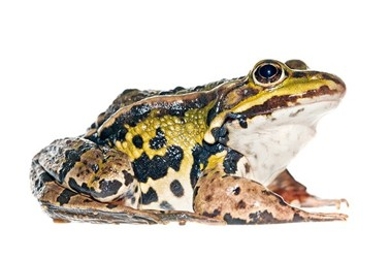
Ben Wielstra and his team explore the bizarre reproduction of water frogs (genus Pelophylax). Across part of Europe, three species of water frog can be found: the marsh frog, the pool frog and the edible frog. The edible frog is a hybrid between the marsh and the pool frog. When edible frogs mate with each other, this results in offspring with extremely low fitness. However, when they mate with a marsh or a pool frog, the offspring do just fine. Remarkably, when edible frogs mate with one of their parental species, they remove that species’ genome when producing gametes, only retaining the genome of the other parental species. This way an F1 hybrid between a marsh and a pool frog is effectively recreated. Wielstra uses modern molecular techniques to study this process called hybridogenesis.
Publications
- France, J., Barten, R., Morcy, N., Theodoropoulos, A., Wielstra, B. (2026). Pelophylax frogs. Current Biology 36(15): PR839-R841.
- van Veldhuijzen, L., Pabijan, M., Stark, T., Struijk, R.P.J.H., Wielstra, B., France, J. (2026). Target capture sequencing provides insights into hybridogenetic water frogs. Ecology and Evolution 16(5): e73570.
- Dufresnes, C., Monod-Broca, B., Bellati, A., Canestrelli, D., Ambu, J., Wielstra, B., Dubey, S., Crochet, P-A., Denoël, M., Jablonski, D. (2024). Piecing the barcoding puzzle of Palearctic water frogs (Pelophylax) sheds light on amphibian biogeography and global invasions. Global Change Biology 30(3): e17180