
Research project
Geo-Poetic Analysis of Pre-Islamic Arabia (GeoPo)
How can pre-Islamic poetry be used as a source to reconstruct the history of central Arabia at the dawn of Islam?
- Duration
- 2026 - 2031
- Contact
- Peter Webb
- Funding
- ERC Consolidator Grant

Scholars have long sought to understand Islam’s formative milieu in central Arabia around 600 CE, yet the specifics of its society and political structures have remained elusive. Existing sources offer only partial insight, leaving major gaps in our knowledge. There is, however, a vast and data-rich corpus detailing the major tribes, their social structures, beliefs, territories, trade networks, and more—pre-Islamic poetry composed by central Arabians between 525–625 CE. This corpus has remained largely untapped due to longstanding doubts over its authenticity and the practical challenges of linking its content to the physical landscape.
The Geo-Poetic Analysis of Pre-Islamic Arabia (GeoPo) project led by Principal Investigator Peter Webb inaugurates an innovative approach to demonstrate the scope of poetry’s authenticity and historical value. Funded by an ERC Consolidator Grant, and in collaboration with the generous permission and logistical support of the Heritage Commission of the Saudi Arabian Ministry of Culture, GeoPo will use Arabic poetry to transform understanding Late Antique central Arabia.
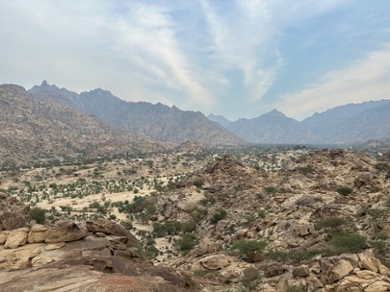
GeoPo is based on a highly successful pilot fieldwork project south of Mecca undertaken by Dr. Webb in cooperation with with the Heritage Commission in 2024. Via extensive interviews with local communities, 120 locations named in pre-Islamic poetry were identified, revealing hitherto unknown insight into the history of three tribal groups. Now, the ERC funding and the Heritage Commission’s logistical support on the ground will enable the research and fieldwork to continue over a 5-year period to reconstruct the full spatial, social, and pre-Islamic cultural landscape on a broad scale. By combining philology, ethnography, epigraphy, and geographic analysis, GeoPo’s team engages deeply with local informants and tribal knowledge-holders whose toponymic traditions preserve vital historical links. Their insights, alongside extensive site visits and the documentation of new Thamudic and proto-Arabic inscriptions, allow GeoPo to authenticate and map over 2,700 place-names preserved in early poetic and prose sources, turning what was once an abstract literary corpus into a precise, mappable archive of central Arabian life on the eve of Islam.
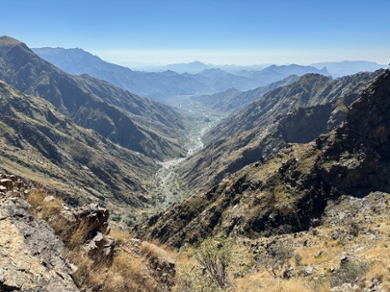
Alongside collaboration with the Heritage Commission to retrace the footsteps and heartlands of pre-Islamic poets, GeoPo pioneers the linking philological analysis of the poetry with the geographical findings from the ethnographic fieldwork. This “geo-poetic” approach allows the team to verify and validate the accuracy of the corpus, reconstruct the first empirically grounded map of pre-Islamic Arabia’s tribes, spaces, and routes, and develop systematic methods to extract the poetry’s unique historical data.