
Research project
Karakorum Rescue Project
The documentation and study of rock art in the Karakorum mountain range of the Pakistani Himalayas
- Duration
- 2020
- Contact
- Marike van Aerde
- Funding
-
 Prince Claus fund
-
 Aliph foundation
-
 Cultural Emergency Response
- Partners
Cultural Emergency Response | CER
The research
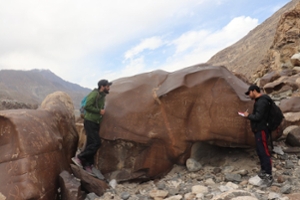
The Karakorum Rescue team conducted archaeological research and ancient heritage outreach in the Gilgit-Baltistan region of the Pakistani Himalayas between 2020-2023, supported by the Prince Claus Heritage Emergency Grant, the Aliph Alliance, and Cultural Emergency Response CER, focused on the documentation and study of rock art in the Karakorum mountain range of the Pakistani Himalayas, which functioned as major trade crossroad in the 1st millennium CE. The fieldwork was non-evasive and conducted in collaboration with and as educational initiative for the region's local communities. We are currently finalising the project' complete rock art catalogues.
Research Aim
Digital documentation of threatened rock art assemblages, and study of the role of the Karakorum mountains in the early trade networks of the 1st millennium CE.
Why Leiden University?
Leiden University encourages community and heritage projects, as well as international collaborations. The Faculty of Archaeology offers the digital tools needed for a heritage rescue project of this type. Several Leiden students contributed to the project through digital internships.
This project is a scientific collaboration between Pakistani and Dutch archaeologists with the aim to compile an openly accessible resource of previously undocumented and currently threatened rock art assemblages from the Karakorum mountain range. The fieldwork component of the project focused strongly on community outreach and participation. As observed by our field team, these efforts increased local interest in the rock art and encouraged people to regard the sites as heritage sites requiring guardianship and with potential tourism opportunities. The local authorities, including the government of Gilgit-Baltistan supported these initiatives by officialising and attending the erection of new official sign posts at the documented heritage sites, together with representatives from the local communities.
The Karakorum mountains functioned as exchange crossroads in Antiquity and early Medieval times, enabling trade from the Indian Subcontinent towards ancient China. The rock art left behind by travellers along these routes present some of the only currently known empirical remains of the physical mountain trade routes. These images, carved into granite, have revealed anthropomorphic, zoomorphic and decorative/symbolic carvings, ranging from prehistoric times to the early historic period. They include hunting scenes, pastoral scenes, symbolic figures, and wild animals, and a notable amount of Buddhist imagery: stupa shrines, worshippers and travellers, and inscriptions in the ancient Brahmi and Kharoshti scripts. The Karakorum Rescue Project builds on and hopes to help expand previous research, conducted in the mid-late 20th century by Pakistani and German scholars in the region, by focussing on rock art sites that were not yet known, documented, and/or published at those times. Additionally, we have introduced angles of digital heritage preservation, open access knowledge-sharing, and community outreach.
While scientific focus is on the digital documentation of the rock art, the project also addresses the ongoing destruction of these rock art sites, due to natural erosions and climate change, large-scale road works, vandalism, and misunderstandings of especially the Buddhist imagery.
As an archaeological rescue project, the project’s methods were non-evasive, using digital photography, photogrammetry, and GPS recordings to document the rock art at the sites of Alam Bridge, Chilas II/III, New Pahri and Doop Sahri Das. In total, approximately 7000 individual rock carvings have been recorded and digitised since March 2021. Our fieldwork teams of young Pakistani archaeologists emphasised accessibility for the communities and the rock art's heritage value, while collaborating with the digital team in Leiden for data documentation. A main part of our fieldwork's approach relied on personal connections and communications with both the local governments and the communities. We organised workshops Chilas and in Gilgit, and created an information booklet on the history of the region and the rock art encountered in the mountain range. Written in Urdu and English, this booklet was distributed in-person among the local communities, and it was also made available in open access online. As active outreach, local participants were directly in the documentation of the rock art. The project offered salary payment to stress the importance of the work while imparting archaeological skills and insights to the participants.
The main results of the project include: 1) its contribution of never-previously published archaeological evidence of human migrations and trade exchange across the Karakorum mountain range; 2) a large amount of data on the relevant rock art assemblages, incl. GIS-recorded coordinates and digital maps of the observed distribution patterns that can help reconstruct the ancient mountain trade routes based on verifiable data; 3) making data openly available for the study of individual carvings and inscriptions, which will aid studies on the spread of Buddhism and its intertwinement with the Eastern Silk Roads, as well as offer new insights into Himalayan biodiversity of the past millennia. While destruction of rock art continues in the region, the project's community outreach initiatives nonetheless yielded results in raising awareness and knowledge-sharing.
Our team is currently finalising the archaeological catalogues of our documented sites, incl. digitised rock art, photographs, and digital distribution maps.