
Publication
The Promise and Perils of Human Rights for Governing Digital Platforms
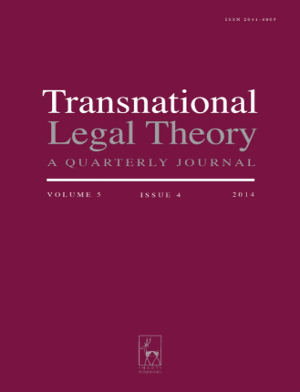
A new Special Issue with Transnational Legal Theory edited by Jelena Belic, Matthew Canfield, Henning Lahmann, Rachel Griffin, and Barrie Sander, brings together a collective of perspectives to unpack the promise and perils of human rights as a vocabulary for governing digital platforms.
- Author
- Jelena Belic, Matthew Canfield, Henning Lahmann, Rachel Griffin & Barrie Sander
- Date
- 12 January 2026
- Links
- Read the full article here
In the first decades of the twenty-first century, digitalisation and ‘platformisation’ have disrupted and even transformed many fields of economic, cultural and social life. With this Special Issue, the aim is not to dismiss platform technologies, but to engage in critical reflection on how platforms are imagined, and the conditions under which they are designed, developed and deployed.
Human rights have provided a widely understood and salient language through which diverse state and civil society actors have challenged the inequalities generated by platforms. For example, activists have drawn on human rights to identify, critique and challenge harms they attribute to platforms; to articulate demands for alternative approaches to platform governance; and to challenge state interventions seen as instrumentalising platform power in ways that threaten civil liberties.
In this context, the editors of this Special Issue organised a two-day workshop at the University of Leiden in January 2024, supported by funding from Leiden University’s Global Transformations and Governance Challenges initiative. Our aim was to push forward these debates not only by enabling sustained conversations on the role of human rights in platform governance, but also by bringing more disciplinary and geographic diversity into these conversations.
All contributors to the Special Issue diverge in some ways from the liberal mainstream of calls for platforms and their regulation to be made human rights-compliant, as though human rights provide a clear and objective normative framework which is sufficient to bring platform governance in line with a universally shared public interest. Beyond this broadly critical orientation, however, the authors take very different perspectives on the importance (or not) of human rights in platform governance. They also draw on diverse theoretical traditions; engage with different bodies of literature, case studies and political contexts; and employ a wide range of research methods and (in some cases) empirical data.
Ultimately, each of the contributions to this Special Issue extends the debate about human rights and digital platforms in various ways—whether in the form of novel disciplinary engagements, more diverse rights-based traditions, wider sets of platforms and rights, or directing attention beyond the default state-centrism of human rights. As the field of platform governance enters a critical juncture, our hope is that this Special Issue offers new fertile sites for further empirical and theoretical engagement for thinking with, against, and beyond rights-based approaches to governing digital platforms.