
‘What do you think I should do?’ The first question from new Scientific Director Dennis Claessen
Appoinment
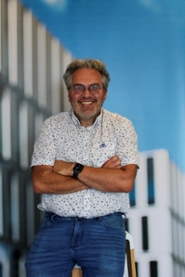
From September, Dennis Claessen will take up the role of Scientific Director of the Institute of Biology Leiden (IBL). He wants to give researchers the freedom to excel, strengthen the institute’s visibility, and, above all, ensure that staff feel at home.
You grew up in Friesland. How Frisian are you?
I was raised in Friesland with a Limburg upbringing. My parents are originally from Limburg and moved to Friesland. So I grew up with a combination of living the good life and the down-to-earth mentality of the Frisians.
I tend to feel at home wherever I am. I have lived in Groningen for many years, and spent several years in the United Kingdom, in Oxford and Newcastle. I have now been in Leiden for quite some time. I usually say that while nothing surpasses Groningen, Leiden comes very close. I genuinely feel at home here. It is a beautiful place and a great environment to work in.
What is your most distinctive character trait?
I always commit to something wholeheartedly. I used to be very active in sport and approached that with quite a bit of dedication as well. I competed in triathlons, of which cycling was always my favourite discipline. At the moment I am losing weight, and I am fully committed to that too. So far, I have lost seven kilograms. That said, there is a limit to my determination. If things turn out differently than expected, I am usually the first person to make peace with that.
Why did you choose biology?
The honest answer? Because a good friend of mine was going to study biology as well. Mathematics was another option. I was good at it, but I was not quite sure what I wanted to do with it after graduating. So, I followed my friend into biology. At first, I had my doubts, as there was a great deal of focus on plants and animals. I found that interesting too, but it was not exactly what I was looking for. Then I took a microbiology course, and that was it for me.
An inspiring lecturer played an important role in that. He later became my PhD supervisor. That is how I became involved in bacterial research and started collaborating with Gilles in Leiden. Through that collaboration, I had plenty of opportunities to observe him in his role as Scientific Director, and over time I gradually grew into this position myself. In the end, biology turned out to be an excellent choice. But as I said, once I commit to something, I really commit.
Je zat al in het IBL-bestuur met de portefeuille onderwijs, vanaf september dus wetenschap. Is onderzoek of onderwijs je passie?
After receiving my Vici grant, I deliberately chose to become Programme Director and later Director of Education. I wanted to show that researchers can make a major contribution to education as well. After all, that is where we train the next generation.
Now I am taking on the role of Scientific Director. Fortunately, I will not be doing that alone. Together with Maribel and Akos, I form the institute’s management team. Having a three-person board is a real advantage. We can challenge one another, and no one has to figure everything out alone. We genuinely work as a team.
What will be your priorities as Scientific Director?
I want to make sure that researchers have the best possible conditions to do their work and contribute to the further development of the institute.Biologists are often quite modest, but we could be a little more outspoken about what we excel at. Together, we will define our research themes more clearly, so that staff recognise themselves in them.
‘Our institute is a great place to work, and we are exceptionally good at what we do. We should be communicating that more confidently.’
I also want to represent our community where it matters, for example in national discussions on issues such as sector plans. Another priority is making sure the right people are given the opportunity to step forward at the right moments.
Most importantly, however, I want colleagues to feel at home at IBL. I want people to choose Leiden because it is a great place to work and because we conduct excellent research. That is why I began with introductory meetings with staff members. I ask everyone the same question: What do you think I should do? One answer comes back remarkably often: clear communication and transparency.
Who is your role model?
In addition to Gilles, I have learned a great deal from Hubertus. Hubertus always remains calm. He checks all the facts first, takes the time to consider them carefully, and when action is needed, he acts quickly and effectively.
What does your family think?
I have four children. The oldest is sixteen and the youngest is nine. But above all, I discussed this role very carefully with my former wife, because it affects her as well. We communicate well, she supports me, and so do the children.
It is important to me that my work does not come at the expense of family life. So far, that is going well, thanks in large part to the tremendous support I receive at work. For example, Sanderein and Susanna have orgasnied my diary in a way that is logical and manageable. That is incredibly valuable.