
Dutch Education Award for suicide prevention: ‘A massive honour’
Teaching prize image: Studio Oostrum
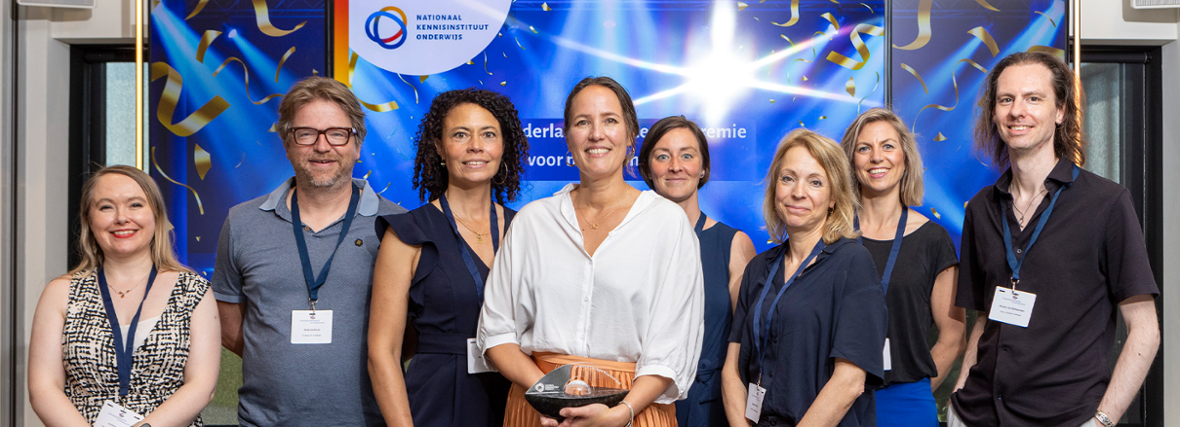
A collaboration led by psychologist Joanne Mouthaan won second prize at the Dutch Education Awards on 25 June. The team will receive €800,000 to develop and implement the National Suicide Prevention Skills Learning Pathway for Psychology Students.
Winning the prize is ‘a massive honour’ for Mouthaan and the team, she says. ‘It’s fantastic news for the project itself, but also for the many people and partners involved. It really is the cherry on the cake.’
The Dutch Education Awards are presented annually to teams from universities of applied sciences, research universities and vocational colleges that have developed an innovative teaching initiative. Minister Rianne Letschert (Education, Culture and Science) presented the prizes at the Comenius Festival.
Leiden’s Executive Board congratulated the team via a live video link. ‘This award is a well-deserved tribute to an exceptional team’, said Rector Sarah de Rijcke. ‘The initiative demonstrates the power of collaboration between degree programmes, institutions and external partners. The impact of this learning pathway extends far beyond education: students have higher levels of competence and awareness as they enter the medical health profession. I wish the team the very best of luck!’
Uncertainty among health professionals
Many health professionals are unsure how to respond to warning signs that a client may be suicidal. ‘That encourages avoidance’, Mouthaan explains. ‘If you don’t know what to do, you’re more likely to do nothing. But then you neglect important responsibilities that are part of your role as a health professional.’
To reduce this uncertainty, the team developed a national training programme that teaches psychology students in bachelor’s, master’s and post-academic programmes how to recognise, discuss and treat suicidal thoughts.
From bachelor to specialist
Six universities have already introduced the learning pathway as an integral part of their curriculum, and two others offer it as an optional module. It has also been incorporated into the postgraduate programmes for healthcare and clinical psychologists. The team also helped adapt the modules for vocational and higher vocational mental health programmes. Twenty-six such programmes now use versions tailored to their learning objectives.
‘This continuous, blended learning pathway offers a blueprint for how study programmes can deliver knowledge and skills step by step in a coherent way that matches each stage of the programme’, says Mouthaan.
Incorporating AI
The team plans to use the prize to strengthen the national network supporting the learning pathway and to continue the impact assessment to explore which skills students acquire. It also hopes to incorporate AI applications into the learning pathway, enabling students to practise with simulated AI patients.
Their ultimate goal goes beyond psychology: ‘Ideally, we want to make this available across all mental health training programmes, so that everyone is trained in line with the guidelines’, says Mouthaan. She is also considering extending it medical training, for example.
National consortium
The learning pathway is the result of the work of a driven national team. It began as an initiative by Leiden psychologist and professor Maartje Schoorl, also lead tutor for the postgraduate programmes, in response to an open letter from clinical psychology professors calling for the systematic incorporation of suicide prevention into the curriculum.
It has since developed through collaboration among psychology programmes from organisations including Leiden University, the University of Amsterdam, Erasmus University Rotterdam, VU Amsterdam, Utrecht University and the University of Groningen. Development was funded by 113 Zelfmoordpreventie through its national suicide prevention scheme. Civil society partners such as Centrale RINO Groep, Ivonne van de Ven Stichting and various mental health services institutions also contributed.
‘This helps prevent each institution from reinventing the wheel’, says Mouthaan, ‘and increases acceptance: people feel that it’s their learning pathway.’
Do you need help?
Are you thinking about suicide, or are you worried about someone else? Talking about it can help. Use the anonymous web chat at www.113.nl or call 113. The service is anonymous and confidential. Is your life in immediate danger? Call 112 immediately.