

Bakels Fund Grant for research into landscape use on Mallorca
Mallorca through time
Letty ten Harkel has received a Bakels Fund grant from the Leiden University Fund (LUF) for a two-year research programme at the archaeological site of Son Sard on Mallorca. The grant will enable her team to carry out geochemical and geomorphological research into the development and use of the landscape through time.
Villa system
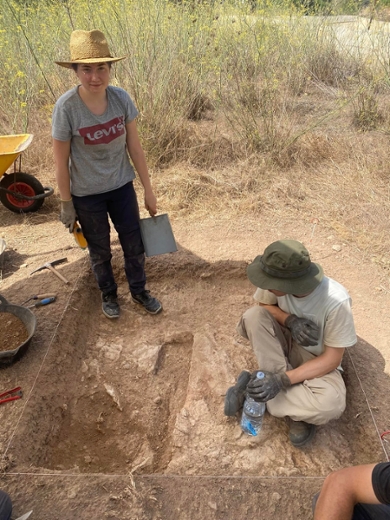
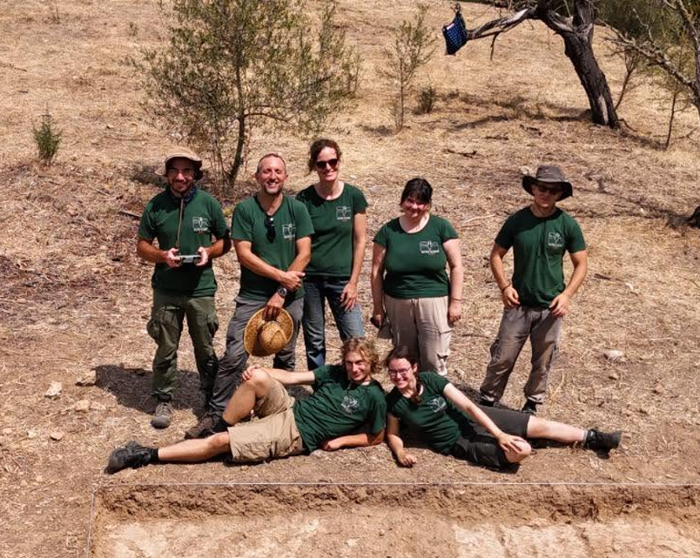
The research builds on the field school that has been taking place at the site for several years. Since excavations began in 2023, the team has focused on an area surrounding a Roman bathhouse, the first ever discovered in a rural context on Mallorca.
‘It was assumed that the bathhouse was associated with a villa, and we wanted to verify that,’ says Ten Harkel. ‘Very little is known about the villa system in Mallorca, so this offers a unique opportunity to investigate it further.’
A complex site
The site soon proved to be more complex than expected. In the very first year, remains from several different periods were uncovered: alongside the Roman context, the team found an Andalusian-Islamic cemetery dating to the eleventh and twelfth centuries, as well as evidence of prehistoric cave occupation.
‘That is what makes the project so special,’ says Ten Harkel. ‘It allows us to develop a diachronic perspective, whereas much archaeological research in Mallorca tends to focus strongly on a single period.’
This broad chronological scope is particularly relevant because both the Roman and the Andalusian-Islamic periods were characterised by significant changes in land use. The research aims to provide new insights into the role of Son Sard within these developments in the eastern part of Mallorca.
Challenges
The project also faces practical challenges. Due to declining groundwater levels—a well-known issue in tourist regions across the Mediterranean—organic remains at the site have been poorly preserved.
‘As a result, traditional methods yield less information. Animal bones and plant remains have often disappeared entirely or have been severely degraded.’
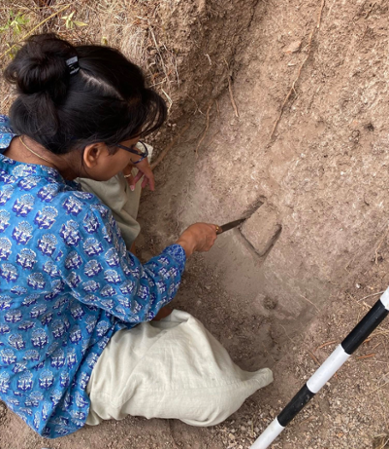
The grant makes it possible to apply new analytical techniques. One component of the research focuses on geomorphological analyses of deposits in the dried-up riverbed that runs through the site. These deposits act as a kind of time capsule, preserving evidence of changes in climate and landscape use. By taking so-called block samples and studying thin sections under the microscope, researchers can reconstruct how these layers were formed.
In addition, the team is conducting geochemical analyses of soil samples to identify trace elements. This makes it possible to distinguish between natural and anthropogenic deposits and, for example, to identify areas associated with food preparation or animal husbandry.
Research and Education
The new methods will be directly integrated into the field school, allowing students to gain hands-on experience with these techniques.
‘These methods are still rarely applied on Mallorca,’ says Ten Harkel. ‘It is extremely valuable for students to encounter them during their studies. It shows them just how many exciting and innovative possibilities archaeology has to offer.’
The project, entitled Secrets of the Soil (SOTS): Geoarchaeological Analyses and Land Use at Son Sard, Mallorca, is, like the field school, a collaboration between Letty ten Harkel, Ritchie Kolvers and Antoni Puig Palerm. The field school has been supported for several years by the Municipality of Son Servera and the artist residency Can Pep Nebot, as well as by an earlier LUF grant from the Chastelain-Nobach Fund.