
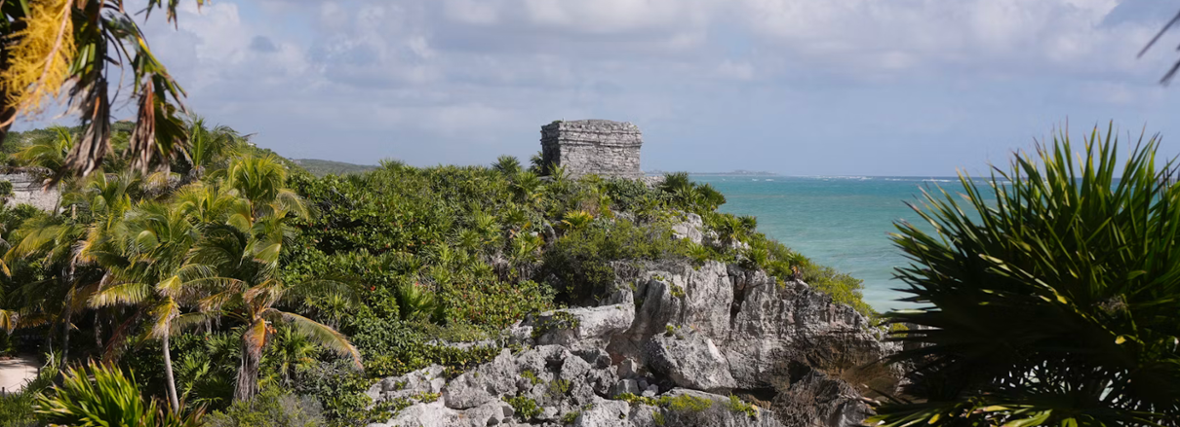
Archaeologist calls for Central America to be studied as a whole: ‘Borders have taken on a life of their own’
Inaugural lecture image: Laslo Ovegas
In his inaugural lecture, archaeologist Alex Geurds argues that Central America should no longer be divided into separate research areas. He believes that bringing regions together improves our understanding of migration, interaction and identity formation, both in the past and today.
In the 1940s, German anthropologist Paul Kirchhoff drew up a list of cultural characteristics and drew an imaginary boundary from northern Mexico to the Nicaraguan border. This cultural-historical region came to be known as Mesoamerica. The area to its south, extending as far as Colombia, has since been referred to by a range of different names. ‘Those borders have taken on a life of their own’, says Alex Geurds. ‘They largely determine which researchers and research institutions engage with one another and which ones don’t.’
He sees this as a tremendous loss because there has been extensive interaction between these regions. Rather than focusing on borders, he calls for these regions to be seen as a whole: Central America. ‘By bringing regions together, you can study how people in the past actually moved and interacted with one another.’
‘Significant’ shift
Geurds conducted his PhD research in the Mexican state of Oaxaca before making a ‘significant’ shift southwards to carry out fieldwork in Central America. ‘There proved to be far more archaeological links than you might expect.’ Above all, he noticed that contemporary schools of thought had little interaction with one another.
A concrete example of these connections between seemingly separate regions can be seen in human migration and cultural exchange. Language, material culture and ideas from Mesoamerica spread across great distances. ‘Linguists have found that languages from central Mexico appeared in Central America around 9 AD. You can also see archaeological echoes of this. Motifs occur on multicoloured pottery in areas where they had not previously been found. This pottery features complex iconography and symbolism from Mesoamerica.’ Geurds believes this shows that cultures define themselves through continuous interaction and interconnection.
Through his chair in Central American archaeology, Geurds hopes to bring together researchers from different regions and disciplines, including through new research projects and collaborations among archaeologists, linguists and historians.
Evolving identities
This broad perspective on the past is relevant to contemporary debates on migration and relationships between human communities. ‘Today’s world is strongly focused on borders and fixed identities. The past, the domain of archaeology worldwide, shows us that identities are constantly evolving. They are shaped by where you live, the time in which you live and your relationships with others. Archaeology also shows that identities themselves are always in motion. If you look back through time, you’ll see that attempting to rely on some sort of rigid core of identity is futile. Changes in identities sometimes speed up and sometimes slow down.
‘I think we are now living in a time in which this change is speeding up. The lesson from the past is that people move if they have good reason, for example, better living conditions or to save their lives. We see that now across Central America. And with it come friction and acceleration. Why should we assume that this will no longer happen, just because people now carry passports that tie them to a particular country?’
Inaugural lecture
Alex Geurds will give his inaugural lecture Beyond borders: Toward an archaeology of Middle America on Monday 15 June (16:00-17:00) in the Academy Building in Leiden.