
Whose voices count in AI risk assessment?
The lecture series 'Humanity in the Automated State' concluded on 26 May 2026 at Leiden Law School with its closing lecture by Professor Natali Helberger from the University of Amsterdam.
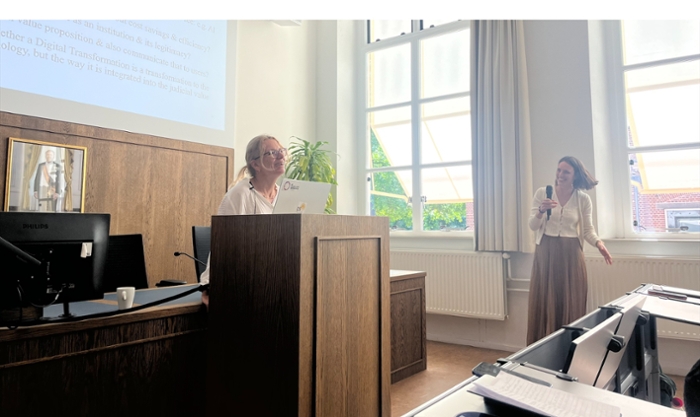
Professor Helberger is Distinguished University Professor of Information Law and Digital Technology at the University of Amsterdam, a member of the Executive Board of the Institute for Information Law (IViR), and an elected member of the Royal Netherlands Academy of Arts and Sciences (KNAW). Her research focuses on how AI and algorithmic decision systems are reshaping society and what their implications are for law and governance. She is the founder and co-director of the AI, Media & Democracy Lab and the AlgoSoc (Public Values in the Algorithmic Society) Gravity Consortium, and regularly advises the European Commission, European Parliament, Council of Europe, and national regulators and civil society organisations.
In her lecture, 'From Metrics to Lived Realities: Sci-Fi Prototyping as a Method to Conduct AI Risk Assessments', Professor Helberger examined a foundational tension in contemporary AI governance: that risk assessments are typically conducted within the companies developing AI systems, and rarely in dialogue with the citizens at the receiving end of automated decisions. She argued that this insider orientation leaves the lived experiences and normative expectations of affected people largely invisible in the risk assessment process.
To address this gap, Professor Helberger presented a participatory risk assessment method developed at the University of Amsterdam as part of the CASMI project, which uses sci-fi prototyping and narrative creation as tools for surfacing how people actually experience and anticipate the impact of AI and automated decision-making. Rather than measuring risk against predefined metrics, the method invites participants to construct stories and scenarios, drawing out the tacit knowledge, concerns, and expectations that standard assessment frameworks tend to miss. Professor Helberger presented the method’s design and reported on findings from its application, illustrating both its practical potential and the conceptual challenges of translating narrative knowledge into governance-relevant insights.
The lecture offered a fitting close to a series that has consistently foregrounded the human dimension of algorithmic governance: what it means to be subject to automated systems, and how those subject to them can meaningfully participate in shaping them.
The lecture series, organised by Dr Melanie Fink (Europa Institute) and Dr Daria Morozova (Department of Business Studies), is funded by the Dutch Research Council (NWO) under the VENI grant 'Gateways for Humanity: The Duty to Reason in the Automated State' and supported by Leiden Law School’s research focus area 'Technology, law, and justice'. Over the course of the 2025/2026 academic year, the series brought together scholars from law, management, public administration, and computer science to examine how algorithmic governance reshapes human relationships with public authority. Speakers included Christine Moser (VU Amsterdam), Aya Rizk (Linköping University), Sofia Ranchordás (Tilburg University/Luiss Guido Carli), Madalina Busuioc (VU Amsterdam), Mengchen Dong (Max Planck Institute for Human Development), Ida Koivisto (University of Helsinki), and Natali Helberger (University of Amsterdam).
The series is accompanied by a Blog Post Symposium on The Digital Constitutionalist (DigiCon), which will be published as a DigiBook in June 2026. The Symposium gathers fourteen contributions from scholars across law, management, public administration, computer science, and adjacent fields, organised into four thematic clusters: human oversight and its limits; accountability and control mechanisms; justice, courts, and legal protection; and dignity, surveillance, and the human subject.
For more information about the lecture series, visit the website Lecture series: Humanity in the Automated State.