

From Liquid Helium to Quantum Materials: Physics in Leiden, Then and Now
PHYSICS
To mark Leiden University’s 450th anniversary, this exhibition pairs historic photographs with contemporary research. Seven ‘Then & Now’ diptychs show how the Institute of Physics blends a rich past with cutting‑edge science.
Below you will find a description of each of the photographs (diptychs).
___________________________________________

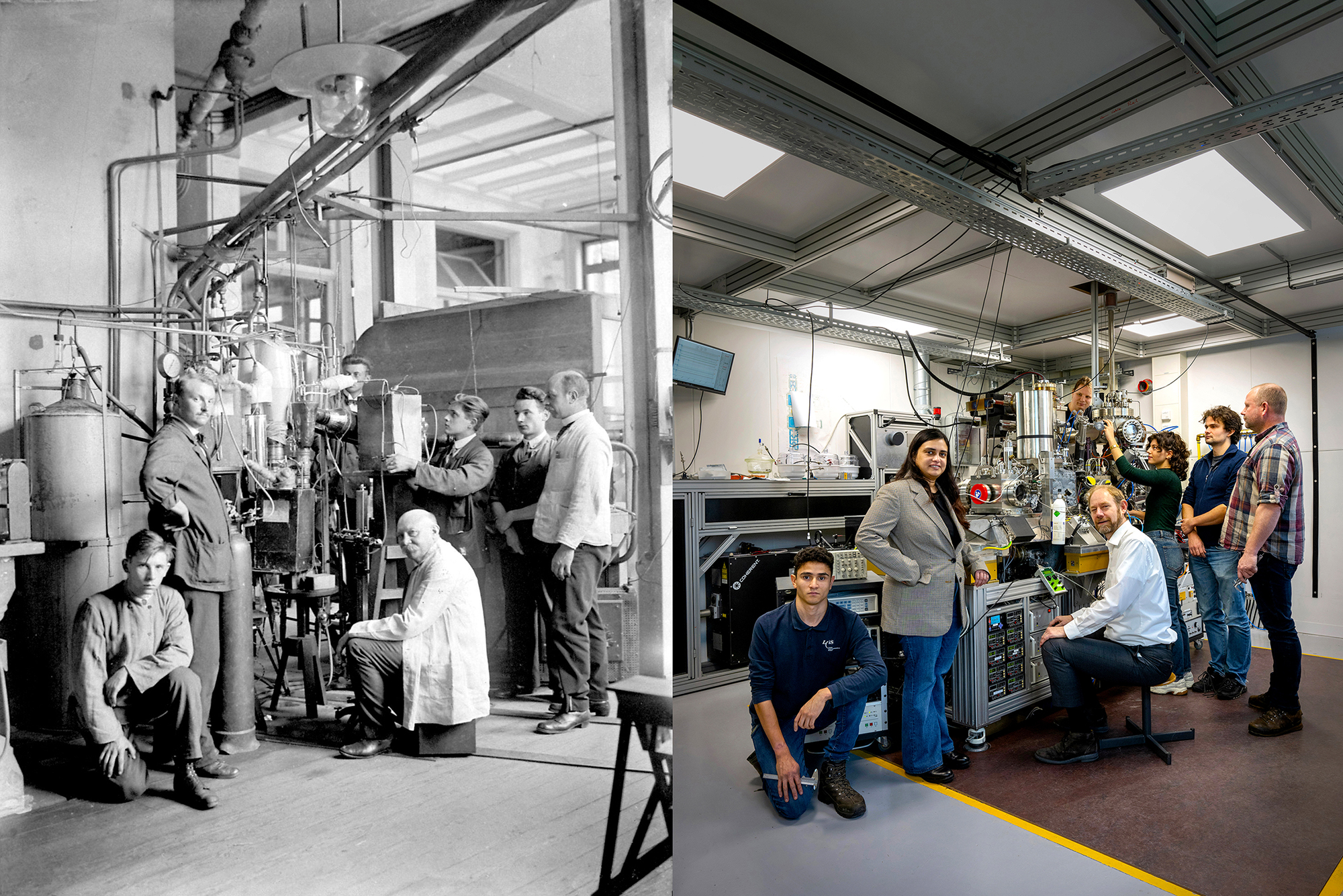
Around 1913: The first liquid helium: Kamerlingh Onnes' breakthrough
Physicist Heike Kamerlingh Onnes (sitting in the middle) used this setup to make helium liquid for the first time, at extremely low temperatures. He was awarded a Nobel Prize for this in 1913.
This photo shows that achieving remarkable results is truly a team effort: a unique collaboration between research staff, instrument makers, physics students (wearing a tie) and students from the LiS (first on the left). They worked side by side in the labs.
Now: Quantum Materials research
Leiden physicists Semonti Bhattacharyya and Sense Jan van der Molen use instruments such as this low-energy electron microscope (LEEM) to study the exciting electronic properties of ‘Van der Waals materials’ and ultrathin molecular layers. Just like in 1913, they train students and PhD candidates, and work closely together with instrument makers like Christiaan Pen of the Fine Mechanical Department.
___________________________________________
Then: Kamerlingh Onnes and the instrument makers
Before 1880, physicists constructed their own measuring instruments. Research could not progress effectively this way, according to Kamerlingh Onnes. In 1882, appointed professor of Experimental Physics, he quickly brought in technically skilled craftsmen from abroad. He asked them to teach talented young people in Leiden to become expert instrument makers.
Recognizing that his research greatly benefited from collaboration within a multidisciplinary team, this initiative ultimately led to the establishment of the Leiden Instrumentmakers School in 1901.
Now: Leidse instrumentmakers School (LiS)
LiS students learn to design, create, improve and manufacture (research) instruments.
The program includes training in metalworking, mechatronics and 3D printing, and offers opportunities to specialize in the field of glass. LiS even provides customised programmes at all levels under the name ‘LiS voor Werkenden’ (LiS for Working Professionals).
The school and the Leiden Institute of Physics still have a warm relationship.
___________________________________________

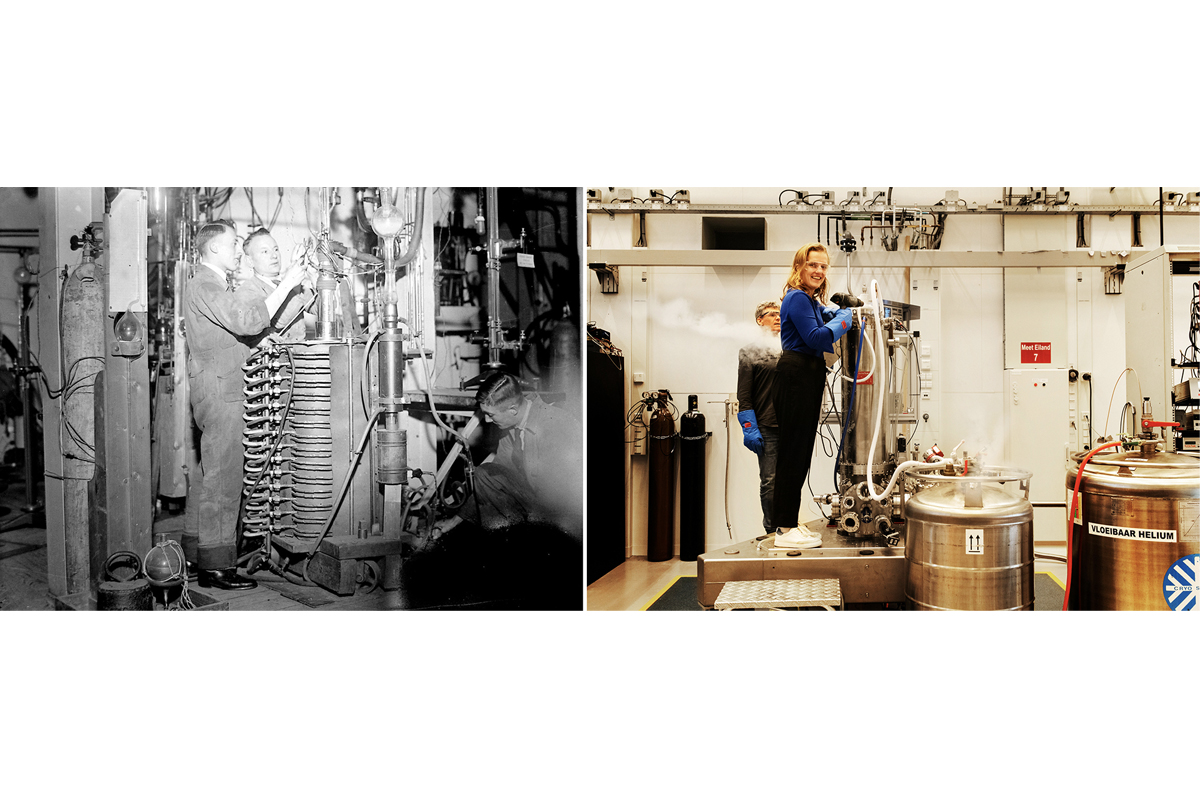
1944: Refilling a helium cryostat
The physics laboratory in Leiden became the ‘coldest place on Earth’ in 1908. Helium was first liquefied there under the direction of Heike Kamerlingh Onnes. Three years later mercury became the first metal to be cooled to the superconducting state at 4 Kelvin. Today, superconductivity makes many electrical technologies possible, including Magnetic Resonance Imaging and high-energy particle accelerators.
Now: Superconductivity research
Every week PhD-candidate Amber Mozes refills this Scanning Tunneling Microscope (DT-STM) with liquid nitrogen and liquid helium, to perform her research on the nanoscale properties of superconductors.
Wilfred van der Geest is the technical project staff member of Leiden Institute of Physics. He single-handedly manages the cryogenics department. ‘My challenge is to make sure that liquid helium is available to researchers any day, any time. I’m proud to say that I have never had to shut down a research setup.’
___________________________________________

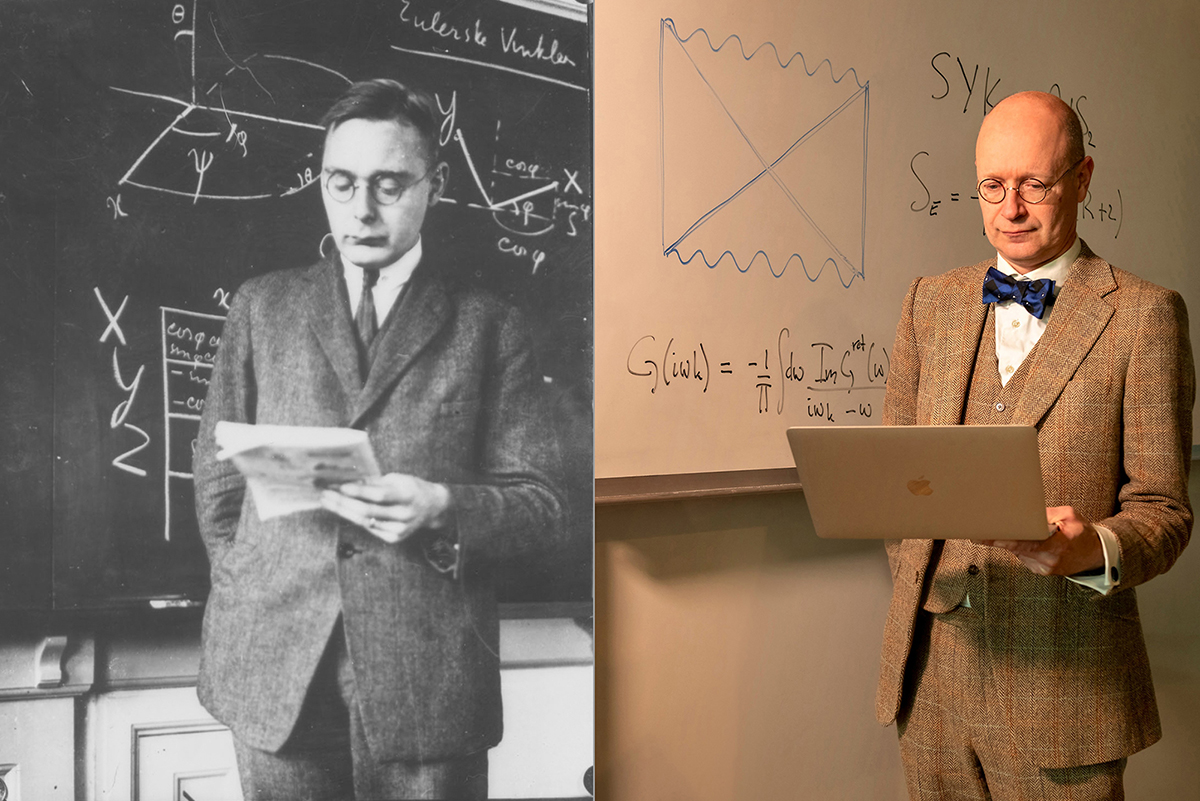
1934: Theoretical Physics
Hendrik Anthony Kramers (1894–1952) succeeded Ehrenfest as Professor in Theoretical Physics in 1934. His name invites comparison with Hendrik Antoon Lorentz, whom Ehrenfest had succeeded twenty years earlier. Kramers was mathematically very strong and successful; he has three equations to his name that are used by physicists worldwide today. This photo was taken in the Lorentz Hall of the Kamerlingh Onnes Building.
Now: Exploring the building blocks of the universe
Koenraad Schalm is one of the seven Professors in Theoretical Physics at the Institute Lorentz. Just like Kramers, he provides mathematical explanations for observed phenomena in physics. Schalm focuses on identifying signatures of string theory.
He draws on data from observations of the cosmos as well as from experiments using particle colliders and new exotic materials, to connect theory to experiment to explore the deepest mysteries of physics. The equation in black is a part of the Kramers-Kronig relation, written down by Kramers and Kronig independently in the 1920s.
___________________________________________

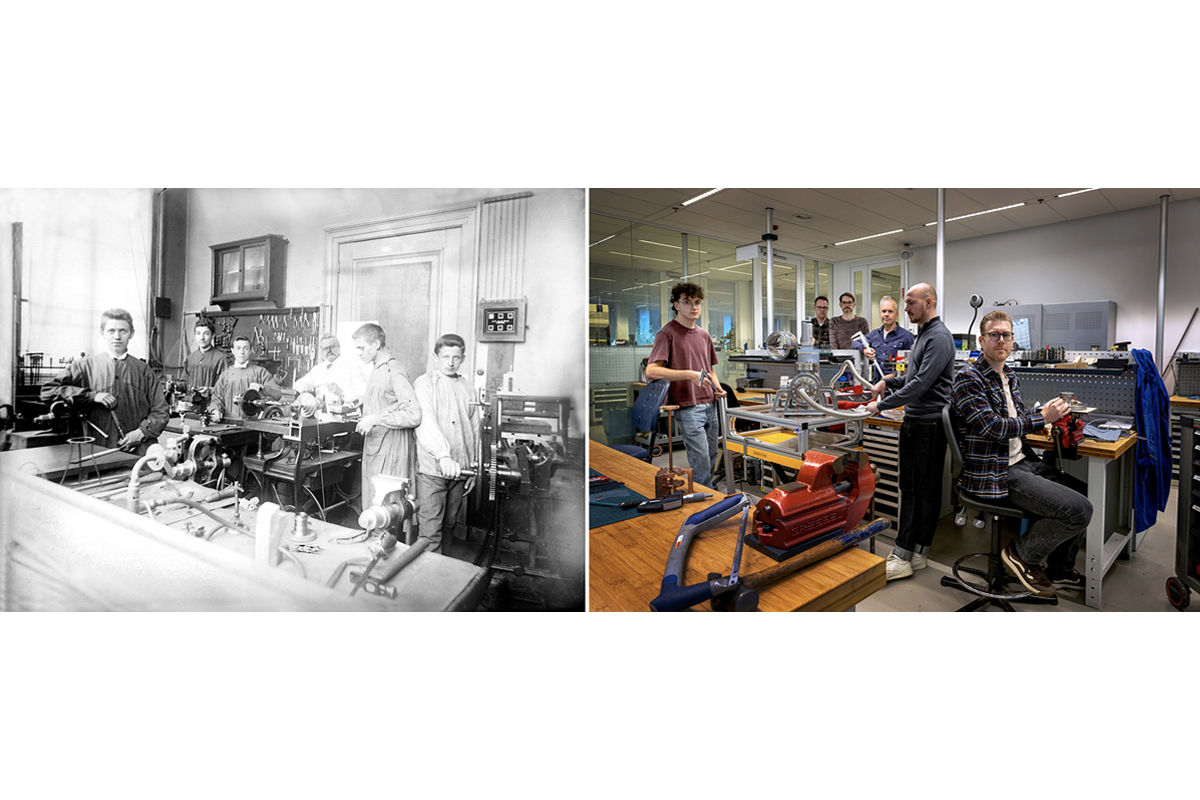
Around 1898: The instrument makers
If you, as a physicist, needed something for your experiments, you would go to one of the instrument makers. Because they wore blue workwear their nickname was ‘The Leiden Blue Guys’. Around 1898, Kamerlingh Onnes in Leiden was supported by a small but highly skilled group of instrument makers and glassblowers, including the young instrument maker Gerrit Flim, who went on to become one of his most important technical collaborators.
Now: The Fine Mechanics and Electronics Department
Physicists still work closely together with instrument makers to design and perfect their research setup. Their measurements often take place under very specific conditions: e.g. more precise than ever before, in a vacuum or at temperatures near absolute zero. Elements of the desired setup that are not for sale are designed and produced in the state of the art workshop at Leiden University.
___________________________________________

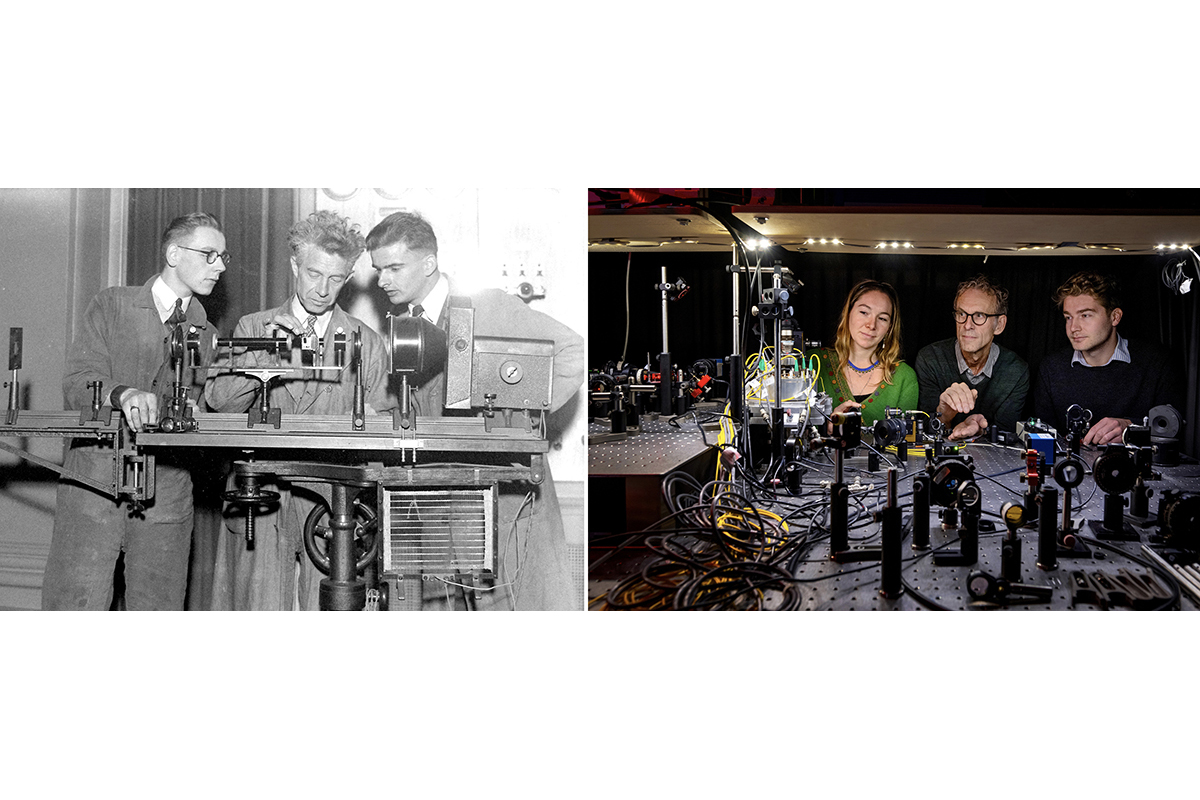
1902: Leiden Optics received Nobel prize
In 1896, Pieter Zeeman discovered that a magnetic field changes the color of emitted light in a subtle way. This effect, now called the Zeeman effect, confirmed Hendrik Lorentz’ theory about electrons and atomic structure. In 1902, they received the Nobel Prize in Physics for these groundbreaking results.
As you can see in this photo from around 1940, researchers at the time wore lab coats and overalls in the optics lab. By fixing a certain combination of lenses, polarizers and a sample on a rail, they manipulated and shaped a single beam of light.
Now: Towards an optical quantum computer
Nowadays, optics experiments use an entire table. In this experiment, tiny mirrors trap light emitted by single atoms, allowing us to control it with astonishing precision. Our Leiden team of researchers might be the first to fully understand this optical trapping process in all its details.
The observed spatial and polarization structure of the trapped light confirms subtle effects predicted by the theory of electromagnetism originally formulated by James Clerk Maxwell. By controlling single atoms like this, we are taking the first steps toward building an optical quantum computer – a technology that could change the future of computing.
___________________________________________

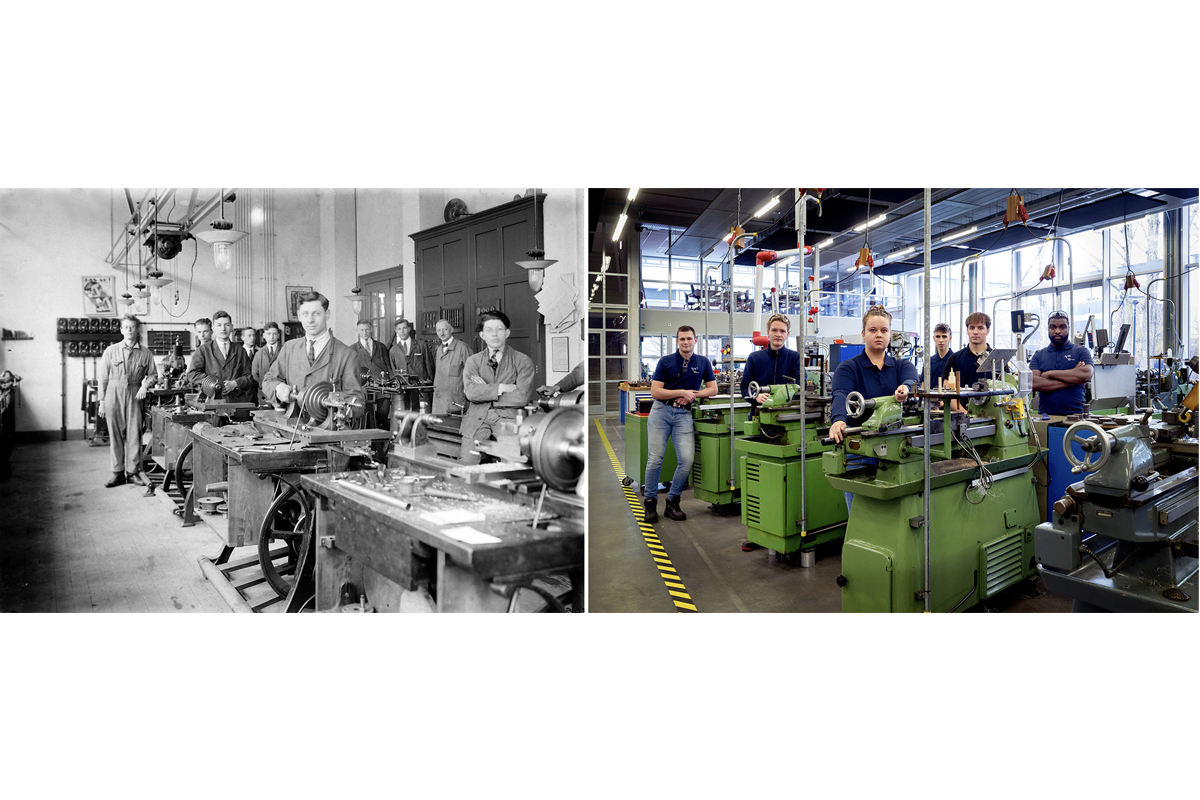
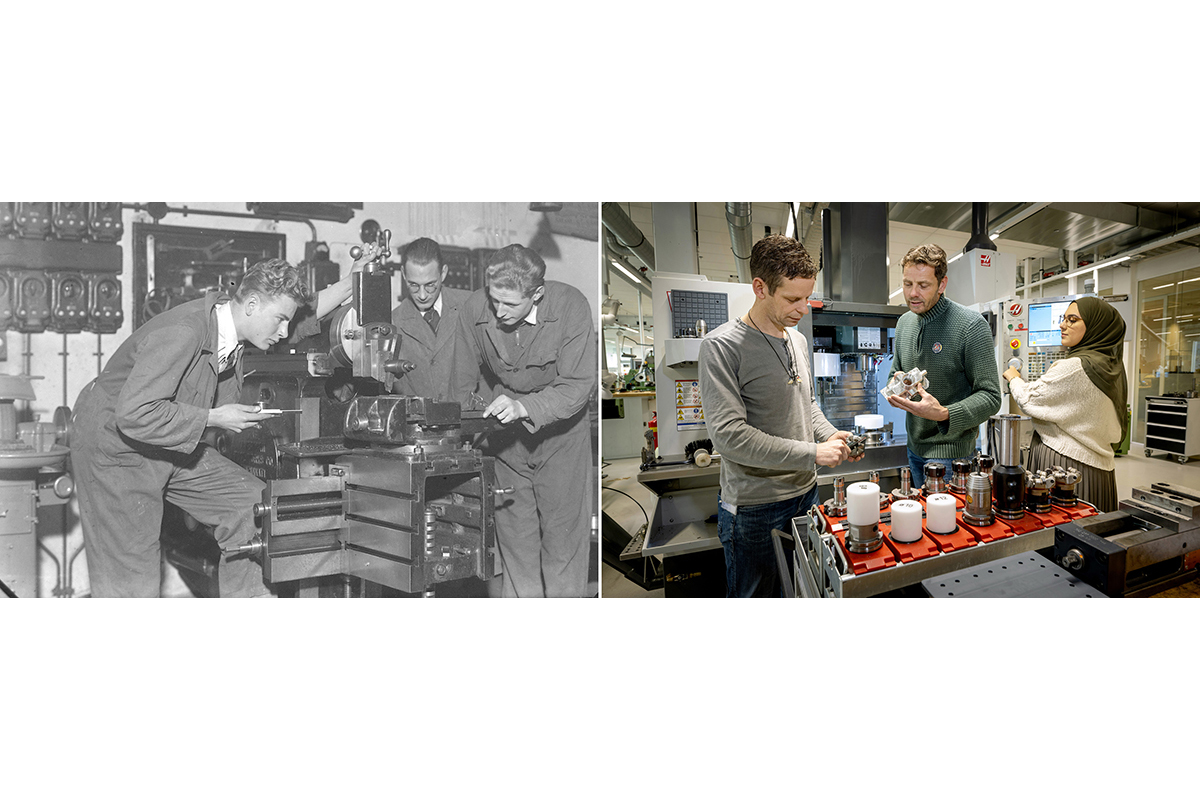
1944: Shaping, milling and turning
This machine is a metal shaper, used by instrument makers to produce extremely flat metal surfaces in a single dimension. They were the most important machines for producing precise flat surfaces before milling machines became commonplace.
Now: Creating complex 3D shapes with nanoscale precision
Today, milling machines are computer controlled and capable of producing highly complex 3D shapes with micrometre precision. Instrument makers work with a wide range of materials such as metals, ceramics, and electronic components to build custom research instruments with nanoscale precision.
Together with researchers from across the Faculty of Science, they turn scientific ideas into instruments that enable groundbreaking research.