
90 years of labour law in Leiden: Evolving with the times
Anniversary
Labour law professors have shaped research and education in Leiden since 1936. From the rise of trade unions to the AI revolution, the field has constantly evolved. Major changes are on the horizon again in 2026. 'Labour law will always be important.'
'Ninety years ago, the world was very different from the one we know today,' says Paul van der Heijden, former rector magnificus and emeritus professor of international labour law. He points to the Industrial Revolution, which started in England in the late 19th century and subsequently spread to the Netherlands. 'Around 1900, the first trade unions started to emerge in the Netherlands, laying the foundation for labour law here.'
Long tradition
On 14 February 1936, Hugo Sinzheimer, the founding father of labour law in Germany, delivered his inaugural lecture in Leiden. This marked the creation of one of the first labour law chairs in the Netherlands, and it was the start of a long tradition culminating in the 90th anniversary this year. Following in the footsteps of Sinzheimer, professors Molenaar, Van Esveld, Rood, Heerma van Voss and, since 2026, Erkens, have held the full-time chair. In addition, there were and still are a number of part-time chairs for specific areas within the field.
‘The essence of labour law has always been the principle that employers and employees do not occupy an equal economic position,’ Van der Heijden continues. ‘Employers control the means of production and have access to the entire labour market, whereas employees face them as individuals.’ Based on this principle of inequality, labour law aims to correct that imbalance in power and to enable employees to negotiate with their employers on a more equal footing. ‘This is particularly true in the context of collective labour agreements and trade unions, where strength of numbers allows employees to put forward their demands.’
No standard Leiden approach
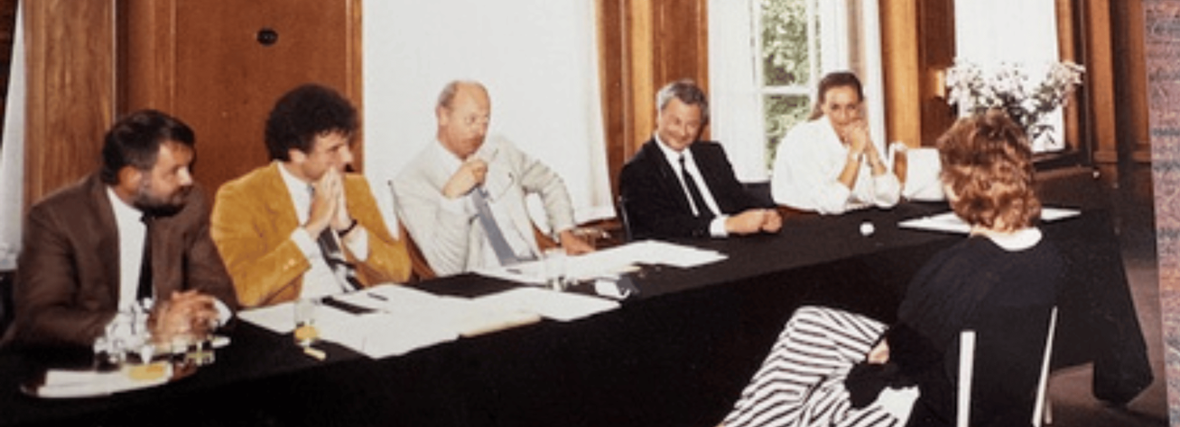
It was precisely this principle of compensating inequality that prompted former assistant professor Lydia Schut to specialise in labour law. ‘The factor of labour and the countervailing powers that play such a major role in labour law appealed to me,’ she says. In 1983, she joined the Department of Labour Law as a student assistant. At the time, the department was still located on Hugo de Grootstraat. ‘We held our weekly department meetings in the Van Esveld Library – a small, dusty room. Of Course, we were a lot smaller than departments such as Civil Law or Constitutional and Administrative Law. But we did have a prominent place in the first-year curriculum.’
Two and a half years after graduating, Schut returned to the department in 1988. She says this had everything to do with Max Rood. ‘He was a brilliant lecturer who challenged me and kindled my passion for labour law.’ Yvonne Erkens, Professor of Labour Law, also mentions Rood as an important source of inspiration. ‘He had tremendous presence and an impressive command of the subject, yet he could explain everything in simple language. That’s a lesson I’ve carried with me: explain things clearly and don’t hide behind fancy words or jargon.’
Still, Erkens says, there is no standard Leiden approach when it comes to teaching labour law. ‘Since early in the last century, each professor has shaped the subject area in their own special way.’ What her predecessors did share, however, is that they established labour law as an independent academic discipline from the very beginning.
International orientation
And, according to her, the department has certainly succeeded in this over the past decades. ‘Labour law has a clear presence in Leiden, thanks in part to our dedicated master’s programme, our strong international orientation in both research and teaching, and our growing interdisciplinarity,’ Erkens explains. ‘In recent years, that international perspective has pushed us to focus even more on broader issues such as sustainability, corporate social responsibility, and the digital revolution.’
Van der Heijden also mentions the establishment of a dedicated master’s programme as an important milestone. ‘We’ve had our own master’s for nearly 15 years now, which allows us to spend an entire year exploring labour law intensively with students and from a range of perspectives,’ he explains. ‘This in-depth approach gives the teaching an added dimension and helps create an active, closeknit group of students, many of whom return later as alumni for post academic courses.’‑depth approach gives the teaching an added dimension and ‑knit group of students, many of whom return later as alumni for post‑academic courses.’
Turning point
Although labour law in Leiden is reflecting on 90 years of experience, Van der Heijden, Schut and Erkens all agree that we are living in exciting times. ‘I think we’re at a turning point,’ Erkens says. ‘We’re on the brink of far-reaching transformations in labour law. Think of climate issues, digitalisation, the AI revolution, and collective systems that are under pressure.’ The professor expects these changes to profoundly change the labour market, the way we think about work, and our collective systems and structures.‑reaching transformations in labour law. Think of climate
‘Virtually all the core components of labour law have come under pressure over the past two decades,’ Van der Heijden adds. ‘For example, the majority of employees used to be covered by a collective labour agreement, but as a result of individualisation and flexibilisation in society, that’s no longer something we can take for granted.’ The emeritus professor says that we can no longer rely on the certainties of past decades. ‘Everything we assumed for decades is now being questioned. And that’s precisely what makes the academic side of labour law so fascinating these days.’
Labour law affects us all
Ninety years ago, one of the first chairs in labour law in the Netherlands was established in Leiden, with the aim of putting the field firmly on the map. In the decades that followed, various professors left their mark on both the development of labour law as a discipline and its teaching. Thanks to their efforts, the chair, the associated master’s programme and the Department of Labour Law – which, besides labour law, also focusses on social security law – have now become a central point of reference within the national and international field of expertise.
‘Labour law will always be important,’ Erkens says. ‘We all encounter it at some point in our lives, whether you work, become a parent, or depend on social benefits. It is this far-reaching impact on everyday life that will ensure the continued relevance and importance of the field.’‑reaching