
What could bring about change in Iran?
Current affairs image: ANP
With ongoing protests across Iran, many are asking whether the regime is on the brink of collapse. What sparked the protests, what do Iranians want and what is needed for political change? Three Leiden experts share their perspectives.
What sparked the Iran protests? ‘The economic situation was the final straw’, says Gabriele van den Berg, an expert on the cultural history of Iran. ‘International sanctions have left the Iranian people in a very vulnerable position. Many don’t know how to make ends meet.’
The unrest builds on long-standing frustrations. For decades, the Islamic Republic has struggled to deliver on its promises of prosperity, justice and freedom. Nor has it proven capable of guaranteeing national security, as the recent 12-day conflict with Israel demonstrated. Meanwhile, people feel increasingly unsafe in their daily lives. Street robberies and other incidents contribute to this, says Babak RezaeeDaryakenari, who researches geopolitics, political power, protest and repression in authoritarian systems, with a particular focus on Iran.
What do the people of Iran want?
Van den Berg follows developments in Iran closely and keeps in touch with Iranian acquaintances abroad. She finds it difficult to say what the people of Iran want because of widespread disinformation and deep divisions in this huge country. ‘Even my contacts disagree’, she says.
Speaking both as a scholar and from personal experience, having himself taken to the streets of Tehran in 2009, RezaeeDaryakenari notes, ‘At the time, we wanted constitutional reform and respect for the rule of law. Since then, in each protest – in 2018, 2020 and 2022 – you see more of a voice against the Islamic regime and its fall. The people don’t want reform. What they want now in 2026 is a change of system.’
Pathways to a new system
Looking at the situation today, Ab de Jong (an expert in the religious history of Iran) thinks the regime is likely to survive this round of protests. ‘But this won’t go away. We don’t know what’s happening behind the scenes around Ayatollah Khamenei, the Revolutionary Guard [the elite military force under Khamenei’s direct command] or within the president’s circle. It wouldn’t surprise me if the balance of power is shifting. The president and the Revolutionary Guard may be exploring ways to reduce the Supreme Leader’s [Khamenei] influence.’
He also expects the regime to lean more heavily on nationalism, asserting that it alone can protect Iran’s territorial integrity and that Islam is an intrinsic part of Iranian identity. ‘The regime consistently stirs up the fear that without them, Kurd, Arab, Baluchi and Turkmen minorities would tear the country apart. I hear this fear echoed by Iranian students here as well.’
Hopes for change
RezaeeDaryakenari, who studies political transitions, sees several scenarios that might facilitate or hinder a transition to a new system.
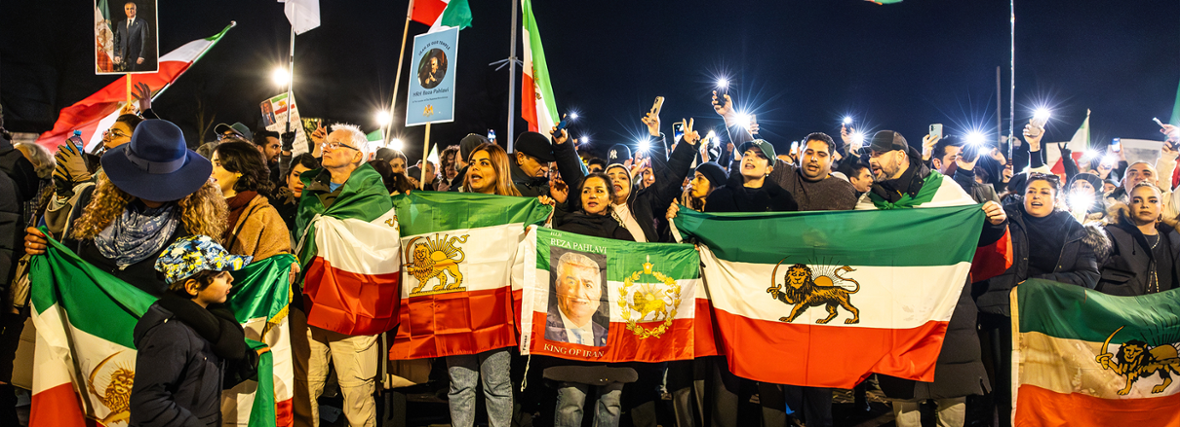
What could help is that many Iranians have lost confidence in the Islamic Republic. ‘Our data [from yet-unpublished research] shows that people have hope for change. They are proud of this change that they are making, so the determination is there. At the same time, they fear repression.’ A notable shift, he adds, is that for the first time in 47 years, people are rallying behind one figure: Reza Pahlavi, the son of the Shah deposed in 1979.
What stands in the way of change?
The harsh and repressive regime remains a major obstacle. Complicating matters further, European states, the United States and neighbouring countries keep trying to influence Iran’s leadership through diplomatic negotiations. ‘They still think there is hope that this regime will be reformed and behave like a normal sovereign state’. says RezaeeDaryakenari. ‘But that hasn’t worked for 47 years.’
What does he think countries should do instead? Put the highest level of pressure on Iran’s repressive apparatus: the Revolutionary Guard. ‘Designate it as a terrorist organisation, as Australia and the United States have done. Impose sanctions on top officials and their families in the EU, and limit them as much as possible. Enough is enough – you can’t kill your people and refuse to listen to them. This behaviour should not be tolerated.’
Why other countries must listen to the Iranian people
According to RezaeeDaryakenari, the international community must pay attention to what is happening on the ground. ‘Research on successful civil resistance movements in authoritarian contexts shows that such movements often unite temporarily around a single recognisable figure. The slogans from inside and outside Iran indicate that this dynamic is emerging. For many demonstrators, Prince Reza Pahlavi serves as a focal point during the transition, especially in guiding the process towards ending the Islamic Republic and initiating a democratic referendum. This should not be interpreted as a predetermined choice for Iran’s future political structure. Pahlavi himself stresses that the people must decide in the referendum.’
While many view Pahlavi as the figure for the transitional period, Van den Berg also hears more critical voices. ‘He hasn’t lived in Iran since the age of 17, and for years, people felt he couldn’t do much from abroad. But we don’t know what might happen now.’ De Jong adds: ‘If the regime falls, he might emerge as someone who could help guide the transition to a new political system that Iranians themselves would choose. That seems sensible.’
Photo above the article: Solidarity march for Iran at Dam Square in Amsterdam. ANP
Support for students and staff
Are you from Iran, or are you deeply affected by the situation there? The university understands the strain this may place on your well-being, work or studies. Visit our website to find out what support is available to you as a student or member of staff.