

'On 1 January I’ll quit for good!': Can you visualise your way out of a smoking addiction?
Behaviour change image: Canva
A million people in the Netherlands attempt to quit smoking each year, often without lasting success. Health psychologist Kristell Penfornis carried out doctoral research into the role of self-image in smoking cessation. “If smoking is normal in your social circle, it more easily becomes part of your identity.”
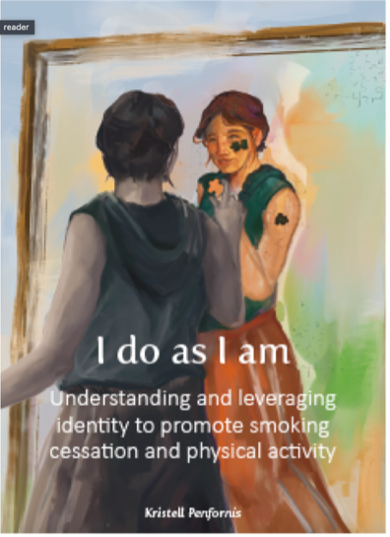
A woman with an ashen complexion in a grey hoodie stands in front of a mirror. Her reflection smiles back, glowing with health. Two puzzle pieces are missing from her upper arm and cheek; one of the missing pieces is held in her hand. The cover of health psychologist Kristell Penfornis’s thesis visualises the central question of her research: what role does changing our identity play in shifting persistent habits such as smoking and low physical activity? On 4 December, she defended her thesis, I do as I am: Understanding and leveraging identity to promote smoking cessation and physical activity.
Less smoking, more movement
'Smoking and exercise are fascinating behaviours to study,' Penfornis explains. She now works as a postdoctoral researcher at LUMC. 'People often want to quit one and increase the other. The habits also influence each other. When you smoke less, it becomes easier to be physically active – for instance, because your breathing improves. The reverse is true as well: people who exercise more often find they have less urge to reach for a cigarette.'
Quitting often fails
Yet although 80% of smokers say they want to quit, and more than a million people make an attempt each year, many smoking cessation programmes prove ineffective in the long term. 'There are plenty of options – group support programmes where smokers meet and receive guidance, apps, one-to-one counselling and medication. But why an attempt fails often depends on the individual and their circumstances,' Penfornis explains. 'High levels of stress make it difficult to break a habit that’s so deeply rooted. Someone who is unemployed, for example, may simply have other priorities at that moment.'
Roken als identiteit
Smoking cessation is so difficult partly due to the addictive nicotine it contains; cigarettes are engineered to make you as dependent as possible. 'Some people are more susceptible to this than others. Many first-time smokers find the taste unpleasant, but the release of serotonin and dopamine still creates a positive feeling,' Penfornis explains. 'Whether or not someone becomes – and remains – addicted also depends on their social environment. If smoking is normal in your social circle, it more easily becomes part of who you are, and you integrate it into your identity more quickly.'
Penfornis therefore set out to examine the role of identity – all the answers to the question “Who am I?” – in changing health behaviours. Can shifting how you see yourself help you change what you do? And can visualisation support that process?
Mental image of the future
Around a hundred smoking participants took part in a future self-intervention, carried out on their own computers. 'In this intervention, they visualised their future selves as both a smoker and a non-smoker, and we asked them to capture those futures in words and images. A mental image is often more powerful than text alone. Some participants, for example, used a picture of a yellow balloon with a smiley face to represent a smoke-free future, while others pictured someone hunched over in a dark corner after imagining a future in which they continued to smoke.'
Visualisation
Participants also completed a visualisation exercise in which they vividly imagined their future selves as both a smoker and a non-smoker. 'We know that visualisation works well for athletes. Olympic competitors, for example, often mentally rehearse crossing the finish line. The effects of visualisation have been studied far less in smokers, but we believe it could be beneficial in a similar way,' Penfornis explains. 'Specifically, we asked participants to compare a mental image of themselves still smoking in ten years’ time with a smoke-free future, and then ask: which of these two versions of myself do I actually want to become?'
Confronting
Useful, but sometimes emotionally intense and confronting – this is how some participants described their experience with the visualisation exercise. 'It makes you realise: I’m not heading in the right direction,' one participant noted. To avoid slipping into feelings of hopelessness, Penfornis emphasises the importance of reinforcing the belief that change is possible. 'That’s why, in the latest version of the experiment, we end with a built-in positive exercise, where participants visualise how they want their lives to look without cigarettes. People found this genuinely helpful.'
Visualising in the waiting room
Although the future self-intervention was well received, Penfornis’s research showed that its effectiveness was mixed, both in supporting longer-term smoking cessation and in shifting self-image. 'A potential improvement could be to personalise the exercise further, or to encourage people to practise it more often,' Penfornis says. Together with colleagues, she recorded the visualisation exercise in a video. 'This could potentially be used in GP waiting rooms – either in video or audio format – to help patients prepare for a smoking cessation consultation. It may serve as a useful first step towards taking real action.'
4x visualising to quit smoking
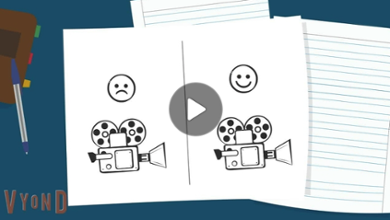
- When you visualise, you create a film in your mind. Research shows that mentally rehearsing change can be an effective way to support behavioural shifts. By picturing what it will be like for you to have quit smoking and become more physically active, you begin to adjust to that future identity. You clarify exactly who you do – and do not – want to become. This can boost your confidence and spark motivation to make those changes.
- Sit somewhere quiet and look ahead or close your eyes. Visualise what your life might look like one year from now if you continue smoking and moving as you do today. How does that future look? How do you look? How does your body feel? How do you feel in yourself? Then, visualise what it might be like if you have quit smoking and become more active. Again, turn this into a mental film. How do you look? Are you the same, or different from before? What are you doing? How do you feel and what are you thinking? Does this new version of ‘you’ align with who you want to be and what you value most in life?
- Now compare the two mental films. Take a pen and paper and write down the differences and any similarities. Write down which future version of yourself you want to become. Jot down anything that comes to mind.
- Finally, write down one small step you can take today to move closer to your positive future self. For example: “I’ll go for a short walk outside during my lunch break.” Writing down the steps you can take makes the process of change more tangible and concrete.