
Papyrological Institute
Blog Papyrus Questions
What can papyri teach us about antiquity? Students of papyrology in Leiden try to answer questions about life in antiquity aided by papyri from our collection.
How were fever amulets produced in antiquity?
By Maaike van den Berg [translated by Boaz Wessels; edited by Maarten Pieterse]
In a world full of danger, where death could strike at any moment, there is nothing you would not do to protect yourself. It is the fifth century CE and we find ourselves situated in Egypt. There are a lot of diseases, and little is known about healing them. In particular, malaria is a common occurring sickness, which can lead to serious health problems. Where we would take preventive pills, the Greeks and Romans wore amulets to prevent or to heal a disease. These types of amulets were commonly called fever amulets. A lot of amulets have survived, but can we determine whether they were made on a large scale? Is it possible to find out how such texts were produced, by looking at the way an amulet is made?
Fever amulets as a remedy against Malaria
The Medicina Plinii is a compilation within which more than 1100 recipes are collected to heal all kinds of ailments. It is a collection of texts of multiple authors, such as parts of the Pliny the Elder’s Naturalis Historiae. Apart from recipes for medicinal drinks and ointments, a precise description of how to make an amulet, when medicine was not enough, can be found in this work. Pliny writes the following about curing malaria:
With a four-day fever [malaria], clinical medicine has nearly no effect. Because of this, I will mention many remedies for the fever, the first of which is recommended to attach. (Plinius, Naturalis Historiae 30.98)
(Unless otherwise stated, translations are from the author)
Malaria was a very common disease in the Roman Empire (Hunt 2022, 99; Scheidel 2001, 77). To combat the disease, fever amulets were produced. The most frequently occurring type was made from papyrus. According to Medicina Plinii, it would be best to use a new piece of papyrus for the amulet (Medicina Plinii 3.15.7). Papyrus is used, as it is cheap and easy to make (De Bruyn 2017, 44). On top of that, it is easy to write on and it can be easily cut down to the right size. Fever amulets were small pieces of written papyrus, which were folded or rolled up, after which they could fit in a small tube or pouch, which would be worn (De Bruyn 2017, 48). Papyri with little holes in them are also found. These amulets were worn directly on a necklace (Daniel and Maltomini 1990, 33-34). They were most likely worn around the neck, or bound around an arm or leg, but few of the surviving amulets mention where they should be worn, so it is difficult to determine this with certainty (Hunt 2022, 107).
Suppl. Mag. 1 18
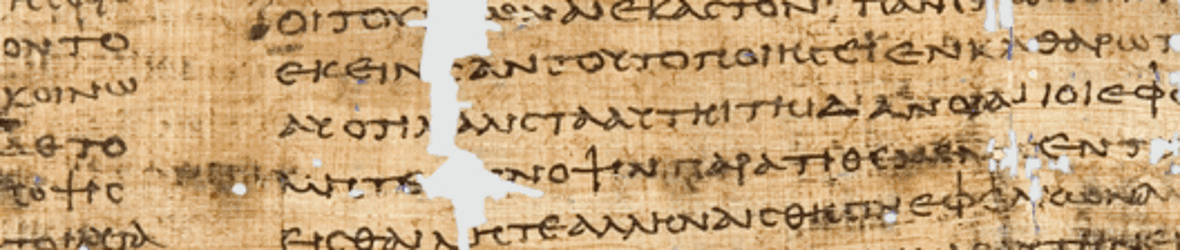
Suppl. Mag. 1 18 is a fever amulet from the fifth century CE. With a size of 8.8 x 2.3 cm, it is one of the smallest full texts from the collection of the Leiden Papyrological Institute.

On the amulet, the following is written:
Leiuel, aeribes, (9 magical signs). Deliver Anatloios, whom …e bore, from all illness and shivering and fever and shivering, tertian, quartan, quotidian, nocturnal, now now, quickly quickly, - - - Ablanathalba. (Translation based on Daniel (1990), 47-48)
The amulet invokes gods to deliver Anatolios, the wearer of the amulet, of all kinds of fever and shivering. Malaria was often referenced as ‘tertian, quartian’ fever (Scheidel 2001, 76-77). The amulet was written on a new papyrus, as there is nothing written on the verso. In it, we find formulas which we are used to finding in these types of papyri. Firstly, the gods are invoked, then some magical signs are written, followed by the message of the text. After this, the name of the wearer is mentioned, with his mother (‘whom …e bore’). At the end, the ailments of which the wearer wants to be cured are mentioned and followed by ‘now, now, quickly, quickly’.
Parallels
Suppl. Mag. 1 12 is also written based on this structure. The text starts with the invocation of gods and ends with the request for delivering Amnon, the wearer, from fever and shivering, ‘now, now, quickly, quickly’. This second amulet is a little larger, with a size of 5.6 x 13 cm. The amulets were possibly the same size after they were folded. Both of the papyri show clear signs of folding lines, horizontally, as well as vertically. There is another indicator for the folding: both of the amulets were folded when the ink was still wet, resulting in a second imprint of some of the lines (Daniel en Maltomini (1990), 47). In Supp.Mag. 1 12, the imprints are above and below the text (Daniel en Maltomini (1990), 33). The imprints on our Leiden amulet make it nearly impossible to read the original writing. The writer folded the amulet before the ink had dried, which could have been an accident, but alternatively, this could point towards a high demand for this type of amulet, and towards the haste of making them.
There is another irregularity in the text. The last word of this amulet, ablanathalba, is known as a magical word, because it is a palindrome when spelled correctly (De Bruyn 2017, 56-57; Martinez 1991, 108-110). The correct form is ablanathanalba. The writer skipped a syllable here. Elsewhere, we also find writers muddling letters. For example, in Suppl. Mag 1 21, where we find ablanathanabla, the writer switched the last beta and lambda. Assuming we are dealing with two different writers, we can infer that both, and with them many others, made this type of amulets often and at some speed, and that little mistakes due to carelessness crept in.
Conclusion
Malaria was a common disease in antiquity and no clinical medicine existed. Our papyrus seems to be part of the frequent and fast production of fever amulets. The formulation of the amulet is found in many other amulets. It was hastily folded through which the ink left prints on the main text. The text also contains small mistakes resulting from carelessness. Wrong spellings of ablanathanalba are often found. Little attention seems to be given in the making of such an amulet, which suggests that this was due to production at speed. Still, the amulet must have been priceless to the wearer, as it is to the Leiden Papyrological Institute now.
Bibliography
Primary sources
Papyri:
P.Mich XVI = Martinez, D.G. (ed.). 1991. Michigan Papyri XVI, A Greek Love Charm from Egypt (P.Mich. 757), Atlanta, GA.
Suppl. Mag. 1 12 = Daniel R.W. and Maltomini, F. 1990. ‘Amulet for a man: against fever with shivering fits; contains certain rhythmic devices’, in R.W. Daniel and F. Maltomini (eds.), Supplementum magicum Vol I, Opladen, 33-34.
Suppl. Mag. 1 18 = Daniel, R.W. and Maltomini, F. 1990. ‘Amulet against disease and fever‘, in R.W. Daniel and F. Maltomini (eds.), Supplementum magicum Vol I, Opladen, 47-48.
Suppl. Mag. 1 21 = Daniel, R.W. and Maltomini, F. 1990. ‘Amulet against fever for a man, with voces et letterae magicae and winged formation‘, in R.W. Daniel and F. Maltomini (eds.), Supplementum magicum Vol I, Opladen, 58-60.
Text editions:
Anon. The medicina plinii: Latin text, translation, and commentary: ed. Y. Hunt, London, 2021.
Plinius Secundus Maior, Naturalis Historiae: eds. H. Rackham, W.H.S. Jones and D.E. Eichholz, Cambridge, MA, 1938.
Secondary Sources
De Bruyn, T. 2017. Making amulets Christian: artefacts, scribes, and contexts. Oxford.
Scheidel, W. 2001. Death on the Nile: Disease and the Demography of Roman Egypt. Leiden.
Hunt, Y. 2022. ‘Pursuing Health by Pursuing Disease: The Use of Spell and Amulets to address Malaria in Roman Antiquity’, in F. Conti and E.A. Pollard (eds.), Nemo non metuit: Magic in the Roman World. Budapest.
How to learn to write stories in Greco-Roman Egypt?
By Dennis Schepen [translated by Boaz Wessels; edited by Maarten Pieterse]
Nowadays, all kinds of tactics are deployed to make learning more fun, with the purpose of creating a more effective education. That is not to say that long ago people did not deploy methods of making education more effective. This is illustrated by the school text P.Leid.Inst. I 16: a long version of the story of Prometheus’ creation of mankind, dated from the fourth century CE. In this article, I hope to make clear how this text does not only properly represent the old methods to train a practised student, but also why this wax tablet was so unique in multiple aspects.
This is what a translation of the tablet might look like. Some parts of the sentences are missing, as not all of the letters are readable on the wax tablet:
Modelling, Prometheus made mortals from all kinds of images / According to the wish of the gods - - - he made mortals by hand / So, having mixed earth and water, he made - - - / Hard to tear away and dark, he - - - finished the hair / - - - putting eyebrows in front / As a bridge in the middle of the eyes he stretched out and made the nose / - - - twice - - - and to the temples he fastened / He made within the mouth the treasury of the tongue for the speech / Adequately he formed cheeks, he combined - - - with cheeks (?).
(Translation by Hoogendijk 1991, 96)

Even with the lacunes, the story is clear: Prometheus creates man and adds facial features, one by one. The many details in this description make this the most detailed (surviving) version of the creation narrative (Hoogendijk 1991, 94), in a school text no less.
School texts
What proof is there even to assume P. Leid.Inst. I 16 is a school text at all? First of all, the use of a wax tablet is a strong indicator: both beginning and advanced students made use of wax tablets, even though these were expensive in comparison with the alternatives (papyri and ostraca), as the wood required for the tablets had to be imported (Cribiore 2005, 153). Still, they were ideal for a school environment, because the wax tablet was easy to reuse by erasing the text (the wax had to be renewed once in a while, however) (Cribiore 2005, 156).
A different indicator for P.Leid.Inst. I 16 being a school text, are the mistakes made in the text. In the first verse, we encounter diamorfes (διαμορφες), the word which is translated as ‘from all kinds of images’. This word is derived from diamorfês (διαμορφής), which is not attested, nor is it metrically correct. Perhaps it should be read as di’ amorfes (δι᾿ ἀμορφές), which means ‘from formlessness’, or it could be a wrong spelling of dias morfês (δίας μορφῆς), which can be rendered as ‘from the divine image’ (Hoogendijk 1991, 97). The peculiarities do not end there. According to this text, Prometheus creates man ‘with ten hands’ (dekacheros), in verse 2, and in verse 8, the nominative thesauros is used, where an accusative is expected (Hoogendijk 1991, 97-98), which would lead to the treasure making something, but without an object in the sentence.
However, it is important to keep in mind that these mistakes do not mean our student is a beginner. The relatively advanced cursive handwriting indicates the opposite, as well as the length of the text (Cribiore 1996, 47).
The mistakes and the somewhat unregular handwriting may suggest a student wrote this, but it is also possible that a teacher wrote it. The text is found on the first ‘page’ of this notebook (Hoogendijk 1991, 98), which was usually the place where a teacher would write the example which the student had to copy.
A good example of such a writing exercise, is P.Leid.Inst. I 15, the notebook of a certain Aurelius Antonius. On the first page of this booklet, the teacher wrote the name of the student and the sample text, and Antonius copied this on six of the seven following pages. Antonius, a beginner, copied a saying from the rhetor Isocrates (Hoogendijk 1991, 88-89):
Some only honour their friends when they are present, but others even love them far away.
This was used as a sententia, a line which would teach the student morals, and which was popular among teachers of beginning students (Cribiore 1996, 44).
Such writing exercises had found their way from beginning students to more advanced students, too. Here, the focus would shift from directly copying to challenging the example (Cribiore 2005, 132). In that case, the student moves towards creating his own text, which could be the case in our papyrus. The text would either be the example which the student is challenging, or the unique result of it.
Content
Whoever the author of this papyrus was, Prometheus’ creation narrative was a unique subject for a school text. The subject only surfaces in three other (surviving) texts (Cribiore 1996, 247), all ostraca, two of which contain the same content. These two stop at the exact same point, and both contain a different handwriting, suggesting two students were working together on an assignment (Milne 1923, 41). Perhaps the texts were a variation on a play from Philemon (Cribiore 1996, 237). Both these texts only mention Prometheus’ creation of women.

The third ostracon contains a small fragment of the play ‘the sculptor’ (lithogluphos) by Philemon, where Prometheus’ name is connected with his creation (Waddell 1932, 17). Thusly, the three ostraca are based on plays and only contain small references to Prometheus’ creation narrative. P.Leid.Inst. I 16 is therefore, regarding content and size, quite unique. One question remains: how did this improve the learning process?
Form
You could argue that a text of such content was used with the goal of teaching a student the anatomy of the human body. The mentioned facial features are of an elementary level (hair, eyebrows, eyes, nose, mouth, tongue, cheeks), which does not correspond with the writing level of the author.
Something that we can say for sure is the form: nine verses (in 12 lines), divided by lines. Perhaps these lines were used to make the reading of the meter easier. The meter is hard to recognize (anapestic tetrameters with a catalectic finish) (Hoogendijk 1991, 95): it is either followed very loosely or signals textual corruption, which, again, could be an indicator for a school text. When one assumes it was meant to be a text of metrical correct verses, it is very likely this was done for didactical reasons: the aoidoi from Homer’s time already knew a text was easier to remember in metrical form.
A similar argument also works for the choice to start every verse with a succeeding letter of the alphabet, a so-called abecedarium, where the first verse starts with an alpha, the second with a bèta, and so on. Such an abecedarium is used in religious texts, oracles and gnostic texts too, but could also be of didactical purpose (Hoogendijk 1991, 94-95).
Abecedaria can improve the learning process. When they are used in an educational environment, the abecedaria usually only consisted of a few sentences (Hoogendijk 1991, 94-95). Outside of our text, there is only one example of an abecedarium in a school context within a coherent story (based on Hoogendijk 1991, 94). That example, P.Tebt., II.278, differs greatly from our text: not a mythological creation story, but someone who laments and rages because of a stolen piece of clothing: ‘How very unhappy I was!’ While this text is laden with mistakes, they are mostly phonetical (meaning they were spelled based on the way the word is spoken) (Cribiore 1996, 197). This is not surprising, as the text is clearly of a more elementary level (in the first column, which survived less well, an abecedarium is found, existing of only separate words).
Conclusion
Even this text, which seems to be the same as our text, differs greatly, which only goes to show how unique P.Leid.Inst. I 16 is: a school text of relative high standard, with a fascinating and unprecedented mythological content, composed with a meter and lastly in the form of an abecedarium. All of these elements play a role in the research of didactical methods in antiquity and show that, in our text at least, people did think about what elements could be used to teach writing effectively.
Bibliography
Primary sources
Papyri:
P.Leid.Inst. I 15 = Hoogendijk, F.A.J. 1991. ‘Schoolbook of Aurelius Antonius: Isocrates, Ad Demonicum 1; Word Division and Mathematics’, in F.A.J. Hoogendijk, P. van Minnen and W. Clarysse (eds.). Papyri, ostraca, parchments and waxed tablets in the Leiden Papyrological Institute (Papyrologica Lugduno-Batava 25). Leiden, 87-92.
P.Leid.Inst. I 16 = Hoogendijk, F.A.J. 1991. ‘Schooltablet with Alphabetic Acrostic on Prometheus’ Creation of Mortals’, in F.A.J. Hoogendijk, P. van Minnen and W. Clarysse (eds.). Papyri, ostraca, parchments and waxed tablets in the Leiden Papyrological Institute (Papyrologica Lugduno-Batava 25). Leiden, 93-98.
P.Tebt. II 278 = Grenfell, B.P., Hunt, A.S. and Goodspeed, E.J. 1907. ‘Acrostics’, in B.P. Grenfell, A.S. Hunt and E.J. Goodspeed (eds.). The Tebtunis Papyri (Part II). Oakland, CA, 33-35.
Secondary sources
Cribiore, R. 1996. Writing, teachers, and students in Graeco-Roman Egypt. Chico, CA.
Cribiore, R. 2005. Gymnastics of the mind: Greek education in Hellenistic and Roman Egypt. Princeton, NJ.
Milne, J.G. 1908. ‘Relics of Graeco-Egyptian Schools’, The Journal of Hellenic Studies 28, 121-132.
Milne, J.G. 1923. ‘More Relics of Graeco-Egyptian Schools’, The Journal of Hellenic Studies 43, 40-43.
Waddell, W.G. 1932. ‘Some literary papyri from Oxyrhynchus’. Études de papyrologie 1, 11-18.
How were workdays recorded in Roman Egypt?
By Bob Salverda [translated by Boaz Wessels; edited by Maarten Pieterse]
Something that connects all people through time is the fact that they have to work. Such a person is Diogenes, someone who is mentioned on the verso of the papyrus P.Leid.Inst. II 34 Vo. The only thing we know about him is that he did work for 22 days and did not work for at least 4 days in the month Phamenoth, somewhere in the second century CE. Would it be possible to discover more about the fact that he did skipped work during this month? Let us take a look at what is written on the papyrus to see if we can learn more about the days skipped.
The following is written on the verso of the papyrus:
Account of Diogenes from Mecheir 30. Phamenoth: from the 1st until the 8th and the 8th itself: 8 days; the 9th, 10th, 11th: days not worked; from the 12th until the 17th: 6 days; the 18th: a day not worked; from the 19th until the 26th: 8 days; … (Translation by Hamberg (2023), 111)
After reading this, the following questions arise: What field of work was Diogenes in? And what do “days not worked” mean? I want to address these questions here.

What field of work was Diogenes in?
Diogenes was most likely working in agriculture. On the recto is a typical bill for a farm. This is signified by the large use of numbers on the papyrus and the use of a sign for ‘an artabe of wheat’ (purou artabôn) (Hamberg 2023, 110). The papyrus is also reminiscent of the papyri from the Heroninos archive, which contains a lot of administrative documents about the estate of a certain Appianus (Freu 2015, 163 n.10). A part of the papyri from this archive contains a type of paycheck. On the paychecks, there is written who should receive what amount of payment. An example of this would be SB 6 9406, on which Kallion, who was also a casual worker (Rathbone 1991, 152-153), worked 16 days, for which he received 48 loafs of bread and 3 monochora of wine.
The time at which he was working is notable. Most casual workers were hired ad hoc when an extra hand was needed at the estate or farm (Rathbone 1991, 88). This was mostly during April, May, and June, during the harvesting season. Additionally, extra help was needed during September, October, and November, as the maintenance work on the dikes and irrigation started in these months (Rathbone 1991, 152). They regularly got damaged by the floods on the banks of the Nile. Remarkably enough, Diogenes worked in February and March, when preparations for the harvest were being made (Pestman et al. 1994, 317). Diogenes might have helped with these preparations.
What do “days not worked” mean?
Diogenes was most likely a casual worker (Hamberg 2023, 110), with no fixed employment on the estate or farm he was working on, as we can conclude this from the fact that he was not working all of the days. It is very probable that these were not free days for Diogenes, as it was difficult for a casual worker to make ends meet (Rathbone 1991, 165). He could have been working at a different place to earn the additionally needed income, at a different farm or even his own farm. The latter might also be the case in ostrakon SB 14 11472, which mentions how someone goes home on a day on which he is not working.
Most Egyptians worked every day throughout the year, with a few exceptions, namely during religious holidays. On those days, people stopped working to celebrate. Diogenes worked in the month Phamenoth, which is around the end of February and a large part of March (Pestman et al. 1994, 317). However, his days of in the month of Phamenoth (i.e. 9, 10, 11 and 18) do not correspond to the public holidays which are attested on days 1 and 2 and 9 to 14 of the month of Phamenoth (Perpillou-Thomas 1993, 47) It is highly unlikely that the absence of Diogenes can be explained by religious holidays, it is more probable that he was working somewhere else.
Conclusion
It is possible then to draw some conclusions about Diogenes based on a small piece of papyrus of about 8x8 cm. Diogenes was most likely a casual worker. The days not worked were probably days on which he was working at a different place. Other than that, not a lot can be said about the tasks of Diogenes, other than the possibility that they had something to do with the preparations of next year’s harvest, as that was typical for the period in which he worked.
Bibliography
Primary sources
Papyri:
P.Leid.Inst. II 34 = Hamberg, A. 2023. ‘34; Account of Days Worked’, in F.A.J. Hoogendijk en J.V. Stolk (eds.), Greek, Demotic and Coptic Papyri and Ostraca in the Leiden Papyrological Institute. Leiden, 110-111.
SB VI 9406 = Varcl, L. (ed.). 1957. ‘Aus den Archiven von Theadelphia’, Listy filologické, 80, 3-18.
SB XIV 11472 = Youtie, H.C. (ed.). 1949. ‘Critical Notes on Papyri and Ostraca’, Transactions of the American Philological Association 80, 212-229.
Secondary sources
Freu, C. 2015. ‘Labour status and economic stratification in the Roman world: the hierarchy of wages in Egypt’, Journal of Roman archaeology 28.
Perpillou-Thomas, F. 1993. ‘Fêtes d’Égypte Ptolémaïque et Romaine d’après la documentation papyrologique Grecque’, Studia Hellenistica 31.
Pestman, P.W., Martinus, D. en Groningen, van, B.A. 1994. The new papyrological primer. Leiden.
Rathbone, D. 1991. Economic rationalism and rural society in third-century A.D. Egypt: the Heroninos Archive and the Appianus estate. Cambridge.
Which drugs were used in Roman times?
By Annelise Marck [translated by Boaz Wessels; edited by Maarten Pieterse]
If you read a book containing papyrus texts, you can get disappointed: a lot of the centuries old documents are ‘just’ about purchases or taxes. P.Leid.Inst. I 69, written in the late fifth or sixth century CE, looks to be just as boring. This papyrus is about collecting taxes, measured in wheat, which was moved to a different place by ship.

In the papyrus an interesting detail is mentioned, however. We read that ‘the landowner was drugged in order that he should accept more’ (Translation by Vandorpe 1991, 247).
The verb used in our papyrus, pharmakeúô, does not only mean ‘to poison’. A pharmakon does not only mean ‘poison’, but also ‘medicine’ depending on the dosage. Was the landowner drugged? If so, how? Was it a sedative or poisonous? There is not enough information provided by the context, but it would not the first time in the Egyptian papyri that someone possibly got poisoned: in P.Oxy. 3 472 (ca. 131 CE), the defendant in a lawsuit tries to disprove that a Hermione poisoned someone. If not, was there a threat to poison the landowner if he did not obey the other unknown party? Or did he just need medicine? Or could it refer to some sort of magic spell and should we translate the phrase as ‘the landowner was enchanted’ or, more figuratively ‘the landowner was worked on until he agreed to accept more’?
All these options do not make the interpretation of this papyrus easier. However, if we assume that the landowner was forced to use something which made him more agreeable, what could that be? What do we know about the use of poison and drugs in Roman and Byzantine context? What kind of sedatives were known?
Opium and hemp
Two drugs that were often used are opium and hemp. Opium has the possible effect to make someone happy and relaxed, which can have a significant effect on any decision (Alcohol and Drug Foundation: Opium). Roman writers mention opium and related products (Trancas, Borja Santos and Patricio 2009, 581). Emperor Marcus Aurelius was possibly addicted to it (Trancas, Borja Santos en Patricio 2009, 587-589; Nencini 2022, 65-66). We also know of a lot of medicinal prescriptions containing opium (Dioscorides, De materia medica 4.64-66; Pliny the Elder, Naturalis Historiae 20.76-80). The influential doctor Galen writes in one of his books about opium, as a final remedy for extreme pain:
If the pain remains after these [measures], you should use medicine made from opium […], knowing that through such medicine some damage will be done to the affected body parts. Because of the urgency, however, you should choose to prevent a person collapsing from the extreme pain, by afflicting some damage. (Galen, 11.114K)
(Unless otherwise stated, translations are from the author)
It is uncertain whether opium was used at the time of our papyrus, but medicinal prescriptions with opium were still copied in this period, for example in an eye ointment in SB 28 17139 and SB 28 17138, both papyri dating from the 5th century CE.
A different possibility is hemp, as a drug better known as cannabis. Hemp was used a lot in antiquity, for items such as rope and clothing (Brunner 1973, 345). The amateur-scientist Pliny the Elder says the following about the plant:
[Hemp] is very useful for rope. It is sown after the west winds have come, which announce spring; the more thickly it is sown, the thinner are the stalks. Its seeds are taken from the plant when it is ripe after the autumnal equinox and is dried in the sun or by smoke. The plant itself is plucked after the wine harvest and is cleaned and peeled by lamplight. (Pliny, Naturalis Historiae 19.173)
Already in early antiquity sources state that hemp was not solely used for harmless ends. Herodotus tells us the plant is used at a strange ritual of the Scythians:
The Scythians then take the seed of this hemp. They crawl under the mats and then throw the seed on the red-glowing stones in the fire. The seed that was thrown on it produces smoke and brings forth steam, which no Greek steam bath could surpass. The Scythians howl in joy at their steam bath. (Herodotus, Historia 4.75)
Used in this form, hemp can bring produce euphoria, as we see in the text above, and even lead to memory loss (Alcohol and Drug Foundation, Cannabis). Therefore, hemp can also be a useful tool for people who want something from another, although most Greek and Roman writes do not seem to know of these effects (Brunner 1973, 345). This could indicate that it was used less as a drug, but it is uncertain. Hemp was mentioned in Egypt in the period of this papyrus, in a clothing list, SB 16 12249 (5th-6th century CE), and in a bill, P.Lips. 1 102 (end of 4th century CE).
Conclusion
If the landowner was threatened with poisoning, it opens a whole different world of possibilities. There are so many poisonous plants, animals, and minerals that it is too much to go into for this blogpost (for further reading, see Cilliers and Retief 2019).
What drug the landowner was exposed to or with what drug he was threatened, we will never discover, but opium and cannabis are likely possibilities. His possible drugging goes to show: there is nothing new under the sun. And those papyri? Not so boring after all.
Bibliography
Primary sources
Papyri:
P.Leid.Inst. I 69 = Vandorpe, K. 1991. ‘Private letter’, in F.A.J. Hoogendijk, P. van Minnen and W. Clarysse (eds.), Papyri, Ostraca, Parchments and Waxed Tablets in the Leiden Papyrological Institute (Papyrologica Lugduno-Batava 25). Leiden, 246-248.
SB 28 17139 = Fournet, J.L. (ed.). 1994. ‘Un papyrus medical byzantine de l’Académie des inscriptions et belles-lettres’, Travaux et mémoires 12, 309-322.
SB 28 17138 = Fournet, J.L. 2004. ‘Recettes médicales ou letter à contenu médical’, in I. Andorlini (ed.), Testi medici su papiro: atti del Seminario di studio (Firenze, 3-4 giugno 2002). Florence, 181-185.
P.Lips. 1.102 = Mitteis, L. 1906. ‘Rechnung für eine Amtsreise’, in L. Mitteis (ed.), Griechische Urkunden der Papyrussammlung zu Leipzig. Leipzig, 300-301.
P.Oxy 3.472 = Grenfell, B.P. and Hunt, A.S. 1903. ‘Speech of an Advocate’, in Grenfell, B.P. and Hunt A.S (eds.). The Oxyrhynchus papyri, part III. London, 151-155.
SB 16 12249 = Sijpesteijn, P.J. (ed.) 1971. ‘Kleiderliste’, Aegyptus 61, 85-86.
Text editions:
Dioscorides, De materia medica: eds. T.A. Osbaldeston en R.P. Wood, Johannesburg 2000.
Galenus, Claudii Galeni Opera Omnia: ed. K.G. Kühn, Leipzig 1821-1833.
Herodotus, Historia: ed. A.D. Godley, Cambridge, MA, 1921.
Plinius, Naturalis Historia: ed. H. Rackham, Cambridge, MA, 1950.
Secondary sources
Brunner, Th. F. 1973. ‘Marijuana in Ancient Greece and Rome? The literary evidence’, Bulletin of the History of Medicine 47 (4), 344-355.
‘Cannabis’, Alcohol and Drug Foundation. <https://adf.org.au/drug-facts/cannabis/>, 16-01-2026.
Cilliers, L. and Retief, F. 2019. ‘Poisons, poisoners, and poisoning in Ancient Rome’, in P. Wexler (eds.). Toxicology in Antiquity 2, 231–42.
Nencini, P. 2022. ‘Facts and factoids in the early history of the opium poppy’, The social history of alcohol and drugs 36 (1), 45-71.
‘Opium’, Alcohol and Drug Foundation. <https://adf.org.au/drug-facts/opium/>, 16-01-2026.
Trancas, B., Borja Santos, N. and Patricio, L.D. 2009. ‘The Use of Opium in Roman Society and the Dependence of Princeps Marcus Aurelius’. Acta Médica Portuguesa 21 (6), 581-590.
What did Egyptians do to counter illegal logging?
By Mare Plantinga [translation Boaz Wessels]
Trees have an inexplicable attractional force on people. The world was shocked when the Sycamore Gap tree, next to the Hadrian wall, was illegally cut down. The perpetrators have been taken to court and were sentenced. In Egypt, a similar scandal occurred in 148 CE: people were outraged by the felling of a sycameinos, a fig tree. What did they do in Egypt to counter the illegal logging?
Logging was well-regulated in Egypt. Trees were public property, scarce, and very valuable. Wood could be used, but also the roots of the tree helped to prevent soil erosion and to fortify the extensive canal system for irrigation. It was of great importance that the trees were healthy and safe (Parássoglou 1976: 91). A high-ranked official, the idios logos, was responsible for the safety of the trees. When the idios logos gets notified of a fallen or felled tree, officials are sent to verify this. In the papyrus P.Oxy IX 1188 (18 February 13 CE), they also check whether the tree is ownerless. The officials continue to make a taxation of the branches and how much money they could be worth. When the information is accurately written down and reported to the idios logos, the branch or tree could be sold. The idios logos was also the vendor of wood found in public spaces. The buyer would then send an offer to the secretary, who would forward this to the higher officials in the province, in order to make the right decision.
Egyptians tried their hardest to stop illegal logging. More information can be found in the large papyrus P.Leid.Inst. II 30 from the year 148-149 CE.

This is a report of a village scribe (komogrammateus). He explains that the he has counted the trees of his area and he recounts a fallen fig tree. This ficus sycomorus was a fig tree with beautiful hardwood. Thanks to its Syrian origin, the tree could do well without a lot of water, ideal for the desert climate of Egypt (Miccoli 2022: 91). During flooding of the Nile, other inspectors came to inspect the dikes. To their surprise, they saw no fallen tree, which would mean that it had been taken away. This was illegal and could be severely punished. They reported this immediately to higher officials. The komogrammateus responds to their report, saying that since they were inspecting the dikes while the Nile was flooding, the fallen tree was probably just not visible. Therefore, the tree was not stolen or taken away, but just hidden under the water or in the reed. His strongest argument is that, when the Nile had returned to its banks, other inspectors had seen the fallen tree. The dike inspectors just must have missed it.
Judging from the extensive documentation about only one tree, we can conclude that Egyptians put a lot of effort into their trees and the rightful selling of wood. Growing a tree in an Egyptian climate takes a lot of time. Through careful inspection and documentation of fallen trees, Egyptians tried to stop illegal logging as much as they could. Almost two thousand years later, we too are angry about the illegal felling of trees in the Amazon, or about the takedown of the English sycamore tree. The outrage of the Egyptians and their thorough inspection seem to make sense.
Bibliography
Primary sources
P.Leid.Inst. II 30 = J.V. Stolk. 2023. ‘Report on a Fallen Sycamore Tree’, in F.A.J. Hoogendijk and J.V. Stolk (ed.). Greek, Demotic and Coptic papyri and ostraca in the Leiden Papyrological Institute. Papyrologica Lugduno-Batava 40. Leiden, 93-98.
P.Oxy. IX 1188 = A.S. Hunt. 1912. ‘Official Correspondence’, in A.S. Hunt (ed.). The Oxyrhynchus papyri IX. Londen, 203-207.
Secondary sources
Kramer, B. 1993. ‘Akanthus oder Akazie? Bemerkungen zu Bäumen’, Zeitschrift für Papyrologie und Epigraphik 97, 131–144.
Miccoli, A. 2022. ‘La figue sèche dans les papyrus documentaires’, in M.-H. Marganne and G. Nocchi Macedo (ed.), Pratiques et stratégies alimentaires dans l'Antiquité tardive. Cahiers du CEDOPAL 11. Liège, 87-99.
Parássoglou, G. M. 1976. ‘On Idios Logos and Fallen Trees’, Archiv für papyrusforschung und verwandte gebiete 24-25, 91-99.
How is wine ordered and delivered in Byzantine Egypt?
By Walt Kraeger [translation Boaz Wessels]
Nowadays, we are used to ordering food, but this concept was also known in antiquity. Based on surviving contracts on papyrus, it is clear that there were some goods in the Egypt during the Byzantine times, which were often bought to be delivered at a later time. One of these contracts is a small piece of papyrus from late antiquity, namely the P.Leid.Inst. II 61, containing a sale of wine. Wine is a product that was often ordered and delivered, since half of existing contracts of this type are concerning wine. Based on this papyrus, I will show how the ordering and delivering wine worked in Egypt during Byzantine times.
Our papyrus
This papyrus contains the lower part of a contract and then only the left half of that part. On the upper half of the surviving piece we read the contract itself, in which the terms are stated. The lower half contains the subscription of the seller, Aurelios Sechthis. This subscription is written for him by a certain son of Johannes, as he could not write himself. All the way at the bottom, there are some traces of a notary’s signature. Based on the handwriting, the papyrus is dated in the fifth or early sixth century CE. The formulas used in the contract indicate that the papyrus originates from the Oxyrhynchite nome, where exceptionally large amounts of papyri have been found.

Unfortunately, this papyrus is incomplete, and therefore we cannot be sure what was written above and to the right of the readable text. This does not mean, however, that we are completely in the dark. There are more surviving contracts about the sale of wine. Contracts often use the same terms and formulas, and in the same order, and because of this, we can start to fill in the gaps. From the running text resulting from this reconstruction, we can see that each line has about the same number of letters surviving as missing. From this, we can deduct that the part lost on the right side of our papyrus, was about as wide as the remaining part.
What, how and when?
A different contract (P.Oxy. XLIX 3512), also from the Oxyrhynchite nome, helps us reconstruct the beginning of the text. In this contract, the seller states to have received the payment for the wine. Next to this, the amount of wine that has been bought. The amount of wine is readable on our papyrus: fifty sekomata. The sekoma, a typical unit of Oxyrhynchus, could be different volumes: fifty sekomata could mean about 135 liter, 165 liter or 220 liters of wine (Mayerson 2001: 101).
Next, the contract mentions how the wine should be delivered: ἀπὸ γλαύκους ἀδόλου, as unadulterated must. This is a formula which is only found in the Oxyrhynchite nome and this also confirms the provenance of the papyrus (Jördens 1990: 312). Must (in Greek γλεῦκος, but written here as γλαῦκος) is a liquid produced by pressing grapes (with still solid pieces of grape in the liquid), before it has fermented. Wine was almost always delivered as must by the seller and stored in fermenting barrels (ληνοί), where the fermentation process already started (Kruit 1992a: 273-274). The fermentation process existed of two phases: the first one, a quick fermentation of about two weeks, and a second, slower fermentation which could last for multiple months (Kruit 1992a: 273).
Finally, the month is mentioned in which the wine (or actually most in barrels) was to be delivered. Our contracts mentions the month Mesore, which falls in July and August in our Gregorian calendar (Jördens 1990: 317). This is not surprising, as the delivery of wine always takes place in Mesore in these contracts (Kruit 1992a: 273). This was the month of the grape harvest and after picking the grapes, they are immediately pressed and ready to be delivered as must (Kruit 1992: 274).
Quality guarantee
The wine was ultimately delivered in barrels named κοῦφα (koufa). These were normally taken care of by the buyer of the wine (Jördens (1990), p. 324). On our papyrus the usual formula about the providing of the jars (σοῦ παρέχοντος τὰ κοῦφα) is not visible, but this phrase is always found in the same place: in the Oxyrhynchite nome it is customary to put this between the formula about the quality and the formula about the delivery itself (Jördens 1990: 321). This would have been on the lost right side of our papyrus, which is how the editor could reconstruct the words on that side.
The delivery process, where the buyer first has to bring his own delivery barrels and only gets unfermented wine, might seem a bit strange and unpractical for the buyer to us. The must was delivered in Mesore, because the grapes are harvested and pressed in that month, but the wine still had to be kept in fermenting barrels for months (Kruit 1992a: 274). This process also had a positive side for the buyer: as long as the wine was still fermenting, the seller could be held accountable for it (Kruit (1992a: 275).
The entire delivery
This brings us to the total picture of the sale of wine and delivery. When wine was ordered in Byzantine Egypt, the wine was delivered at a later time as must, unfermented wine. This took place in the month Mesore, during the late summer, when the grapes were plucked and pressed. The wine was stored in fermenting barrels, in which the wine initially had to ferment for a few weeks. The barrels in which the seller delivered the wine, were brought by the buyer. The wine was sometimes kept in these barrels for many more months. During this process, the seller was still accountable for the quality of the wine: a piece of customer service we could perhaps still learn from today.
Bibliography
Primary sources
P.Leid.Inst. II 61 = J.V. Stolk. 2023. ‘Sale of Wine for Future Delivery’, in F.A.J. Hoogendijk and J.V. Stolk (ed.). Greek, Demotic and Coptic papyri and ostraca in the Leiden Papyrological Institute. Papyrologica Lugduno-Batava 40. Leiden, 227-231.
P.Oxy. XLIX 3512 = R. Hübner. 1982. ‘Sale of wine’, in A. Bülow-Jacobsen and J.E.G. Whitehorne (ed.), The Oxyrhynchus Papyri 49. Cambridge, 249-250.
Secondary sources
Jördens, A. 1990. Vertragliche Regelungen von Arbeiten im späten Griechischsprachigen Ägypten, mit Editionen von Texten der Heidelberger Papyrus-Sammlung, des Istituto Papirologico "G. Vitelli", des Ägyptischen Museums zu Kairo und des British Museum, London. Heidelberg.
Kruit, N. 1992. ‘The Meaning of Various Words Related to Wine. Some New Interpretations’, Zeitschrift für Papyrologie und Epigraphik 90, 272-276.
Mayerson, P. 2001. ‘Σηκώματα: Measure of Wine, Not Jars’, Τhe Bulletin of the American Society of Papyrologists 38: 97-101.
How to cure fever in antiquity?
By Disa Lindholm
Everyone will probably be well familiar with the annoying and unpleasant feeling of coming down with a fever. Fortunately for most people nowadays, the struggles faced remain best summarised precisely as ‘annoying’ and do not actually enter the domain of serious (or even life-threatening) afflictions. The same could not be said of people in the ancient world, however. In the time before modern medicine, many illnesses which today are considered minor inconveniences could very well mean death. It is not surprising, therefore, that people throughout history have explored all possible areas in search of a cure for these afflictions. Apart from (or often closely linked with) early medicinal practices was the use of magic and religion to combat a variety of illnesses and misfortunes. Sometimes, spells and prayers for well-being were written down, and these texts would act as amulets of protection when carried around by a person or deposited in a specific place (De Bruyn & Dijkstra 2011: 164). An illustrative example of what such an amulet could look like is the sixth century Christian incantation known as Suppl. Mag. 1 35.

The incantation of this amulet begins with one of the most fundamental segments in such texts, namely the invocation of the divine power who will (hopefully) grant the wish of the applicant:
Christ was proclaimed, Christ appeared, Christ suffered, Christ died, Christ was raised (from the dead), Christ was taken up (to heaven), Christ reigns.
Not only do these lines clearly identify who is being invoked (through the Christian creed), but they also emphasise one of the most important elements in any magical incantation: the name of the divine agent. In many cultures and religions, including Christianity, the use of so-called nomina sacra (sacred names) was seen as the primary source of power in an incantation or prayer, because a name was not merely an “identifier” of a person, but a magical word in itself (Overcash 2018: 5-6).
When the divine party thus had been introduced, it was time to establish the identity of the human applicant, and to reveal the actual purpose of the incantation:
Christ saves Vibius, whom Gennaia bore, from all fever, and all shivering, (from) the daily (fever), the everyday (affliction). Now now, quickly quickly!
Of course, fevers and other ailments are not Christian inventions – and neither is the practice of using magical amulets to ward off evil and cure diseases. In fact, this evidently Christian amulet bears traces of practices which reflect a much older Egyptian magical tradition. For example, it is interesting that Vibius introduces himself by declaring who his mother is, without mentioning his father at all. The normal way of establishing one’s lineage would be through the use of a patronymic (the name of the father). Sometimes the name of a person’s mother was also included, but rarely on its own. The fact that this is the case in Vibius’s amulet – and indeed in magical texts more generally – is therefore significant. Apart from being the most secure way of identifying a specific person (the biological mother is usually more certain than the biological father), a possible explanation could go back to the Egyptian belief that the first name of a mother holds a special power, exceeding that of other names (Overcash 2018: 195-196, note 1). Therefore, by identifying himself by his mother’s name in the spell, Vibius could invoke this power in addition to the power of Christ.
Despite the obviously Christian elements present in this and many similar amulets, the practice of writing magical texts was in itself not sanctioned by the Church. In fact, ecclesiastical authorities actively disapproved of and tried to stop such traditions, since any kind of magical practice was closely tied to pagan religion and witchcraft, and thus evil in nature (De Bruyn 2017: 18). However, as the many surviving examples of such texts show, the widespread, existing practices and traditions of people were very difficult – even impossible – to completely eradicate. Instead of being abandoned, existing traditions were mixed with Christian elements, which with time resulted in a new genre of Christian incantations (De Bruyn 2017: 184-185). Vibius’s fever amulet is an excellent example of this new genre.
To the uninitiated, this division into different genres might seem arbitrary, since there appears to be a large overlap in subject matter between these (initially) pagan texts and Christian scripture. What, in other words, really distinguishes an incantation (as an expression of magical practices) from a prayer? Amulets were usually prepared by experts according to traditional customs, and they were meant to either be worn by someone or deposited in a designated spot (De Bruyn 2017: 48). Not all amulets bore inscriptions, but writing was nevertheless a very common element, as the act of writing down and subsequently reciting the spell were means by which the magical properties of the amulet could be activated (De Bruyn & Dijkstra 2011: 164). In the case of Suppl. Mag. 1 35, however, there is one additional feature which confirms the designation ‘amulet’. The articulation of the actual wish of Vibius, is in fact not phrased as a wish at all. Rather, it reads like a factual statement: “Christ saves Vibius”. In other words, it does not directly address the divine power, as might have been expected if Vibius really were praying to God. Instead, the text expresses the belief that the mere invocation of Christ is enough to grant the wish, a belief which is echoed in many other amulets containing an acclamation of his name (De Bruyn 2010: 5).
It is, of course, impossible to know exactly how Vibius used his amulet, and whether it ultimately proved effective or not. What we do know is that people in antiquity faced many of the same struggles as we do now, and that humans have always found new, creative ways of dealing with these situations. Modern medicine might have provided a cure for many of the common ailments, but who knows - maybe a magical amulet every now and then wouldn’t hurt.
Bibliography
Primary sources
Suppl. Mag. 1 35 = R.W. Daniel and F. Maltomini. 1990. Supplementum Magicum I. Opladen. pp. 102-103.
Eerdere editie: P.Batav. 20 = P.W.A.Th. van der Laan. 1978. ‘Amulette chrétienne contre la fièvre’, in E. Boswinkel and P.W. Pestman (eds), Textes Grecs, Démotiques et Bilingues. Papyrologica Lugduno-Batava 19. Leiden, 96-102.
Secondary sources
De Bruyn, T.S., and J.H.F. Dijkstra. 2011. ‘Greek Amulets and Formularies from Egypt Containing Christian Elements: A Checklist of Papyri, Parchments, Ostraka, and Tablets’, Bulletin of the American Society of Papyrologists 48, 163-216.
De Bruyn, T. 2010. ‘Ancient Applied Christology: Appeals to Christ in Greek Amulets in Late Antiquity’, in K. Merriman and E.M. Leonard (eds), From Logos to Christos. Ontario, 3-18.
De Bruyn, T. 2017. Making amulets Christian: artefacts, scribes, and contexts. Oxford.
Overcash, B.R. 2018. What's in a name? Nomina Sacra and social semiosis in early Christian textual practice. PhD dissertatie. Sydney.
Were fables used in education in antiquity?
By Nicoline Huijbrechts
Everybody knows fables, the little tales about (usually ) animals containing a moral. These fables can be used to teach moral truths to not only children, but also to adults. One of the definitions of the Oxford Englisch Dictionary (2023, Sense 2) is as follows: “A short story devised to convey some useful lesson; esp. one in which animals or inanimate things are the speakers or actors.” This definition is not universal, as fables are defined by Theon and Aphthonius in Antiquity as a fictional story, which is an image or allegory of the truth (Adrados 1999, 23). Furthermore, the genre ‘fable’ is an old one, as the earliest collection we know of, the collection of Demetrius of Phalerum, is dated to the end of the fourth century before Christ (Adrados 1999, 3). Since fables are mainly used nowadays as an educational tool for teaching moral lessons to children, it would be interesting to look at the possible educational purposes of fables in Antiquity. Were they used for educational purposes, and if so, how?
The function of the fable
Quintilian (1st century CE) gives a strong indication for the use of fables for educational purposes in his Insitution Oratione (1.9.2, Russell): Aesopi fabellas […] narrare sermone puro et nihil se supra modum extollente, deinde eandem gracilitatem stilo exigere condiscant [‘Let them learn to tell Aesop’s fables in pure and unpretentious language; then let them achieve the same slender elegance in a written version’]. In other words, the students learned to paraphrase Aesop’s fables and to write them down elegantly. These fables therefore played an important role in educating the students, not only for teaching moral truths, but they also functioned as writing exercises and as an introduction to the ancient culture (Kümmerling-Meibauer, 2006). As such, fables were used for multiple purposes in Antiquity.
The fable of the donkey
P.Leid.Inst. I 5 is an example of a papyrus with a fable that was used for educational purposes. Though the papyrus is broken away on both sides, the words καὶ ὄνος [‘and (the) donkey’] are clearly legible on the second line. Thus we know that the main characters of the papyrus are a donkey along with another animal, probably a lion. On the fourth line the papyrus reads ἐκ τῆς ἄγρας [‘of the hunt’] from which the conclusion can be drawn that the donkey is participating in a hunt. Furthermore, in lines 7-8 the words δευτ[έραν] and τρίτης [the ‘second’ and ‘third’ (share)] can be found, which helps us establish that the fable concerns the division of the loot. Through these elements, the fable has been connected to a fable also found in works of Babrius (2nd century), Phaedrus (1st century) and Ignatius Diaconus (8th century). Though these fables are very similar, there are variations between them. Babrius, for example, writes that the lion and the donkey go on a hunt, after which the lion claims the spoils, despite the spoils being divided into three shares (Fernández Delgado 2007, 323). In the version of Phaedrus, however, the donkey is absent. Instead, there are three other animals and the lion is the one without a share, despite the spoils being divided in four shares. Because, as stated by Quintilian, students were instructed to paraphrase the fables, the various versions of this fable may indicate the use of the fable for educational purposes. It is probable, therefore, that P.Leid.Inst. I 5 is such a school papyrus containing a paraphrase of this fable.
Teacher’s comments
A second clue for the use of fables in education is visible on the school papyri themselves, since the way that the papyri were written shows that the fables were used in all years of education (Laes 2006, 899). This can also be seen on P.Leid.Inst. I 5. Cribiore (1996, 239) states that the oblique strokes above some of the letters indicate that the fable was used as a reading exercise, since the strokes were used to indicate new words. Also, P.Leid.Inst. I 5 starts with the words ἀχαθῇ τύχῃ [’good luck’]. These words can be read as a good luck wish put by the teacher at the top of the papyrus (Daniel 1991, 8). These ‘good luck wishes’ have also been found on other papyri related to education (Cribiore 1996, 239).
Besides P.Leid.Inst. I 5, more papyri with fables are found that were probably used in education. One of these is Mper n.s. III xxx. This fable is about a weasel who tries to lure a mouse out of its hidey-hole (Oellacher et al. 1939, 51). This fable is described as an ‘Schulübnung,’ a school exercise in Oellacher’s edition, based on the form of the writing, the language and the content (Oellacher et al. 1939, 51). Clearly multiple fables all with different main characters, were used for educational purposes in antiquity.
Conclusion
In short, fables were used in Antiquity in multiple ways, since they were used as writing, language and reading exercises, as moral truths and as an introduction to cultural practices. This is further supported by P.Leid.Inst. I 5, in which reading indications are added to help the student learn to read and write, and the teacher added good luck wish to a student.
Bibliography
Primary sources
P.Leid.Inst. I 5 = R.W. Daniel (1991). In F.A.J. Hoogendijk, P. van Minnen & W. Clarysse (eds), Papyri, Ostraca, Parchments, and Waxed Tablets in the Leiden Papyrological Institute (Papyrologica Lugduno-Batava 25). Leiden.
MPER N.S. III xxx = H. Oellacher, H. Gerstinger & P. Sanz (1939). Mitteilungen aus der Papyrussammlung der Nationalbibliothek in Wien, Neue Serie. Volume III. Griechische literarische Papyri. Vienna.
Quintilianus, Institutio Oratione: D.A. Russell (2001). Quintilian. The Orator's Education, Volume 1: Books 1-2. Cambridge, Massachusetts.
Secondary sources
Adrados, F. R. (1999). History of the Graeco-Latin Fable, Volume 1 (Mnemosyne Supplement 201). Leiden.
Cribiore, R. (1996). Writing, teachers, and students in Graeco-Roman Egypt. Atlanta, Georgia.
Fernández Delgado, J.A. (2007). ‘The Fable in School Papyri’. In J. Frösén, T. Purola & E. Salmenkivi (eds) Proceedings of the 24th International Congress of Papyrology, Helsinki, 1-7 August, 2004, Volume 1. Helsinki. pp. 321-330.
Kümmerling-Meibauer, B. (2006). Children's and Young Adults' Literature (CT). In Brill's New Pauly Online. Leiden. https://doi.org/10.1163/1574-9347_bnp_e1408880 [accessed December 17, 2023].
Laes, C. 2006. ‘Children and Fables, Children in Fables in Hellenistic and Roman Antiquity’. Latomus 65. Brussels. pp. 898-914.
Oxford English Dictionary. 2023. Oxford.
Which gods were called upon to answer oracle questions in antiquity?
By Rosemary Selth
If one is to inquire about oracles in antiquity, they will probably be told about the oracles at Delphi and Dodona, or even the Sibyl in her cave from the Aeneid. However these were far from the only kinds of oracles found in antiquity. P.Leid.Inst. I 8, a papyrus fragment housed at the Leiden Papyrological Institute, is a unique fragment of the mysterious Sortes Astrampsychi, an oracle book of disputed origin. The text is made up of numbered questions and answers and primarily survives in Christianised manuscripts.
While most surviving fragments of this text comprise of oracle answers, this fragment is the only place which preserves the pre-Christianised concordance, the table which connects questions to answers. While this papyrus is not only invaluable for our understanding of the transmission and dating of the text, it is also a fascinating insight into oracular deities, with each concordance being accompanied by the name of a god. In this brief article, I’ll examine which gods were called upon to answer questions in this papyrus, and whether these gods are representative of oracular deities in general.
Introducing the gods
The concordance table is introduced with the phrase ‘gods who give oracles and signs.’ Each row after this contains a divine name between two numbers, the number on the left corresponding to a question, the number on the right corresponding to a table of ten answers. Unfortunately, the concordance preserved on this fragment is not completely intact – the bottom of the papyrus is lost so only half the table remains. Based on later manuscripts, we know that there should have been a total of 103 deities listed, but our fragment only contains 49. 7 of these are too damaged to read with any certainty, so we are left with 42 names. These are presented in the table below – the concordance numbers have been left out for the purpose of readability and mistakes in spelling and case endings have been corrected.
|
Gods who give oracles and signs Leto Sarapis Ischus (‘power’) Agathodaimon Ge (‘earth’) Astrapes (‘lightning’) Ephialtes (‘nightmare’) Eros (‘love’) Thetis Hekate ? ? ? ? Erinyes (furies) |
Athena Apollo Asklepios Aphrodite Ammon Anoubis Belos Boubastis Hera Dioskouroi (divine twins) Herakles Helios Dionysos ? Hephaistos ? ? |
Epitaktes (‘commander’) Muses Mithras Ourania Memphites Eunoia (‘benevolence’) Nymphs Mother of the Gods (Kybele) Klytios (‘listener’) Nike (‘victory’) Osiris Poseidon Parthenos (‘maiden’) Prosdokia (‘hope’) Ophelia (‘help’) Panakeia (‘cure’) Poros (‘means/possessions’) |
This list shows an intriguingly broad variety of deities. The majority is made up of major and minor Greek gods and heroes (e.g. Poseidon, Apollo, Asklepios, Ourania). Also included are six Egyptian deities (Sarapis, Agathodaimon, Ammon, Anoubis, Boubastis, and Osiris) as well as three other foreign deities - Belos, a Babylonian god; Mithras, an Iranian god; and Kybele, a Phrygian goddess. Also included are various personifications of abstract concepts (e.g. Nike ‘victory’, Prosdokia ‘hope’, Ophelia ‘help’). Lastly, there are several unusual names which appear to be epithets (cult titles) of gods that are otherwise unnamed (e.g. Epitaktes ‘commander’, a title that could refer to any number of gods). Of the 42 deities listed, only 13 have been established to have a previous association with divination. Specifically, these 13 deities are mentioned by Curnow (2004, 173-175) as having oracle sites in antiquity, but only three of them (Apollo, Asklepios, and Sarapis) have a large presence (the other eight deities being Ammon, Aphrodite, Dionysos, the Dioskouroi, Ge, Hera, Herakles, Leto, nymphs, and Poseidon).
Why these gods?
On initial reading, there is little else we can say about the choice of deities, especially as there is no connection between each god and the types of questions which were answered by them - an individual god in the concordance could be associated with ten completely different questions. What we can surmise is that this selection of gods may be so varied for the simple fact that there are 103 slots which needed to be filled on the concordance table. It is no surprise, then, that few of them have an explicit connection to divination. This is also potentially the reason that we see a lack of syncretism (the combining of deities). For example, Dionysos and Osiris are often considered to be one and the same, especially in Egypt (e.g. as described by Diodorus of Sicily, 1.13.1-1.20.6), but listing the two names separately would keep the composer from having to think of one extra name. This need for names may also be the reason for the inclusion of some rather obscure figures (e.g. Klytios, Memphites). However, there is much more to be understood about this selection of deities when we compare this list to other oracular texts.
Other oracles
Of particular relevance to this concordance are the western Anatolian astragaloi (knucklebones) oracle inscriptions (Graf 2005, 51-97). These inscriptions contain potential oracle answers prefaced by the name of a god, with each answer corresponding to a particular result from throwing five knucklebones. Graf (2005) identifies 19 such inscriptions, 13 of which are very closely related. Because of the attachment of a divine name to each answer, these inscriptions make a fascinating comparison to the Sortes. Although there are some clear differences to the Sortes concordance, such as the large number of repetitions (Zeus appears eight separate times with various titles), the makeup of gods is remarkably similar – the list of 56 deities is made up of Greek gods, Egyptian gods, other foreign gods, and personifications. 14 names from the concordance appear in these inscriptions (including non-Greek gods Sarapis, Kybele, Ammon, and Agathodaimon). It is also notable that the astragaloi oracle inscriptions all date around the end of the second century CE, the same period in which the Sortes Astrampsychi was likely composed (Stewart 1995, 135-147). One could also add to these examples a collection of oracle answers inscribed on ostraca (pot sherds) from Dios, all of which also date to around 200 CE and some of which also contain the names of gods (though due to their limited number, we can’t make any real observations as to the variety of chosen deities – Apollo, Leto, Typhon and Zeus) (Cuvigny 2021, 501-523). Considering the widespread nature of the astragaloi inscriptions and apparent popularity of these kinds of oracles during this period, we can perhaps make the argument that the Sortes Astrampsychi fits in with the larger tradition of popular oracles in the second century CE. If we accept this interpretation, the apparent mishmash of names on P.Leid.Inst.I 8 actually seems to be quite typical of oracular texts of this period.
Conclusion
To summarise, this Greek papyrus contains a fascinating selection of Greek gods, Egyptian and other foreign gods, personifications, and epithets. Furthermore, there is some intriguing comparative evidence which suggests that the variety of gods and personifications is quite typical for oracular texts of the second century CE.
Bibliography
Primary sources
P.Leid.Inst. I 8 = W. Clarysee & F.A.J. Hoogendijk (1991). In F.A.J. Hoogendijk, P. van Minnen & W. Clarysse (eds), Papyri, Ostraca, Parchments, and Waxed Tablets in the Leiden Papyrological Institute (Papyrologica Lugduno-Batava 25). Leiden.
Browne, G. M. (ed.) (1983). Sortes Astrampsychi I: Ecdosis Prior. Leipzig.
Stewart, R. (ed.) (2001). Sortes Astrampsychi II: Ecdosis Altera. Munich.
Secondary sources
Curnow, T. (2004). The Oracles of the Ancient World. London.
Cuvigny, H. (2021). ‘Chapter 31: The Shrine in the Praesidium of Dios (Eastern Desert of Egypt): Graffiti and Oracles in Context’. In R.S. Bagnall (ed.), Rome in Egypt’s Eastern Desert, Volume 2. New York. pp. 479-526.
Graf, F. (2005). ‘Rolling the Dice for an Answer’. In P.T. Struck & S.I. Johnston (eds), Mantikê. Leiden. pp. 51-97.
Naether, F. (2010). Die Sortes Astrampsychi: Problemlösungsstrategien durch Orakel im römischen Ägypten. Tübingen.
Rea, J. (1977). ‘A New Version of P. Yale Inv. 299’. Zeitschrift für Papyrologie und Epigraphik 27. Bonn. pp. 151-156.
Stewart, R. (1995). ‘The Textual Transmission of the “Sortes Astrampsychi”.’ Illinois Classical Studies 20. Illinois. pp. 135-147.
Stewart, R. & K. Morrell (1998). ‘10. Fortune Telling: The Oracles of Astampsychus’ In W. Hansen (ed.), Anthology of Ancient Greek Popular Literature. Indianapolis. pp. 285-324.
Do we know what ancient Greek music sounded like?
By Lisette Verhoeven
It might surprise you how much information papyri can give us about the ancient world. No matter the size of the scrap, it can help us reconstruct all kinds of facts of Greek life: even how music in Antiquity sounded.
Music played a prominent role and must have surrounded the Greeks at all times. Think, for example, of public festivals with singing processions or personal music-making during symposia. Also, performances of tragedies included choral or soloist songs. But how do we know any of this?
We have several sources that help us recreate the sound of Antiquity by giving us information about different instruments that were used (the first one can be dated back to 2700 BCE!) or development of the system of musical notation: think of depictions of performing musicians on vase-paintings, but also direct references to music-writing in literature. And not just that: the actual music that was played can be reconstructed thanks to remains of musical scores.
The Seikilos epitaph
A well-known example is the Seikilos epitaph (2nd century CE), a pillar inscribed with a small song for a funeral. Above the sentences we find musical notation. Unlike the system we use nowadays, the Greeks used alphabetic signs representing the pitches of the melody for the voice. Above these, there are linear symbols to indicate the intended duration of syllables and dots to specify the movement of the sung line. Thanks to this epitaph, we can make reconstructions of ancient sounds: https://antigonejournal.com/2021/12/song-of-seikilos/. If you listen carefully, you will notice that the melody respects the word accents almost everywhere and that the song is quite rhythmic. This would not be surprising, since Greek itself was an inherently metrical language. What a unique sound!
Iphigeneia in Aulis
Now that we have seen some ancient musical notation on stone, let’s take it up a notch and look at a different surface, by which most fragments of ancient Greek music are transmitted: papyrus. The one that you see in the picture (P.Leiden Pap. Inst. inv. 510) dates from the 3rd century BCE, one of the oldest musical papyri transmitted to us. Even though it is small and damaged, we can still make out some letters and musical signs. This scrap contains parts of Euripides’ tragedy Iphigeneia in Aulis, which tells the tale of how the Trojan War started: with the sacrifice of Iphigeneia, daughter of Greek army commander Agamemnon. This horrible task had to be completed in order to appease the gods who, as a result, would grant a favorable wind direction, allowing the Greek army to sail to Troy and fight a legendary war. Interestingly, the text on our papyrus is not in the original order of the play. The first four lines are taken from Iphigeneia’s sung dialogue with chorus as she departs to be sacrificed, which would have taken place towards the end of the tragedy. Of these lines, the musical notation was not preserved, but given the space between the sentences we can assume that it would have been annotated originally. The other verses come from the second choral song, or stasimon, in which the Trojan War is described in vivid detail, and do contain indications for musical accompaniment. Even though these passages are not in the correct order (first lines 1500-1509, then 785-794), they both appear to have been dramatic moments in the storyline. The letters in bold are those preserved on the papyrus, while the rest of the text has been added to reconstruct the original.
1500-1509
Chorus:
Did you summon the city of Perseus,
carrying the hard work of Cyclops?
Iphigeneia:
You nourished me to be the light of Greece:
I do not refuse to die.
Chorus:
In that case, may glory not escape you.
Iphigeneia:
Oh! Oh!
Torch-carrying day
and light of Zeus, another
lifetime and lot I will inhabit.
Farewell, dear light.
785-794
Chorus:
Neither on me nor on the children of my children
may this hope ever befall,
such as those rich in gold,
the Lydians and wives of the Phrygians,
will acquire, beside their spinning wheels
they say this to one another:
“Who then, while straining me, a tearful
fence with well-braided hair,
will tear me away from my destroyed fatherland?”
Because of you, child of the long-necked swan, ….
Musical symbols
Not all musical symbols on this papyrus are clearly visible, which results in many different readings. However, we can agree on some things. As indicated on the photograph, we find notation (blue) in between lines: underneath μή and above πολύχ (red), there are signs that resemble C.T CT. These symbols do not look as fluent as the Greek letters, presumably because they were added later by a non-professional hand that was not as well trained. In terms of modern notes, these notations would have sounded like G and Gis. What is interesting, is that these signs are vocal as well as instrumental indications. We know about this difference thanks to another papyrus: Vienna G 2315 contains pieces of a different Euripidean tragedy, Orestes. The musical notation found here makes a clear distinction between notes for the singer, which were written above the text, and for the player of the instrument, placed in the same line as the sentences themselves.
The Leiden papyrus, however, solely contains musical notation above the text, including vocal and instrumental signs in the same lines. This would have made it difficult to decipher the difference between the two types of indications, but thankfully the Orestes papyrus helps us with this. It allows us to distinguish between the rounded C, a vocal notation written above the text of Orestes, and the squared C, which must have been an instrumental indication found in the Leiden papyrus. It is because of this comparison that we are able to come to such a conclusion and recreate the Euripidean tragedy as closely as possible: the Iphigeneia in Aulis-line would have been sung by a soloist accompanied by an instrument. Even though these songs were designed for the role of a female figure, it was typically interpreted by a male actor, in this case one with the vocal range of a tenor. In the Leiden papyrus then, we see that this Euripidean tragedy must have included music and, instead of a rendition of the entire play in the correct order, would have been performed in some kind of recital of musical highlights by a male singer accompanied by an instrument.
Conclusion
Ancient music sounded differently from ours, and it was also notated with letters instead of notes. We can reconstruct melodies in large part thanks to musical notation preserved on papyri. Surprisingly enough, little fragments give us the possibility to retrieve a lot of information about the performance of ancient Greek music in tragedies, even the way it sounded!
Bibliography
Primary sources
Pap. Flor. 43 (2) = Pordomingo, F. (2013). Antologias di Época Helenistica en Papiro. Papyrologica Florentina 43. Florence. pp. 65-68.
Vienna G 2315 = Pöhlmann, E. & M.L. West (2001). Documents of Ancient Greek Music: the extant melodies and fragments edited and transcribed with commentary. Oxford. pp. 18-21.
Seikilos Epitaph = Poljakov, F.B. (1989). Inschriften griechisher Städte aus Kleinasien (IK) 36.1 219. Bonn.
Secondary sources
Jourdan-Hemmerdinger, D. (1973). ‘Un Nouveau Papyrus Musical d’Euripide (Présentation Provisoire)’. Comptes Rendus de l’Académie des Inscriptions & Belles-Lettres 117e anneé 2. Paris. pp. 292-302.
Ceresa-Gastaldo, A. (1978). Problemi di Metrica Classica: Miscellanea Filologica. Genova.
Prauscello, L. (2006). Singing Alexandria: music between practice and textual transmission. Mnemosyne, Supplements Volume 274. Leiden. pp. 161-178.
Gammacurta, T. (2006). Papyrologica Scaenica: i copioni teatrali nella tradizione papiracea. Hellenica 20. Alexandria. pp. 14, 143-150.
Anderson, W. D. (1997). ‘From the Beginnings to the Dark Age’. In Music and Musicians in Ancient Greece. Ithaca, New York. pp. 1-26.
Barker, A. (1990). Greek Musical Writings. Cambridge.
D’Angour, A. (2017). ‘Euripides and the Sound of Music’. In L. McClure (ed.) A Companion to Euripides. Hoboken, New Jersey. pp. 428-443.
D’Angour, A. (2021). ‘The Song of Seikilos: a Musically Notated Ancient Greek Poem’. Antigone: https://antigonejournal.com/2021/12/song-of-seikilos/. Accessed 3-3-2025.
Hagel, S. (2009). Ancient Greek Music: A New Technical History. Cambridge.
Johnson, W.A. (2000). ‘Musical Evenings in the Early Empire: New Evidence from a Greek Papyrus with Musical Notation’. The Journal of Hellenic Studies 120. pp. 57-85.
Mountford, J.F. (1920). ‘Greek Music and its Relation to Modern Times’. The Journal of Hellenic Studies 40. pp. 13-42.
Pöhlmann, E. (2020). ‘The Regain of Ancient Greek Music and the Contribution of Papyrology’. In E. Pöhlmann (ed.) Ancient Music in Antiquity and Beyond: Collected Essays (2009-2019). Berlin. pp. 227-250.
Weiss, N.A. (2017). ‘From Choreia to Monody in Iphigenia in Aulis’. In The Music of Tragedy. Performance and Imagination in Euripidean Theater. Berkeley. pp. 191-232.
West, M.L. (1992). Ancient Greek Music. Oxford.
Winnington-Ingram, R.P. (1978). ‘Two Studies in Greek Musical Notation’. Philologus 122. pp. 237-248.