Lecture
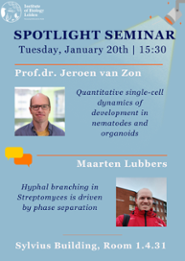
IBL Spotlight - Jeroen van Zon and Maarten Lubbers
- Date
- Tuesday 20 January 2026
- Time
- Series
- IBL Spotlights
- Location
-
Sylvius
Sylviusweg 72
2333 BE Leiden - Room
- 1.4.31
Speakers
Jeroen van Zon
Quantitative single-cell dynamics of development in nematodes and organoids
During development, intricate patterns and structures arise on the level of tissues, organs and even the entire body, yet ultimately these are the consequence of the dynamics of individual cells, as given by their divisions, movements and gene expression. However, linking the behavior of cells across time- and length-scales to the emergence of large-scale tissue structures remains challenging. Here, I will give an overview of our group's work in addressing such questions, by a combination of advanced time-lapse microscopy imaging, AI-assisted automated cell tracking and mathematical modelling. I will focus on two distinct topics. First, I will discuss how the nematode worm C. elegans decides to pause its development or not, depending on environmental conditions, through stochastic pulses of insulin signalling that are synchronized throughout the entire body. Second, I will discuss how we use automated tracking of all cells in intestinal organoids, to understand how the intestinal epithelium organizes itself into a highly robust spatial pattern of stem and differentiated cells.
Maarten Lubbers
Hyphal branching in Streptomyces is driven by phase separation
Biological systems rely on precise molecular organization to support essential processes. One mechanism underlying this organization is phase separation, which is the ability of molecules to self-organize into membrane-less compartments. While well understood in eukaryotes, the role of phase separation in bacteria remains largely unexplored. In this study, we demonstrate that hyphal branching in Streptomyces is critically dependent on this principle. Polar growth is orchestrated by the essential protein DivIVA, which localizes to the growing hyphal tips and lateral walls where new branches emerge. Computational analysis revealed that DivIVA contains two intrinsically disordered regions, predicted to drive phase separation, which are enriched with residues known to promote biomolecular condensate formation. Targeted substitutions within these disordered regions abolished phase separation and caused hyphal bursting, mirroring the phenotype observed upon complete deletion of these regions. Replacing DivIVA’s native disordered segments with the prion-like domains of human ARID1A restored hyphal branching. Together, our findings provide compelling evidence that DivIVA governs hyphal branching through phase separation, highlighting biomolecular condensation as an organizing principle in filamentous Actinomycetota.