
Research project
Eating habits in modern society
A research into how people eat and drink during their daily routines, and the circumstances under which these activities take place.
- Duration
- 2013 - 2028
- Contact
- Lotte van Dillen
- Funding
-
 NWO
NWO
- LUF (Den Dulk Moerman Fonds)
- ODISSEI LISS fund
- The Gratama Stichting
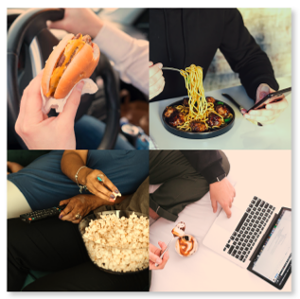
We have a lot on our minds and often eat and drink in front of the television, in our car, or in front of the computer. We eat our sandwich while we work at the desk or, we quickly consume our lunch during our walk to the next meeting. We eat in company, we eat alone: our eating habits evolve constantly and change according to the times.
At the same time, our eating habits are becoming more unhealthy and obesity as well as diabetes are increasing within the population. This project tests these relationships, by examining modern eating and drinking habits and their effect on metabolic dynamics. Another aspect we examine is whether people engage in compensatory behaviours when their consumption experiences fall behind their expectations.
Research aim
The aim of this project is to research the relationship between the consumption experience and consumption behaviour. Are there specific circumstances in which the consumption experience is compromised? For example, when we find ourselves in company or outside in the fresh air? Do people compensate for suboptimal consumption experiences by consuming more (frequently)? And how does this affect somatosensory and metabolic processes?
Approach
This research involves a mixed methods approach, that ranges from neuroimaging taste processing and real time blood glucose monitoring to smartphone-based approach/avoidance measurements, large-scale experience sampling and citizen science.
In our research, we commit to Open Science practices. We preregister our primary hypotheses, and aim to share our data, analytic code and materials, where possible. We publish our work Open Access.
Join this study?
Are you interested in participating in this study? Then contact Marina Hanssen: m.a.h.hanssen@fsw.leidenuniv.nl
Funding and science prizes
- NWO Open Competition funding for research into distracted consumption
- LUF-subsidies voor twee Leidse psychologen (Dutch)
- Floor van Meer op reis met een wetenschapsprijs (Dutch)
- Lotte van Dillen starts the European collaborative project Work Hard, Play Hard
Key publications
- Dillen L.F. van & Hofmann W. (2023), Room for feelings: a “working memory” account of affective processing, Emotion Review 15(2): 145-157.
- van Meer, F., van Steenbergen, H., & van Dillen, L. F. (2023). The effect of cognitive load on preference and intensity processing of sweet taste in the brain. Appetite, 106630.
- Zech H.G., Dijk W. van & Dillen L.F. van (2023), Food approach dynamics in daily life: speed and force of food approach movements fluctuate with hunger, but less so for people with high BMI, Journal of Experimental Psychology: General 152(8): 2300-2317.
- Meer A.F. van, Vos F. de, Hermans R.C.J., Peeters P.A. & Dillen L.F. van (2022), Daily distracted consumption patterns and their relationship with BMI, Appetite 176: 106136.
- Van Dillen L.F. & Van Steenbergen H. (2018), Tuning down the hedonic brain: Working memory load reduces neural responses to high-calorie food images in the nucleus accumbens, Cognitive, Affective, & Behavioral Neuroscience 18(3): 447-459.
- Wal R. van der & Dillen L.F. van (2013), Leaving a flat taste in your mouth: Task load reduces taste perception, Psychological Science 24(7): 1277-1284.