
Research project
GRASP: AI-enabled Gene Regulatory Analysis for Crop Stress Resilience
How can artificial intelligence help reveal the gene regulatory mechanisms that enable crops to respond to environmental stress and disease, ultimately supporting the development of more resilient agriculture?
- Duration
- 2027 - 2028
- Contact
- Pingtao Ding
- Funding
-
 European Research Council (ERC)

Description
Climate change and emerging plant diseases are placing increasing pressure on global food production. Improving crop resilience requires a better understanding of how plants regulate their responses to environmental stress.
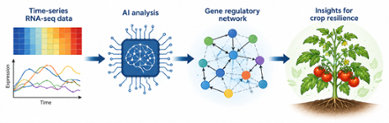
The GRASP project develops computational approaches that combine artificial intelligence with plant genomics to identify gene regulatory networks involved in stress responses. Rather than focusing on individual genes, the project aims to understand how groups of genes work together over time to coordinate plant defence and adaptation.
By integrating biological knowledge with advanced computational analysis, GRASP seeks to generate interpretable predictions that can support hypothesis generation and future crop research. The project will establish computational resources that facilitate the analysis of complex plant genomic datasets and contribute to the broader field of systems biology.

In the longer term, this research may support the development of innovative strategies for improving crop resilience and promoting more sustainable agriculture.
The Ding Lab investigates plant immunity and systems biology using experimental and computational approaches.
