
Research project
ROZA Survey Project
Surveying the 1st-millennium port site at Zawyet Sultan
- Duration
- 2025
- Contact
- Marike van Aerde
- Partners
We are excited to collaborate with the ongoing Egyptological project of Zawyet Sultan's site director Prof. Dr. Richard Bussmann from Cologne University, which is also associated with Cairo University.
Research aim
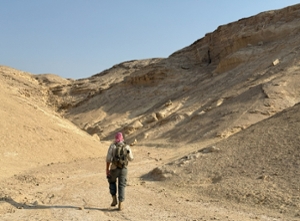
This project documents the never previously studied 1st-millennium port site at Zawyet Sultan (known during Egypt's pharaonic times as Hebenu). The Roman/Coptic settlement functioned as an integral node connecting a wide range of trade, spanning from Northeast Africa to Southeast Asia. Global imports were discovered during the pilot survey in 2025, incl. materials from Tunesia, Ethiopia, Italy, Iraq, China, India and Sri Lanka. The archaeological study of non-elite Nile settlements and 1st-millennium river ports have not received much attention, so our fieldwork hopes to contribute significant new findings, innovative research tools, and expanded interpretations.
By documenting a never-before studied Nile river town from the 1st millennium CE, new insights are sought about the role of the Nile river within the wider trade networks across the Indian Ocean region.
The project documents the remains of a never previously studied Roman-era river town in Egypt, with permits from the Egyptian government and in collaboration with Cologne University as well as researchers from Cairo University and heritage inspectors from Minya (Middle Egypt).
Our first survey’s aims were twofold: to complete a full overview of all visible structural remains in the town area, and a survey of all the surface-level pottery remains of the same area. A digital QGIS grid was constructed of the zone that allowed us to investigate the area in a sequence of grids. Only non-evasive methods were used for our documentation: fabric analysis of pottery, digital photography, digital structural scans with a mobile device, and object description. All data descriptions have been gathered in databases for future reference and subsequent interpretations concerning the nature and long-term development of the site throughout the 1st millennium AD.
In the 2025 season, our Team 1 surveyed the town structures. They recorded, scanned and described 69 structural remains in total, including Roman mudbrick tower houses as well as riverside manufacture centers with limestone presses, grind stones, and large collection vessels. Team 2 of the survey was concerned with all ceramic finds. A sequence of evenly spread grids were investigated and representative samples of surface pottery sherds were analyzed.
The majority of pottery finds so far date to the late Antique period, from ca. 4th century AD until 7th century AD, matching the late Roman and Byzantine eras. Earlier Ptolemaic and early Roman examples are more rare. Only 1-2 % of the pottery can be dated to the early Islamic period. In the western zone of the site, matching for the most part the section identified for manufacture-related structures, a notable amount of Roman-era storage amphora were found: this seems to indicate the storage of oils from the numerous presses found in the same area.
Why Leiden University?
The fieldwork is part of the Ancient Networks archaeology project at Leiden University, and can also benefit from a wide range of expertise also from Leiden Egyptologists.
Only non-invasive methods are used for the site survey: surface pottery analyses, structural documentation, digital photography, microscopy, and handheld LiDAR scanning.
Based on 2025 ROZA survey’s preliminary findings, the Roman-era site of Zawyet Sultan appears to have been an active town focused on trade and manufacture, and with evidence of long-term residential presence throughout the 1st millennium AD, up until the early Islamic era. The continuation of the pottery survey will shed more light on emerging patterns of the pottery types and related functions throughout the site. The structural data will be used to construct a more comprehensive map of the Roman/Late-Antique site so that it can be understood and navigated more effectively.
The survey of the site will continue in future seasons (2027 onwards), and will result in the town's first survey catalogue. Based on these initial results, new angles and opportunities future research proposals will be explored.