
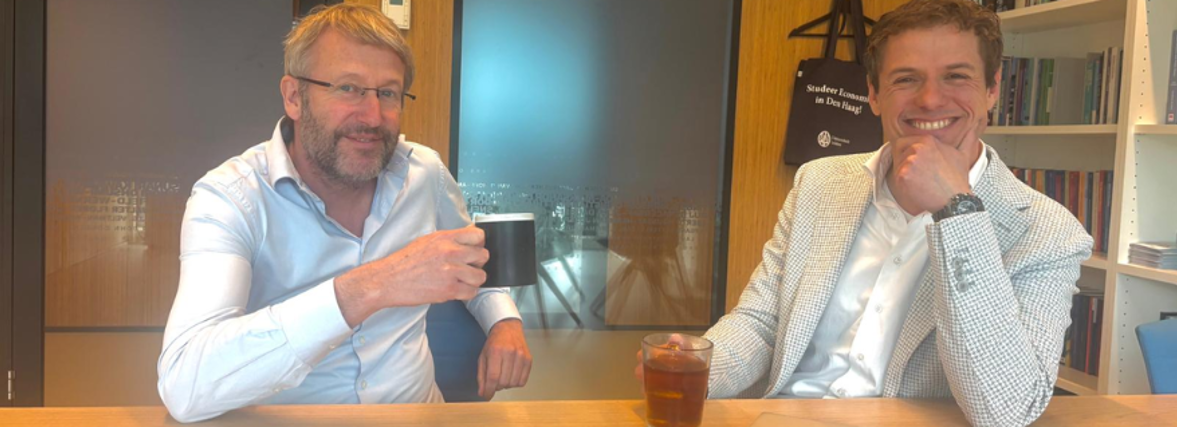
Tea with Gert and Niels: ‘Positive developments at FGGA, but major constraints due to BAS’
Over a cup of tea, Gert Renkema and Niels Laurens discuss the financial position of the Faculty of Governance and Global Affairs. Their message is clear: FGGA is in good shape and continues to grow. At the same time, vacancies remain unfilled and limitations in BAS create extra work.
Stable and consistent: that is how Niels Laurens, Executive Director, describes the faculty’s development. The Executive Board has approved the budget for 2027 and subsequent years, and the Faculty Council has also expressed its support. ‘We’re simply in a very strong position.’ He sees positive developments in teaching, research and support services. ‘That growth is also reflected in our project portfolio and grant applications.’ Meanwhile, student numbers are growing faster in The Hague than in Leiden.
Finding the right colleagues remains a challenge
Recruiting enough people with the right expertise remains a challenge, says Gert Renkema, Head of Financial and Economic Affairs. This is also reflected in BFR2, the financial forecast for 2026. A surplus of €1.3 million is expected for 2026, higher than budgeted. According to Renkema, this is entirely due to vacancies taking longer to fill than planned, resulting in lower staff costs than anticipated.
Laurens emphasises that there is scope to recruit new colleagues, but finding suitable candidates remains difficult. This is particularly true for new and rapidly growing programmes and fields, such as Cybersecurity and Cybercrime, where a new master’s programme is also being developed.
For Laurens, recruiting good staff is closely linked to managing workloads. He sees maintaining ‘growth with quality’ as a key principle. This relationship requires particular attention at ISGA, where growth continues and new programmes and fields are emerging.
More work to produce financial reports
Another challenge is the transition to the new core administration system, BAS InSite. According to Laurens, keeping track of budgets and expenditure now takes more effort. ‘It’s difficult to get a clear picture of where we stand. Project leaders, group leaders and other budget holders, such as professors, need to be able to track how much has been spent and what is still available. The previous system provided that information, whereas BAS requires more manual work just to get a basic overview.’
Renkema explains that much of the focus has been on core processes. ‘Things like paying salaries and paying and issuing invoices. That all works,’ he says. Monitoring and managing those processes is more difficult. The finance team has to request some data separately, while certain reports are unavailable or difficult to access. ‘That makes people’s work harder and takes more time and energy,’ says Renkema.
Laurens also sees advantages in the new way of working. When the process runs smoothly, a contract for a new colleague can, for example, be arranged within a day. Meanwhile, considerable effort is going into making the missing information and reports available.
Appreciation for the extra effort
Laurens expresses his appreciation for the colleagues handling financial and HR administration under these circumstances. This includes professionals in the Faculty Office, as well as institute managers, group and project leaders, and budget holders. The additional work, he says, puts considerable pressure on those involved.
‘People are working incredibly hard,’ says Laurens. He sees staff going the extra mile and believes it is important to recognise their efforts.