

How many animals can you capture on camera? Take the challenge with the new Hortus game
Biodiversity image: Teun Bergsma
Place a camera near a berry-laden shrub and click away: how many animals can you photograph? In Hortus Spotter, you go on a digital wildlife hunt through the Hortus botanicus in Leiden. Behind the game lies real biodiversity research, and a lot of programming work.

Just one more bird, one more try. ‘We could hardly get people to stop playing,’ says former Computer Science master’s student Teun Bergsma. Visitors first tested Hortus Spotter during a congress at the Hortus botanicus, and the response was enthusiastic. People were reluctant to give up their turn for the next player.
That was exactly what Bergsma had hoped for. For his graduation project, he wanted to create a game that would help people learn about the wild animals and plants of the Hortus botanicus in Leiden while having fun.
‘I really enjoy coming to the Hortus,’ says Bergsma. ‘In fact, when I was deciding what to study, I was hesitating between Computer Science and Biology. So when I got the chance to combine the two, I was immediately excited.’
The opportunity arose through the research of computer scientist Rita Pucci, who uses wildlife cameras to study wild animals in the Hortus. When Bergsma approached Pucci’s colleague Giulio Barbero about a graduation project, the idea emerged to turn her research into a game. Barbero is affiliated with the Game Research Lab, where games are used to support scientific research.
-
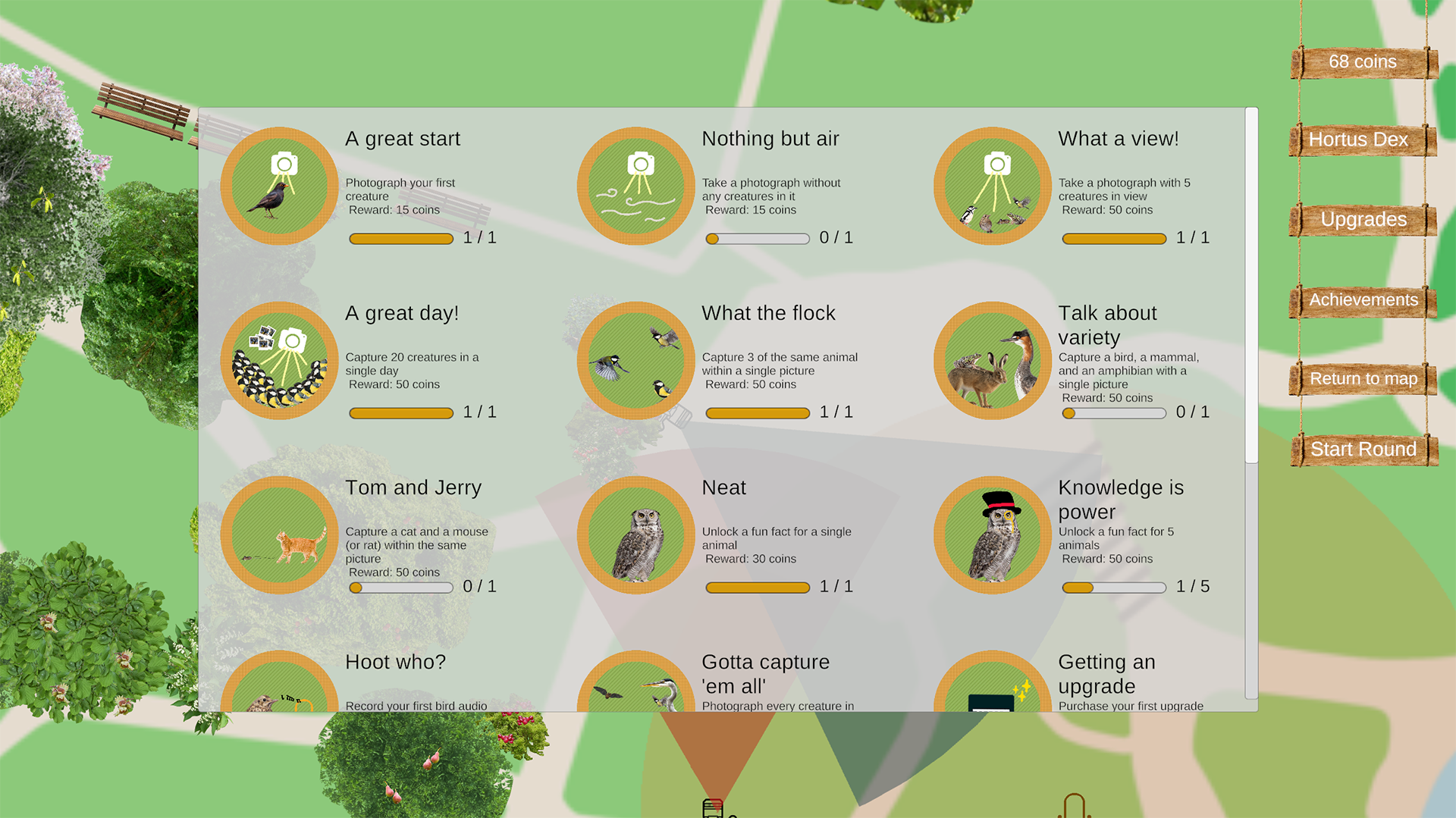
During the game, you can earn different badges, for example for your first successful photo or for capturing multiple animals in a single image. -
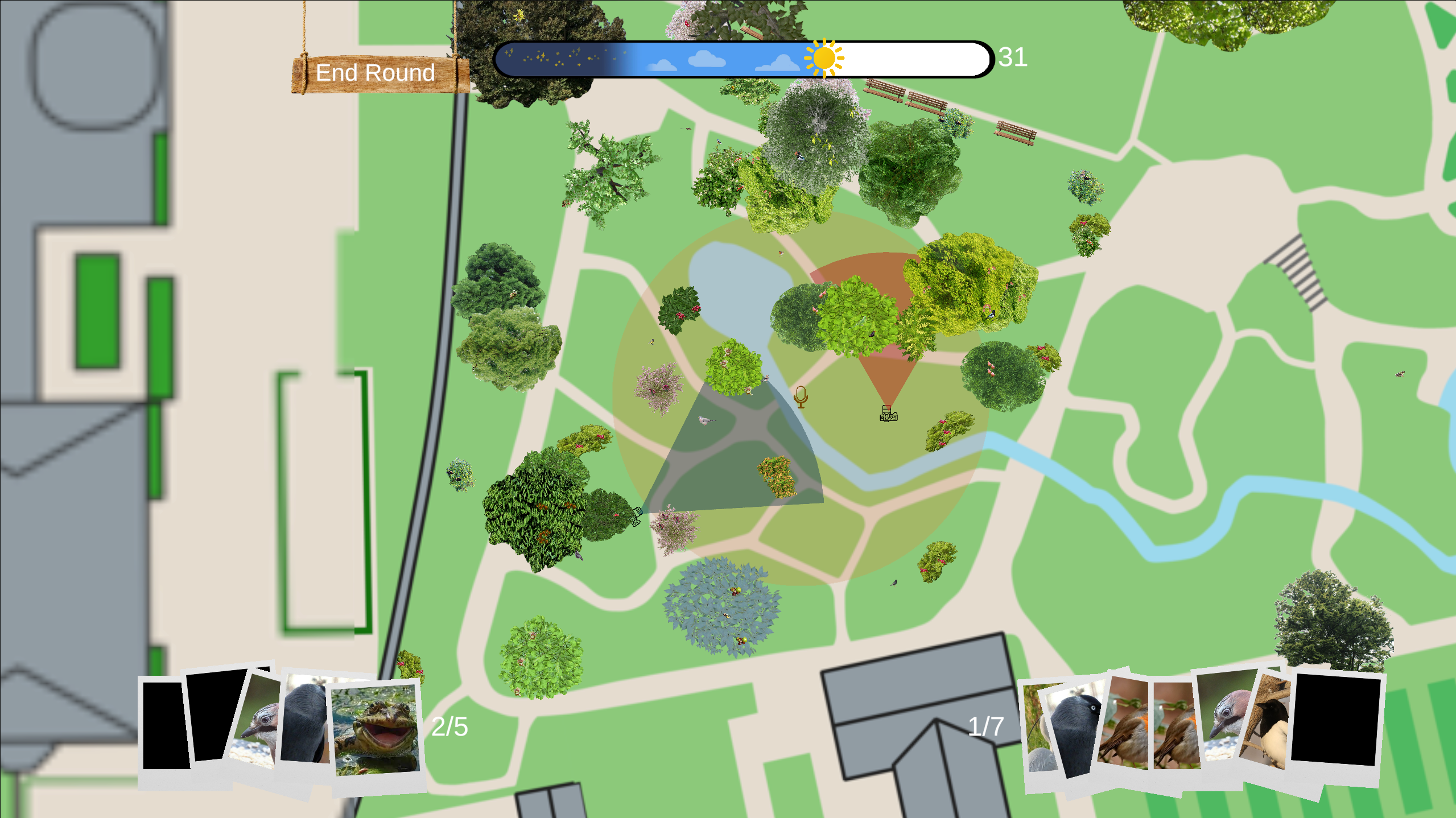
The course of a day in the game -
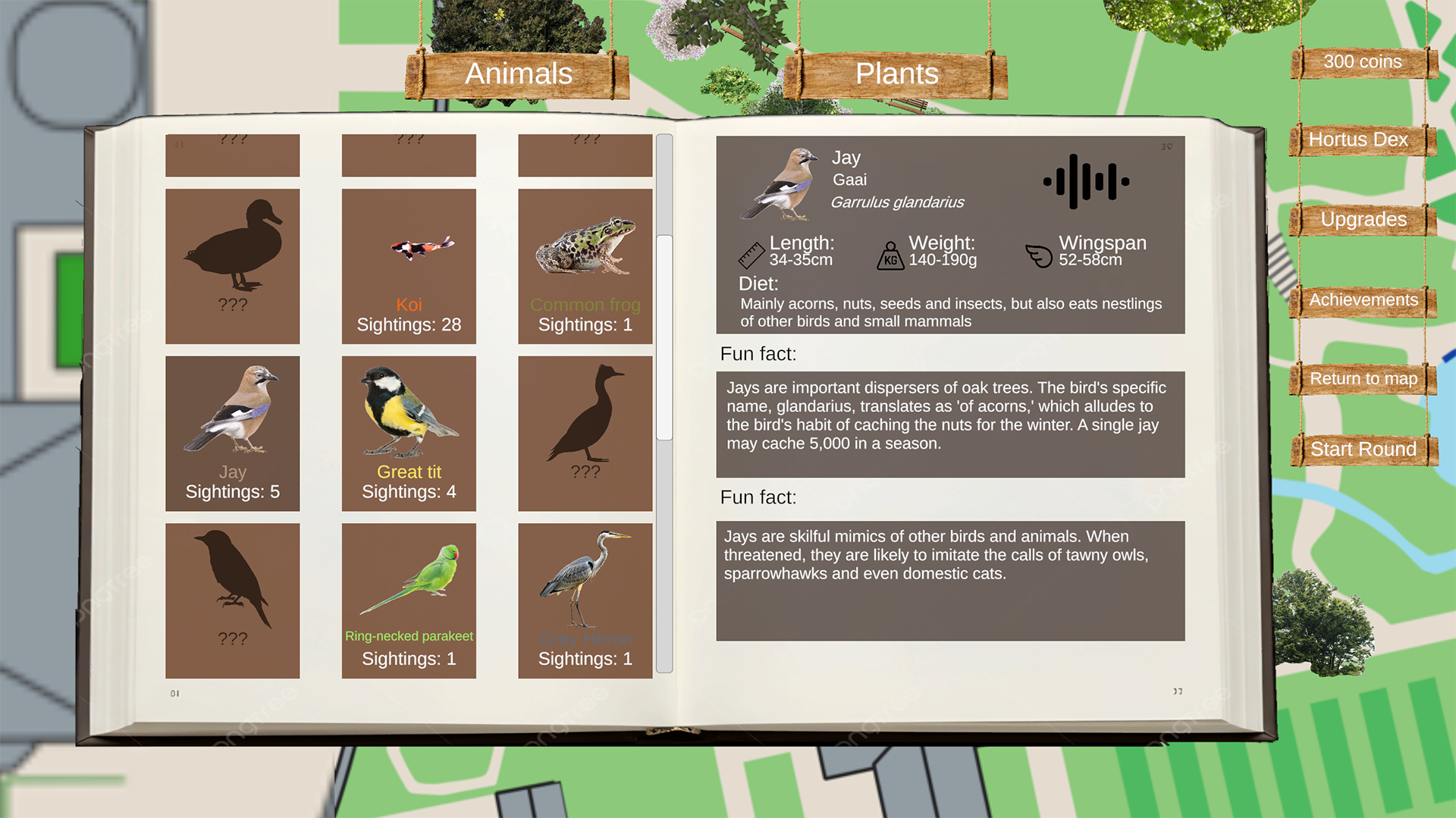
During the game, you gradually learn more and more about all the animals. -

The game's start screen
Place your camera wisely
In the game, players choose where to place a camera in the Hortus. They need to think strategically: a spot with lots of berries, for example, could be a good choice if you want to photograph certain birds. The concept is partly inspired by Pokémon Snap, in which players also photograph wildlife.

Then the day begins. Animals move around the digital garden, search for food and encounter one another. Players must take photos at just the right moment. Capturing a rare animal, or unusual behaviour earns extra points. At the end of the day, you can use those points to buy better cameras and unlock more information about the animals. Players discover fun facts as well as scientific information, such as an animal’s weight, diet or wingspan. This knowledge also helps them make better decisions in the game.
Curious how many animals you can capture?
Play Hortus Spotter yourselfFrom idea to playable game
Bergsma tackled this substantial project step by step. Using the game engine Unity, he first recreated the Hortus and positioned all the plants in their correct locations. He then added the cameras and animals. The next challenge was programming how everything would interact.
Slowly, all the pieces came together, and the development progressed quickly. ‘At our second meeting, just two weeks after the first, he already had a prototype,’ Barbero recalls.
While building the game, Bergsma also learned a great deal about nature himself. He based the animals’ characteristics and behaviour on existing scientific knowledge and received support from several Hortus staff members, including Scientific Director Barbara Gravendeel.

Bringing science closer to the public
Meanwhile, Pucci’s research in the real Hortus continues. ‘We want to understand which wild birds interact with the plants,’ she explains. That knowledge is vital for understanding how garden spaces start rewilding.
‘Games are a powerful tool to engage people with science.’
Pucci sees the game as a valuable way to bring her research closer to the public. ‘Instead of listening to or reading about biodiversity, players now discover it for themselves. Without worrying about prior knowledge.’
The game encourages curiosity. Which bird did I just see? Why is it in that particular spot? How can I earn even more points? By asking these questions, players gradually learn more about the natural world around them. ‘If they later recognise a bird or plant in the Hortus, they may know more about it than what is written on the sign,’ says Pucci.
Bergsma is now working on a scientific paper about the game. That should hopefully be published soon. But first, perhaps just one more round of Hortus Spotter…
Collaboration between Hortus and LIACS
Hortus Spotter is one of the first collaborations between LIACS and Hortus botanicus. Hortus director Barbara Gravendeel sees great value in the collaboration: ‘A unique food web has developed in the botanical garden, which is four and a half centuries old. We study this using wildlife cameras. Thanks to LIACS, we can analyse the vast amount of digital data. We are currently seeking funding to further develop the game. In the future, we hope to offer the game to visitors to the Hortus in Leiden and expand it further.’