
Can AI build a beautiful city in Minecraft? These Leiden students did it better
Game AI
Five Computer Science master's students from Leiden University have won an international Minecraft AI competition. Their program built the most beautiful virtual settlement ever seen in the contest. ‘Nobody beats motivated humans with AI tools.’
The challenge sounds simple: create a program that can automatically build a settlement in an unfamiliar Minecraft world. But once the program starts, no human intervention is allowed. The algorithm must decide where to place roads, houses and public buildings, while adapting to the landscape.
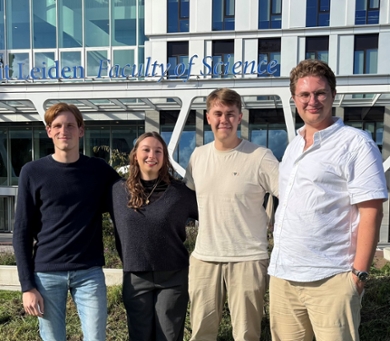
Five computer science master’s students took on this challenge—and won. Combining years of Minecraft experience with knowledge from their studies, they developed an AI system that won the international Generative Design in Minecraft (GDMC) competition. It also achieved the highest aesthetics score in the contest’s history.
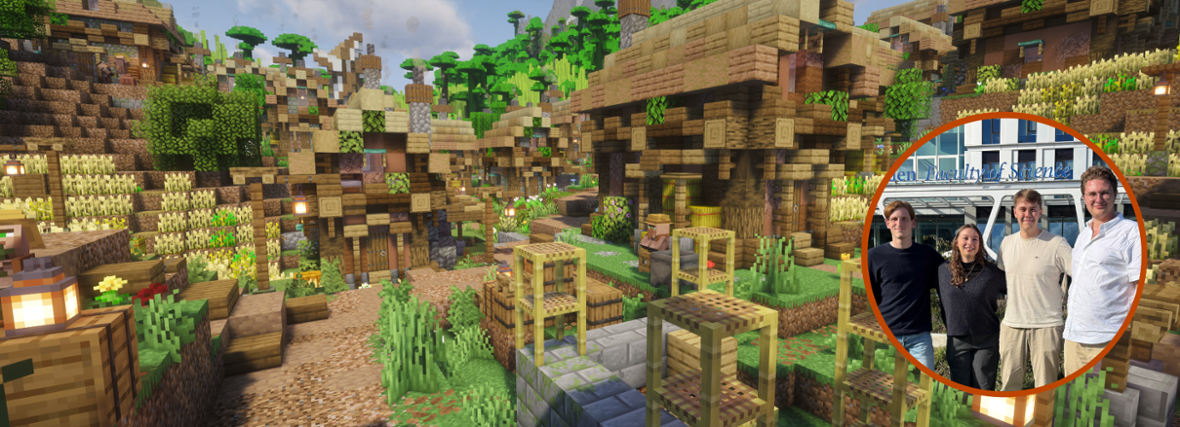
The winning team drew inspiration from medieval town planning. Their system began with the landscape, added roads and key buildings, and then expanded into a full city. Roads followed mountains, valleys and rivers, while buildings included a market square, a castle, neighbourhoods, farms and harbours.
‘The models really seemed to struggle with reasoning about three-dimensional space.’
Humans and AI working together
At a time when generative AI dominates headlines, the students discovered that large language models were not the best tool for every task.
‘We tried it in a relatively naive manner, but the output made no sense,’ says team member Niels Versteeg. ‘The models really seemed to struggle with reasoning about three-dimensional space.’
Instead of relying heavily on AI-generated designs, the team created a large collection of building templates by hand. Their algorithms then focused on deciding where buildings should be placed and how they should fit into their surroundings.
According to lecturer and AI researcher Mike Preuss, that result highlights an important lesson. ‘They have shown that if it is about creativity and aesthetics, nobody beats motivated humans with AI tools. Human teams with AI tools win.’
-

A screenshot from Minecraft showing one of the villages generated by the Leiden generator. -

A screenshot from Minecraft showing one of the villages generated by the Leiden generator. -

A screenshot from Minecraft showing one of the villages generated by the Leiden generator.
Why the settlement stood out
The judges were particularly impressed by how natural and varied the settlement felt. Houses could change depending on the environment. Buildings in deserts lost water features and plants, while jungle houses gained vines. Interior layouts also differed from house to house, making each neighbourhood feel unique.
The students believe their long experience with Minecraft played a major role. Most team members have been playing the game for more than a decade. ‘The combination of practical experience, attention to detail and extensive refinement resulted in a settlement that the judges found particularly aesthetically pleasing,’ the team says.
Leiden is now the only institution to have produced two winning teams. According to Preuss, this is partly due to the university’s practice-oriented approach to teaching.
Learning through games
The project started as an assignment in Preuss' course ‘Modern Game AI Algorithms’. The course teaches students how AI techniques developed for games can be applied far beyond entertainment, from path-finding algorithms to modern machine learning methods.
Preuss notes that Leiden is now the only institution to have produced two winning teams in the competition's nine-year history. He credits the university's practical teaching style for encouraging students to experiment and test ideas in real-world challenges.
The result of the team is not just a winning settlement, but also a reminder that, even in the era of generative AI, creativity often comes from the combination of human insight and smart algorithms.
The competition
The Generative Design in Minecraft competition is an annual international challenge organised by researchers from several universities and sponsored by the IEEE Computational Intelligence Society. The winning team receives a $500 prize. Team Merge Conflict consists of Jort van Leenen, Jasper van der Zwet, Lana van Sprang, Niels Versteeg and Robert Salden.
Curious about their generated map? On the website of the competition, you can download their map, and also the other entries (they're entry 10).