

ERC-funded research uncovers the role of stereotypes in citizens’ support for EU policy
Two years after launching an ERC Starting Grant to investigate cultural stereotyping in European Union governance, Adina Akbik and Christina Toenshoff at Leiden University are now publishing their first major findings. Looking at public opinion across the EU, the researchers show that cultural stereotypes are not merely rhetorical devices. The stereotypes citizens hold about other nations can shape their support for EU policies, particularly policies that foster solidarity and lower inequality between member states.
The ERC project takes a broad look at the role of stereotypes across different elements of EU governance and EU institutions. In the paper ‘The honest, the efficient, and the trustworthy', Akbik and Toenshoff begin by looking at the general public. They examine how citizens across the EU perceive one another along national lines, and how these perceptions influence policy attitudes on EU redistribution.
How stereotypes shape support for EU policies
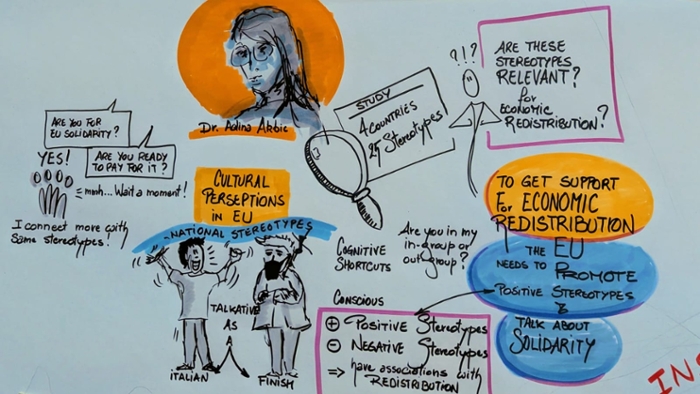
The central finding of the paper is that the way citizens perceive people in other EU countries influences their support for certain EU policies. According to the researchers, people who hold positive stereotypes about citizens in other member states are more likely to support EU solidarity and policies that aim to reduce economic inequality between countries. Negative stereotypes tend to have the opposite effect.
Importantly, the study also shows that which stereotypes matter depends on the policy context. “For policies aimed at reducing economic inequality, what matters most are the views that citizens in wealthier countries have of people in poorer EU member states,” Akbik explains. In this sense, stereotypes shape what kinds of policies the public is willing to accept from European policymakers.
Surveying public opinion across Europe
To study these dynamics, the researchers conducted a survey with representative samples in four EU countries representing different regions: Germany (West), Italy (South), Sweden (North), and Romania (East). Participants were asked about their attitudes towards several EU-level policies, particularly policies related to solidarity and redistribution between member states.
To assess how widespread stereotypes are, respondents were also asked which stereotypes they themselves — or people in their country more generally — associate with different EU countries. To keep the task manageable, the researchers pre-selected 25 stereotypes that are commonly found in political debates and public discourse. Participants were then asked about their perceptions of eight EU countries representing different regions of Europe.
Common stereotypes across EU member states
Across countries, some clear patterns emerged. Among the most frequently mentioned stereotypes were traits such as “lazy”, which respondents most often linked to Romanians, Italians and Greeks, and “corrupt”, which was frequently associated with Romanians and Italians. By contrast, Germans were often described as “hardworking”, while Swedes and Germans were commonly perceived as “trustworthy”.
When stereotypes matter most
The study also shows that the influence of stereotypes varies depending on the type of policy under discussion. When it comes to support for general solidarity across EU member states, stereotypes held by citizens in all countries about citizens in other countries appear to play a role. However, the dynamics look somewhat different for policies aimed specifically at economic redistribution.
“When we ask about support for economic redistribution, it is mostly stereotypes in richer Eurozone countries about countries in Southern and Central and Eastern Europe that matter,” Toenshoff notes. In their sample, this was particularly visible in Germany, where stereotypes about countries such as Greece, Italy, Poland and Romania were linked to levels of support for redistributive EU policies.
Implications for EU governance
The study focuses on public opinion rather than policymaking itself. It therefore examines how stereotypes shape citizens’ perceptions of concrete EU policies, rather than how they influence decision-making inside EU institutions. “How stereotypes influence policymaking more directly will be examined in other parts of the project,” Akbik explains.
Overall, the findings suggest that stereotypes can make it easier or harder to build public support for EU policies that redistribute resources between member states. If citizens hold negative stereotypes about people in a particular region, policies that benefit that region may be more difficult for policymakers to justify domestically.
According to Akbik and Toenshoff, this dynamic is not purely theoretical. It has been visible in past political debates, for example during the Eurozone crisis, when stereotypes about debtor countries were frequently invoked in discussions about financial assistance and bailouts.
First results from the EUROTYPES project
The paper marks the first step in the broader EUROTYPES project. While this initial study focuses on public opinion, later stages of the project will examine whether similar cultural perceptions also appear in political discourse and policymaking within EU institutions.
Future research will therefore look at debates in the European Parliament as well as the work of policymakers and civil servants in other EU bodies, including the European Commission and EU agencies. In doing so, the project aims to better understand how cultural perceptions about member states shape both public attitudes and political decision-making within the European Union.