
Listen to students
PhD defence
We often look at the behaviour of students and label them motivated or not based on that. But what motivates students? We can respond to their needs better by listening to them. Then we can see what the cause of their behavior is. Anja Schoots argues this in her dissertation.
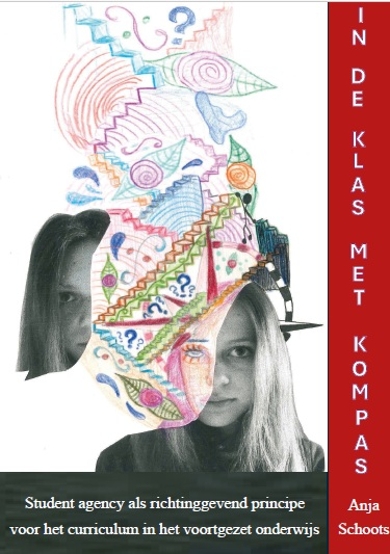
The dissertation In the classroom with compass focuses on the conviction that student agency should be a guiding principle in the secondary education curriculum. Student agency is the will and skill to influence one's own learning process and the learning environment. It is the stepping stone to human agency: the will and skill of people to consciously give direction to their actions and their future. In education, student agency is associated with learning, personal development and preparation for a future role in society.
The role of student agency
Until now, the term student agency has been used mainly as an abstract concept. It is not concrete and measurable in an unambiguous way. There is no coherent curriculum in education that systematically stimulates the development of student agency. Anja Schoots researched the role of agency in the way students approach learning, and the relationship with their learning performance, well-being and tension. She also looked at how components in the curriculum can promote the development of student agency.
Making a difference
Schoots found the biggest challenge in the research that the concept of student agency is often used in a vague way. She tried to make it concrete by focusing on the learning approach of students. This allowed her to investigate agency in relation to learning outcomes (performance). She started from the origin of the word 'agent': effectively bringing about change.
Results of the study
We can respond much more adequately to the needs of students. Their confidence in their own abilities, moral compass and awareness in relation to well-being, tension and learning performance shows different profiles on which we can base our support in education.
The results of the research are used in various ways. In the redesign of the curriculum, where the design is already basically such that the pillars and characteristics of agency can be developed. In addition, it is also used to determine what support students need from teachers and mentors, based on the self-reflection of students.