Lecture
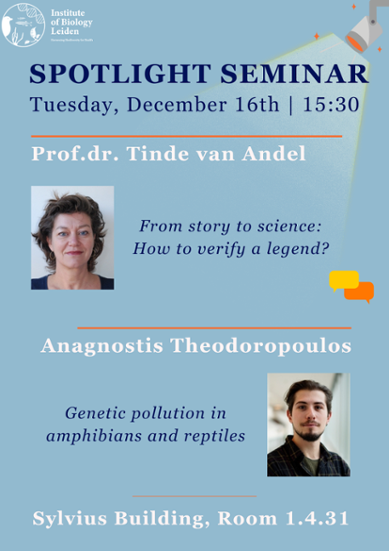
IBL Spotlight - Tinde van Andel and Anagnostis Theodoropoulos
- Date
- Tuesday 16 December 2025
- Time
- Series
- IBL Spotlights
- Location
-
Sylvius
Sylviusweg 72
2333 BE Leiden - Room
- 1.4.31
Speakers
From story to science: how to verify a legend?
During fieldwork on traditional rice cultivation among Maroons in Suriname and French Guiana, ethnobotanist Tinde Van Andel heard several stories. Maroon women would have braided rice grains in their hair before escaping slavery. Maroons also found rice growing wild in the savanna during their flight from the plantations. Historians and anthropologists have qualified these legends as fairy tales, because at that time there was no rice in Suriname. The West Indian Company did not have access to rice-growing areas in West Africa, so they could not buy the grain to feed the enslaved Africans they transported to Suriname. Several traditional rice varieties were named after Maroon women, but neither the published literature nor the Dutch colonial archives mention these persons. However, these sources are generally silent about traditional agriculture and women. How can you verify these legends? In this lecture Van Andel, will explain how she used multidisciplinary methods and worked with several smart students and researchers to trace whether these legends were based on true events. Her findings were not always valued by established scientists.
Genetic pollution in amphibians and reptiles
Invasive species contribute to biodiversity loss through a variety of mechanisms. One of the least discussed yet significant among them is genetic pollution: anthropogenic hybridization between native and introduced species or populations. This process targets biodiversity at the genetic level, effectively rewriting parts of the native gene pool. More than a decade ago, the non-native Anatolian crested newt (Triturus anatolicus) was introduced into Montnegre i el Corredor Natural Park (Catalonia, Spain), where it began hybridizing uncontrollably with the native marbled newt (T. marmoratus). The invasion irreversibly damaged the native population, prompting eradication efforts to prevent further spread. In this study, we used target sequence capture (NewtCap) and mtDNA sequencing to assess the frequency, directionality, and fertility of these hybrids. We also compared the invasive genotypes to a reference dataset spanning the native range of T. anatolicus in Turkey to identify the source of the introduction. Our results confirm the presence of fertile F1 hybrids and later-generation backcrosses, despite the deep evolutionary divergence between the species (~25–30 Mya) and the infrequent hybridization between T. marmoratus and the native crested newt, T. cristatus. We detected strong directionality in hybridization, with crosses predominantly occurring between T. marmoratus males and T. anatolicus females. Later-generation hybrids were found to only backcross with T. marmoratus, suggesting potential for adaptive introgression into the native gene pool. Given that T. anatolicus is thought to be less susceptible to the fungal pathogen Batrachochytrium salamandrivorans (Bsal), this raises the possibility of adaptive alleles entering the native gene pool. Additionally, the origin of the invasive population was traced to Lake Abant in western Turkey. This study highlights the severe consequences of anthropogenic hybridization and the need for gene-wide monitoring to inform management actions.