
Japanese Studies (MA) (120EC)
Student experiences
Anna van Ark: My internship at the Rijksmuseum
I have always been interested in the art world. As having artists as parents, I spent much of my childhood in museums and galleries. While completing two bachelor’s in Japanese studies, one in Leiden and one at Hokkaido University, Japan, I have always chosen art subjects as my electives. This made the opportunity presented by my teacher during my master to do an internship at the Rijksmuseum a dream come true.
What is your role at your internship at the Rijksmuseum?
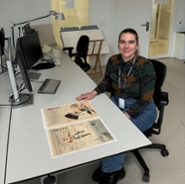
I do independent research on a collection of Japanese prints. To gain an idea of the prints, I first measured them and translated the titles. Moreover, I help the curator of Japanese prints Marije Jansen. This also makes me experience the work a curator does firsthand.
"Doing research on prints firsthand has taught me a lot. So much of what I have learned studying Japanese I can apply while doing this internship."
How do you use the knowledge and skills you learned during your master’s in your internship?
As I am working with Japanese prints I use my Japanese language skills, knowledge of Japanese art and cultural knowledge. The titles of the prints have often a double meaning and a hint to cultural practices or even theater forms. This makes me apply knowledge I picked up during my studies.
What do you enjoy most about your internship?
The combination of both being part of the acquisition team and working with a curator has been very enlightening. Also, having the prints in front of me and being able to study the prints up close has been great.
What did you learn from this experience?
I have learned about different functions at the Rijksmuseum and the work a curator does. Also doing research on prints firsthand has taught me a lot. So much of what I have learned studying Japanese I can apply while doing this internship. Both cultural knowledge and language skills are of the essence.
Do you have any recommendations for other Asian Studies students or prospective students who are interested in doing an internship at a museum?
It is important to keep your ears open and tell your teachers that you would love to do an internship. They often have more connections and as was the case with me could be able to get you in touch with a curator at a museum. Moreover, if you can do something you like do not hesitate and try it.

Jona Boekesteijn: My year in Japan
During my stay in Japan, Japanese language classes were part of the curriculum that I followed at the university there. It was a fairly intensive programme, and I learned a lot from it, but I also found that it is important to make sure that you leave space for other subjects. In terms of Japanese language skills, you ultimately learn the most by using it in your everyday life there anyway!
Of course, in addition to the fact that my Japanese language skills have improved tremendously, I have also been able to learn other subjects. But, perhaps more interesting is that I have also learned a lot about self-reliance in a completely new environment. How do I take care of all sorts of affairs at the ward office, what is the student culture like in Japan and how do I involve myself in it, how do I balance daily life, sightseeing and university? I think I have grown considerably as a person.
"In terms of Japanese language skills, you ultimately learn the most by using it in your everyday life there anyway!"
If I had to give advice to new MA students it would be something like this: I was rather nervous about applying for this Master’s programme because I thought that it was only meant for top students, and also because a year in Japan seemed quite intense to me. You really don't have to worry about that first thing, if your motivation is in order and your Japanese is good enough to pass the language courses in Leiden, you are more than ready. And yes, a whole year in Japan may look daunting and it was certainly not always easy, but for me it turned out to be an experience that I wouldn't trade for anything.
One last tip: when selecting your Japanese university, double-check if they have any additional requirements for things like courses in Japanese or how many language courses you would be doing!