

Governance, Economics and Development (BSc Major of Liberal Arts and Sciences: Global Challenges)
Wrenching poverty, global inequality, violent political and ethnic strife, deadlocked, unresponsive or even collapsing governments, growing dissatisfaction with democracy and missed opportunities for innovation – these are merely some of the challenges of governance and development with which our programme aims to teach students to critically engage.
The Major BSc. Governance, Economics and Development is part of the Bachelor's programme Liberal Arts and Sciences: Global Challenges at Leiden University College in The Hague. Students choose a Major at the end of their first year and study the Major- curriculum in the second and third year.
Lucie Zicha
Major Team Lead in Governance, Economics and Development

"What I love about teaching in GED is that in the same week, my students seamlessly move from deep data analysis to debating what makes someone a totalitarian, and they do so with equal curiosity and insight. It's that connection that makes GED classrooms really engaging to teach in."
Benthe Geerdink
Alumna Governance, Economics, and Development

"I chose the Governance, Economics, and Development major because I’ve always been fascinated by how countries tackle complex social and economic challenges. I enjoy using data to tell stories and uncover the forces behind these issues. This major gave me the analytical tools and global perspective I was looking for, and it laid a strong foundation for my master’s studies in social and economic policy and career as an economic policy officer."
Jasper Jansen
Student Governance, Economics and Development (GED)

"I am taking GED to learn about the policies that shape our society. Topics such as inequality cannot be solved by an economist alone, as there are many social and political factors to be considered as well. GED teaches us to understand all of these perspectives, while proving us with methods to study them, so we can make decisions that shape our society for the better.
Due to the selected cookie settings, we cannot show this video here.
Watch the video on the original website orThe Governance, Economics and Developement Major
Many global challenges—climate change, technological disruption, inequality, democratic erosion, and financial instability—rest at the intersection of governance and scarcity. To address them purposefully, we must coordinate the will of many while resources are limited. Humans create institutions – the rules of the game – to shape who gets what, when, and how, but those rules may serve some better than others. In GED, we study these problems, why they arise, and how they can be addressed.
In so doing, we prepare versatile problem-solvers who...
In so doing, we prepare versatile problem-solvers who combine structured, disciplined reasoning with the imagination to ask different and useful questions. We draw on all social sciences: anthropology, economics, political science, sociology, and psychology. Prosperity is our central theme—understood not only as simple metrics like GDP, but a broader set of social, political, and economic conditions under which people and their communities flourish. To study it seriously, we need to understand institutions and how power and exchange work in practice, whether we are talking about self-governance or the governance of nations.
GED cultivates the habit of questioning assumptions and the capacity to see the world through other people's eyes. This means connecting theory to real-world application. You will train in data analysis—working with statistical evidence—alongside interviews, case studies, and close reading of texts that ground your thinking in the experiences of people on the receiving end of governance choices. By the time you graduate, you'll know how to read a policy report or scientific research critically, evaluate the evidence behind a claim, and understand why what works on paper doesn't always work on the ground. As a GED student you will learn to navigate complexity rather than retreating from it.
In this major, we examine questions such as...
- Why do policies that work on paper die in parliament?
- Why is polarization rising, and can politics fix it?
- What makes institutions work or fall apart?
....and more:
- Why do policies that work on paper die in parliament? We know how to reduce carbon emissions and inequality—so why do these policies often fail to make it from research to reality?
- Why is polarization rising, and can politics fix it? Divisions are deepening across democracies worldwide. What forces are pulling societies apart—and under what conditions can political systems respond effectively?
- How do we govern complex systems when it's unclear who's in control? Digital platforms, financial markets, or ecosystems—power is diffuse, responsibility is murky, and consequences spill across borders. What are the real trade-offs between decentralized chaos and centralized authority?
- How does power actually work? Not how we imagine it or wish it would, but how it operates in practice—in democracies and dictatorships alike. Who has it, how do they use it (or abuse it), and what does that mean for everyone else?
- What makes institutions work or fall apart? Why do some rules, organizations, and systems deliver for their people while others entrench dysfunction?
- When do individual incentives block collective progress? What does it take for groups, communities, or nations to cooperate when everyone has reasons to defect?
- How do you see a problem through someone else's eyes? A policy that looks rational from a ministry in The Hague may look very different from a village in Nigeria. How do we build the skill of genuinely understanding perspectives shaped by experiences unlike our own?
- When does natural resource wealth become a curse? How exactly do oil, minerals, and gas distort economies, governance, and human well-being—and what policy choices determine whether resource-rich countries thrive or stagnate?
- What can markets do—and what can’t they? Markets can deliver remarkable efficiency, but also inequality, instability, and environmental harm. When do they serve society and when do they need boundaries?
- Can reading novels make you a better policymaker? Fiction builds empathy and sharpens moral imagination. What can stories about political identity, oppression, lives in totalitarian regimes, and resistance teach us about the challenges facing democracies today?

What does the future hold?
Due to the broad nature of the Liberal Arts & Sciences degree and the strong interdisciplinary skills developed in the programme, graduates are in demand on the labor market. Liberal Arts & Sciences students go in many different directions after graduation. Your major is a key stepping stone in your path towards a Master's degree or future career.
Further Studies
It is common for Liberal Arts & Sciences graduates to pursue a master's degree, to further challenge themselves and to specialize. The master's builds on knowledge gained in the major as well as the programme as a whole. Some examples of master's programmes that students with a major in Governance, Economics and Development pursued:
- MA Public Policy @ University College London, UK
- MPhil Development Studies @ Oxford University, UK
- PhD Candidate in Political Science @ University of California, USA
Careers
During and after their studies, students pursue many different extracurriculars, engage in internships or follow master's degrees. Due to the wide variety of experiences and goals, each career path is different. Some examples of career paths that students with a major in Governance, Economics and Development pursued:
- Business Development, World Startup Factory, The Netherlands
- Data Science
- Political Science or Public Administration/Policy
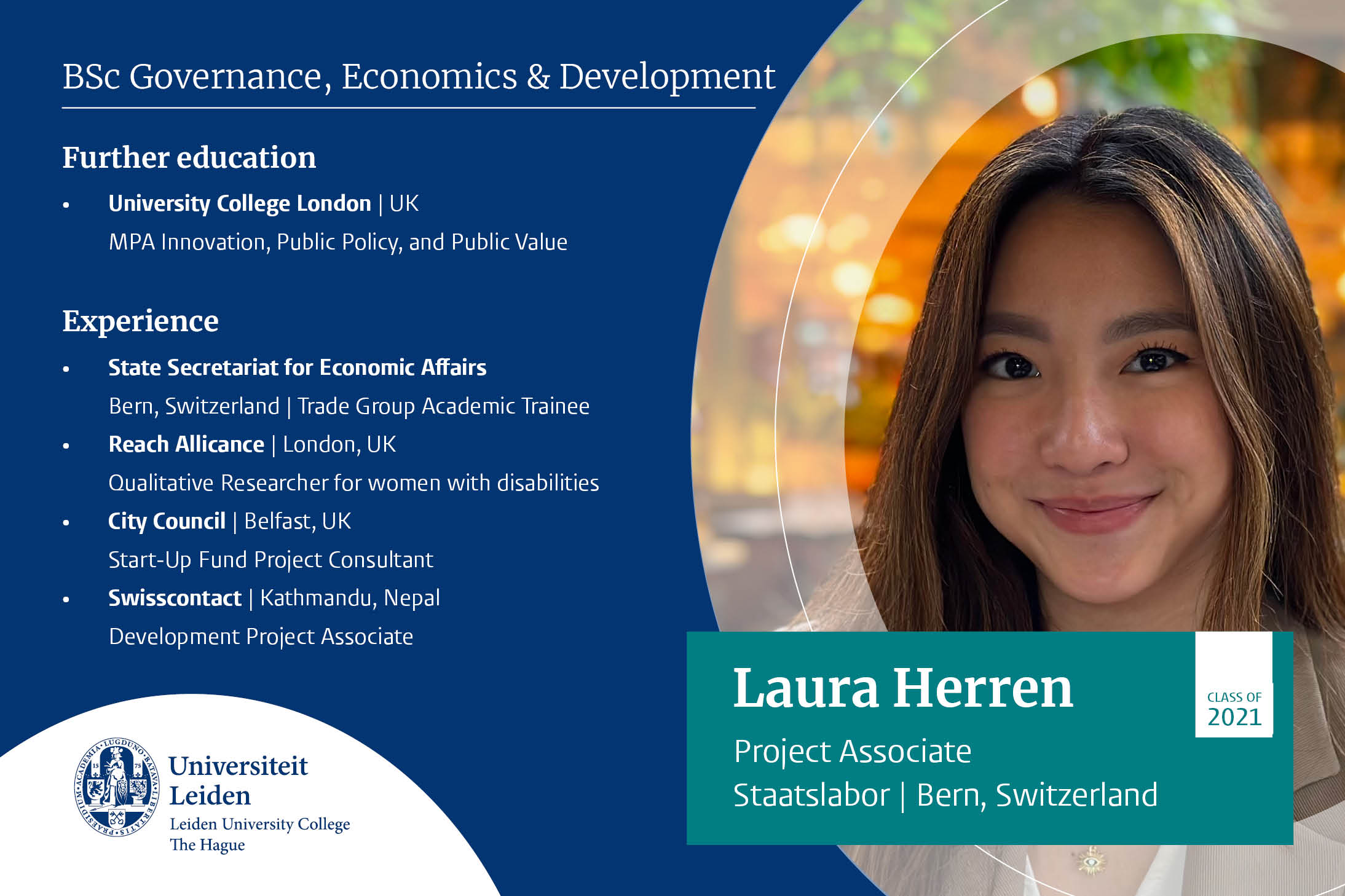
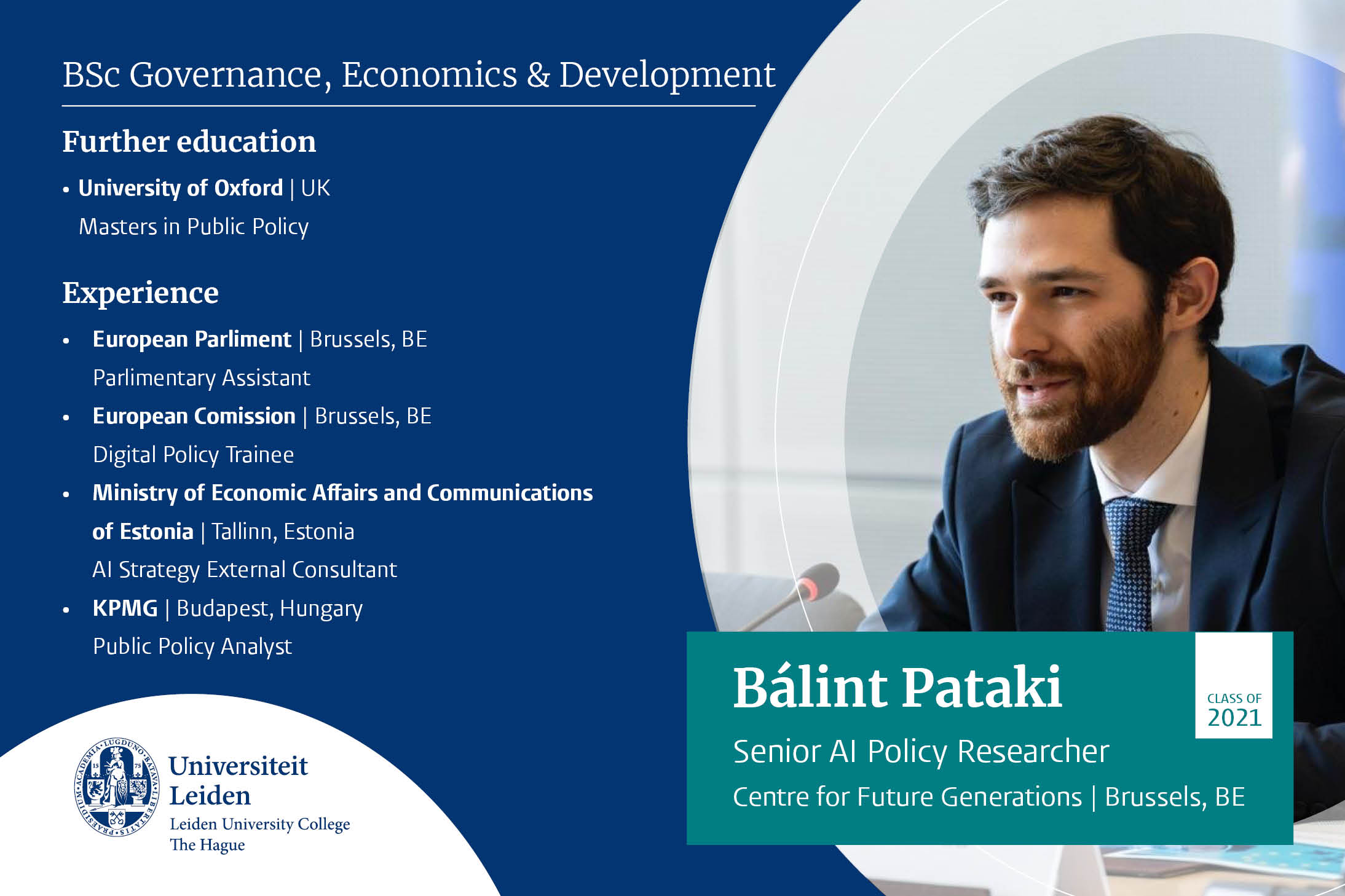
Get inspired by Laura and Bálint, two of our Governance, Economics and Development alumni.
Curious?
Read more about this unique study programme on the programme website, see our upcoming events or read how to apply!
Chat with a student from this Major