
Research project
Taking a Risk on Disasters: speculative humanitarianism amidst a changing climate in Malawi
How do government officials and humanitarian organisations in Malawi anticipate and speculate on future disasters?
- Contact
- Tanja Hendriks
- Funding
- NWO VENI
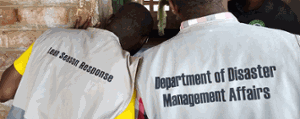
States and global governance institutions are grappling with ways to respond to disasters in the present, while also preparing for increasingly dystopian future scenarios. This qualitative research project coins and develops the concept of ‘speculative humanitarianism’ to analyse the innerworkings and contemporary consequences of future-oriented disaster governance in Malawi.
There has been a change in disaster governance and humanitarian interventions in the last decades. Formerly essentially reactive and focused on immediate needs, there is nowadays a growing preoccupation with preparedness, mitigation and resilience; aiming to prevent or reduce humanitarian needs before these arise. Proactive and geared towards potential futures, this so-called anticipatory action relies on specific types of (big) data, such as climate change models, weather forecasts and projections. Its funding mechanisms tend to follow insurance logics and are tied to pre-established trigger values. Presented as a more sustainable and (cost)effective way to govern in times of climate change, this speculative, future-oriented focus signifies important political and moral shifts in humanitarian governance.
This ethnographic research project explores and elucidates the poorly-understood innerworkings, implications and contemporary governance effects of this emerging form of speculative humanitarianism from a state perspective. Malawi, a profoundly disaster-prone and donor-dependent country in southern Africa where humanitarian interventions take place annually, provides a case study to examine how speculative humanitarianism is experienced and expressed by the people planning, producing and performing it through policies and in practice. By conducting nine months of in-depth ethnographic fieldwork and semi-structured interviews with state and non-state actors in humanitarian interventions, this research zooms in on the complex moral trajectories of these collaborations and their contested speculations about disastrous and desirable futures: which risks are identified, deemed worth taking, why, when, and by whom? Studying this expands the anthropology of humanitarianism and the state, while also providing practical insights for disaster governance.