
News
-
 ‘Homo sapiens is too arrogant: call us Homo faber, the toolmaker’16 May 2022
We need to dispel the arrogant and misguided idea that modern humans are superior to earlier human species. It is thanks in part to all our predecesso...
-
 Aitor Burguet-Coca studied fire-use from Palaeolithic to Bronze Age: ‘This gives us an image on different uses of fire across prehistory’09 May 2022
For the following years, Dr Aitor Burguet-Coca will be a returning face at the Faculty of Archaeology. He will join Dr Amanda Henry’s team with his ex...
-
 Archaeologist Martin Berger works on online FIFA exposition about origins of football04 May 2022
Martin Berger was asked by the FIFA Museum in Zürich to help develop an exposition on the origins of football. In line with his expertise, he worked o...
-
 Registration open new minor Violence Studies22 April 2022
In the academic year 2022-2023 the Social Resilience and Security interdisciplinary programme will offer a new minor for students who are interested i...
-
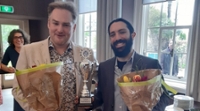 Angus Mol and Aris Politopoulos are the winners of the fourth LUCAS Public Prize 2022!13 April 2022
On Tuesday 12 April Angus Mol and Aris Politopoulos have been awarded the fourth LUCAS Publieksprijs.
-
 Ten Leiden researchers awarded a Veni grant11 April 2022
Ten Leiden researchers will receive funding of up to 280,000 euros from the Dutch Research Council (NWO). They will use this grant to develop their re...
-
 Faculty of Archaeology ranks 7th in QS World University Ranking08 April 2022
It is the sixth year in a row that the Faculty of Archaeology is placed in the top ten of archaeological institutes worldwide. The QS World University...
-
 Cypriot Ambassador visits Faculty of Archaeology04 April 2022
The Faculty of Archaeology was honored by a visit by the Ambassador the Republic of Cyprus. Ambassador Frances-Galatia Lanitou Williams had heard of t...
-
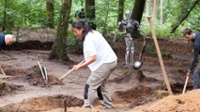 New excavation robot shapes future of archaeology31 March 2022
Archaeology has always been at the forefront of innovation. Now, an inventive collaboration between archaeologists Tuna Kalayci and Alex Brandsen brin...
-
 Omani Ambassador visits Faculty of Archaeology30 March 2022
The Faculty of Archaeology was honored by a visit by the Ambassador of the Sultanate of Oman. Ambassador Sheikh Dr. Abdullah Salim Hamed Al Harthi had...
-
 New Executive Director Jan Pronk: ‘In the end it is all about people enjoying their work.’09 March 2022
In March, Jan Pronk starts as the new Executive Director at the Faculty of Archaeology. We sat down with him for an interview on his background, his d...
-
 Archaeology alumna Oda Nuij wins Florschütz Thesis Award03 March 2022
Annually, the Dutch Palynologische Kring invites nominations for the Florschütz Award for best MSc thesis in Palynology and Palaeobotany. This year, t...
-
 The Ethics Committee at Archaeology: ‘Think ahead before starting your research, that’s the point’02 March 2022
In the past decade many academic journals have started to require that researchers provide evidence of ethical review when submitting papers, for exam...
-
 Prestigious Gutenberg Research Award for archaeologist Wil Roebroeks23 February 2022
Leiden archaeologist Professor Wil Roebroeks receives the 2021 Gutenberg Research Award of Johannes Gutenberg University Mainz (JGU). "By granting Wil...
-
 Streaming the Sagas: a live role play in the North-European Age of Heroes21 February 2022
Hwæt! You've heard of the adventures of the mighty Beowulf. You've heard of the brave folk standing beside him, and the awe-inspiring foes standing ag...