

Teaching and learning toolkit on stars and their many meanings
Uni-visions image: Jos van den Broek
Download free: an inspiring teaching and learning toolkit by Jos van den Broek exploring star shapes, their symbolic meanings and their role across cultures and religions. The toolkit encourages pupils to engage through their head, heart and hands.
Jos van den Broek (75) is one of the winners of Uni-visions, a call by Leiden University in its jubilee year to imagine the future of education. Van den Broek’s vision: teaching for the head, heart and hands.
Originally, he wanted to create an exhibition, but after consulting the Graduate School of Teaching (ICLON), he decided on a teaching and learning toolkit instead, a free resource for schools. In it, he shows how stars in all shapes and sizes feature in symbols, stories, flags, countries, cultures and religions. He also explores the mathematics behind stars, and how to make them.
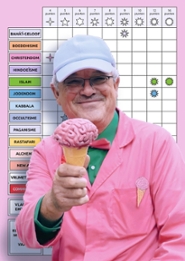
Pro- and amateur-fessor
Van den Broek is not just a Uni-visionary – he’s much more than that. In his working life he was a journalist and professor of science communication. He is also the brains behind Wijscokar (Wise-cream cart): a converted ice cream cart filled with which brought him to all corners of Leiden during Leiden2022, European City of Science.
As a self-termed ‘amateur-fessor’, he teaches every week at a Leiden primary school, and he is also an ambassador for the Leiden Academy on Vitality and Ageing. The common thread running through his career and life: curiosity and optimism.
The free inspiration toolkit is designed for the upper primary and lower secondary years: Download (in Dutch) Verbeter de wereld en kijk naar de sterren. Leren elkaar te begrijpen aan de hand van symbolen, by Jos van den Broek.
Jos, you’re a Uni-visionary. How do you see the future?
‘I entered Uni-visions because I’m an optimist and idealist through and through, no matter how troubled the world may seem. My motto comes from a well-known saying: “What would I do if the world were to end tomorrow? I would still plant a tree!”
‘As a Uni-visionary, I asked myself: what do we need for the future? My answer is education with the head, heart and hands. Wanting to learn, having a thirst for knowledge, making something of and doing something with it. For me, that’s the essence of good education, and it’s what this teaching and learning toolkit about stars is all about.
The children we teach today will be the ones making decisions in the future. If you want to think about the future, you have to start today.’
You are a researcher and teacher at heart. How does that manifest itself?
‘I’ve been doing experiments all my life: finding out how things work and where they come from. I recently wrote an activity book for teachers about this: Proefjes voor een betere wereld.
‘I also teach children at schools and community centres, and learn a great deal from that too. For example, how important it is to be consciously positive towards all pupils, to treat everyone equally. And: what you give, you get back twice over.
‘Children are so curious. They are hungry for knowledge. And believe me, there’s nothing more satisfying than feeding that curiosity. Learning is such fun. I can’t imagine playing golf or wintering in Spain. A study trip to Morocco would be inspiring though.’

What inspired you teaching and learning toolkit?
‘A Moroccan coin with a star on it. That old coin made me curious: where does that star come from? Everyone assumes it’s an Israeli coin. Yes, it has the Star of David on it. But in Islam, that’s also known as the Seal of Solomon, David’s son.
‘I began to look into it some and discovered that the same star appears all over the world: in Hinduism, Buddhism and Christianity. Observation and close attention are at the heart of research: observing, making connections, being surprised and curious.
‘That curiosity led to fantastic stories about all sorts of stars – with four, five, six or even sixteen points.’
What do you want to achieve with the toolkit?
‘I hope that pupils and teachers from different cultures will recognise that similar symbols appear across cultures and that these symbols often represent shared values. Understanding between cultures is so important, particularly today.
‘This toolkit won’t change the world, but it might contribute in a small way to a generation that will. I do have that optimism and idealism!’
Win Jos van den Broek’s book (in Dutch)
Want to do more experiments in school? Enter our competition. We’re giving away one copy of Proefjes voor een betere wereld. The book is packed with challenging questions and thought-provoking topics for discussion in the classroom and at home. To enter, send an email to nieuws@leidenuniv.nl by 24 April with ‘Doeboek’ as the subject line.